
Riding
Horse Riders on UK Roads: Legal Position, Highway Code & Safety Guide
A UK road-safety guide for horse riders — Highway Code rules, the 10mph/2m passing distance, hi-vis equipment, traffic training and what to do after an incident.
By Debbie Irwin · 18 March 2026 · 10 min read
Riding on UK roads carries real risks, but horse riders have recognised rights and responsibilities under the Highway Code. With the right preparation, visible clothing, road-aware training and clear communication, riders can reduce risk and help drivers understand how to pass horses safely.
This guide explains the legal position of horse riders on roads in England, Scotland and Wales, what the Highway Code says, and the practical steps every rider should take before hacking on public roads.
Are horse riders allowed on UK roads?
Yes. Horse riders are legally allowed to use most public roads, provided they follow the relevant rules of the Highway Code and any local restrictions. Riders should use bridleways, byways and off-road routes where possible, but many riders need to use roads to connect yards, fields, bridleways and hacking routes.
Horse riders are classed as vulnerable road users because they are at greater risk of injury in a collision. Horses are also large flight animals, which means they can react suddenly if startled by speed, noise, close passing or unexpected movement.
The Highway Code and the hierarchy of road users
The Highway Code was updated in 2022 to include a hierarchy of road users. This places those most at risk in the event of a collision, including pedestrians, cyclists, horse riders and motorcyclists, towards the top of the hierarchy.
The hierarchy does not remove responsibility from riders. Everyone using the road must behave safely and considerately. However, it does make clear that road users who can cause the greatest harm have the greatest responsibility to reduce the danger they pose to others.
How drivers should pass horses
Rule 215 of the Highway Code gives clear guidance for motorists approaching, overtaking or passing horses. Drivers should:
- Slow down to a maximum of 10mph when passing a horse.
- Allow at least 2 metres of space when it is safe to pass.
- Pass wide and slowly.
- Be patient and wait if the road is narrow or there is not enough space.
- Avoid sounding the horn.
- Avoid revving the engine.
- Drive away slowly after passing.
- Heed a rider's request to slow down or stop.
If a horse appears nervous, unsettled, young, inexperienced or is being escorted by another horse, drivers should take extra care and wait until it is safe to pass.
Is the Highway Code legally binding?
Some Highway Code rules use the words "MUST" or "MUST NOT". These rules are backed by specific laws, and breaking them may be a criminal offence.
Other rules use wording such as "should" or "should not". These may not create an offence on their own, but the Highway Code can still be used as evidence in court proceedings to help establish liability after an incident.
This matters for horse riders because unsafe passing, excessive speed, intimidation, careless driving or ignoring a rider's signals may all be relevant if there is an accident, near miss or complaint.
Key Highway Code rules for horse riders
Horse riders have responsibilities as road users. The most important Highway Code rules for riders include:
Safety equipment
Children under 14 must wear a correctly fastened riding helmet that complies with the relevant regulations, unless exempt. Other riders should also wear a properly fitted riding hat that meets current safety standards.
Clothing and visibility
Riders should wear boots or shoes with hard soles and heels. The Highway Code also recommends light-coloured or fluorescent clothing in daylight and reflective clothing at night or in poor visibility.
Riding at night or in poor visibility
It is safer not to ride on the road at night or in poor visibility. If you must, wear reflective clothing and ensure your horse has reflective bands above the fetlock joints. A white light to the front and a red light to the rear should be fitted to the rider's right arm, leg or boot. A fluorescent or reflective tail guard is also strongly recommended.
Tack and control
Before taking a horse onto the road, make sure all tack fits correctly and is in good condition. You should be confident that you can control the horse. Never ride a horse on the road without both a saddle and bridle.
Position on the road
When riding on the road, riders should generally keep to the left, keep both hands on the reins unless signalling, keep both feet in the stirrups, and avoid carrying anything that may affect balance or become tangled in the reins.
Riding two abreast
Riders should never ride more than two abreast. Riding two abreast may be appropriate when escorting a young or inexperienced horse or rider, but riders should move into single file on narrow or busy roads and when riding around bends.
Footpaths, pavements and cycle tracks
Riders must not take a horse onto a footpath or pavement. Riders should not use cycle tracks unless specifically permitted. Use bridleways and equestrian crossings wherever available.
Hi-vis equipment for horse and rider
Hi-vis and reflective equipment can dramatically improve how early drivers see you. This is especially important on rural roads, shaded lanes, in low sun, at dusk, in rain, and in poor visibility.
Both horse and rider should wear visibility equipment. The aim is to be seen from the front, rear and sides.
Recommended rider hi-vis
- Hi-vis tabard, waistcoat or jacket
- Hi-vis hat cover
- Reflective armbands or leg bands
- Hi-vis gloves for clearer hand signals
- Reflective or fluorescent winter outerwear
- Lights if riding in poor visibility or low light
Recommended horse hi-vis
- Hi-vis exercise sheet
- Reflective tail guard
- Reflective brushing boots or leg bands
- Hi-vis breastplate or neck strap
- Reflective rein or martingale attachments
- Reflective bands above the fetlock joints if riding at night
Do not rely on a single small item of hi-vis. A driver approaching from behind, from the front, or from a side road needs to recognise quickly that there is a horse on the road.
Training your horse for road work
Never take an unprepared or untried horse onto a public road without careful training. A horse that is calm and confident in traffic is one of the greatest safety assets a rider can have.
Start in a controlled environment
Begin traffic training away from the public road where possible. Introduce the horse gradually to common sights and sounds such as cars, vans, bicycles, pushchairs, dogs, wheelie bins, road signs, high-vis clothing and flapping objects.
Use a steady companion
When first hacking near traffic, ride with a sensible, experienced horse. A calm companion can help a nervous horse settle and learn that vehicles and roadside activity are normal.
Build up gradually
Start with quiet lanes at low-traffic times. Gradually introduce larger vehicles, busier roads, parked cars, roadworks, tractors, trailers and delivery vans only when the horse is ready.
Practise essential responses
Your horse should reliably halt, move forward, turn, stand quietly, move away from pressure, and wait when asked. You should also practise opening gates, passing obstacles, turning around safely and dealing with unexpected noises.
Know when not to ride
Do not ride on the road if your horse is overexcited, frightened, lame, unwell, poorly tacked up, or difficult to control. Choose an off-road session instead and return to road training when conditions are safer.
Communicating with motorists
Clear communication helps drivers understand what you need. Many motorists do not ride and may not realise how easily a horse can be startled.
Useful rider signals
- Slow down: raise one arm with an open palm and move it up and down calmly.
- Thank you: give a clear nod or wave when it is safe to take one hand off the reins.
- Turning: look behind, check it is safe, then give a clear arm signal.
- Stop or wait: use a clear hand signal if a driver needs to pause because your horse is unsettled or the road is too narrow.
Make eye contact with drivers where possible, but never assume a driver has seen you or understood your signal. Stay alert and always leave yourself an escape route if available.
Planning a safer road route
Good planning reduces the chances of a problem before you leave the yard.
- Choose quieter roads and avoid fast or narrow roads where possible.
- Avoid peak commuting and school-run times.
- Use bridleways, byways and permissive routes where available.
- Avoid poor visibility, fog, heavy rain, ice and very low sun.
- Tell someone where you are going and when you expect to return.
- Carry a charged mobile phone in a secure pocket on your body, not attached to the saddle.
- Consider carrying rider identification and emergency contact details.
- Check your tack, girth, stirrup leathers, reins and fastenings before setting off.
Riding around bends, junctions and narrow lanes
Many road incidents happen because drivers have too little time to react. Take extra care where visibility is limited.
Bends and blind corners
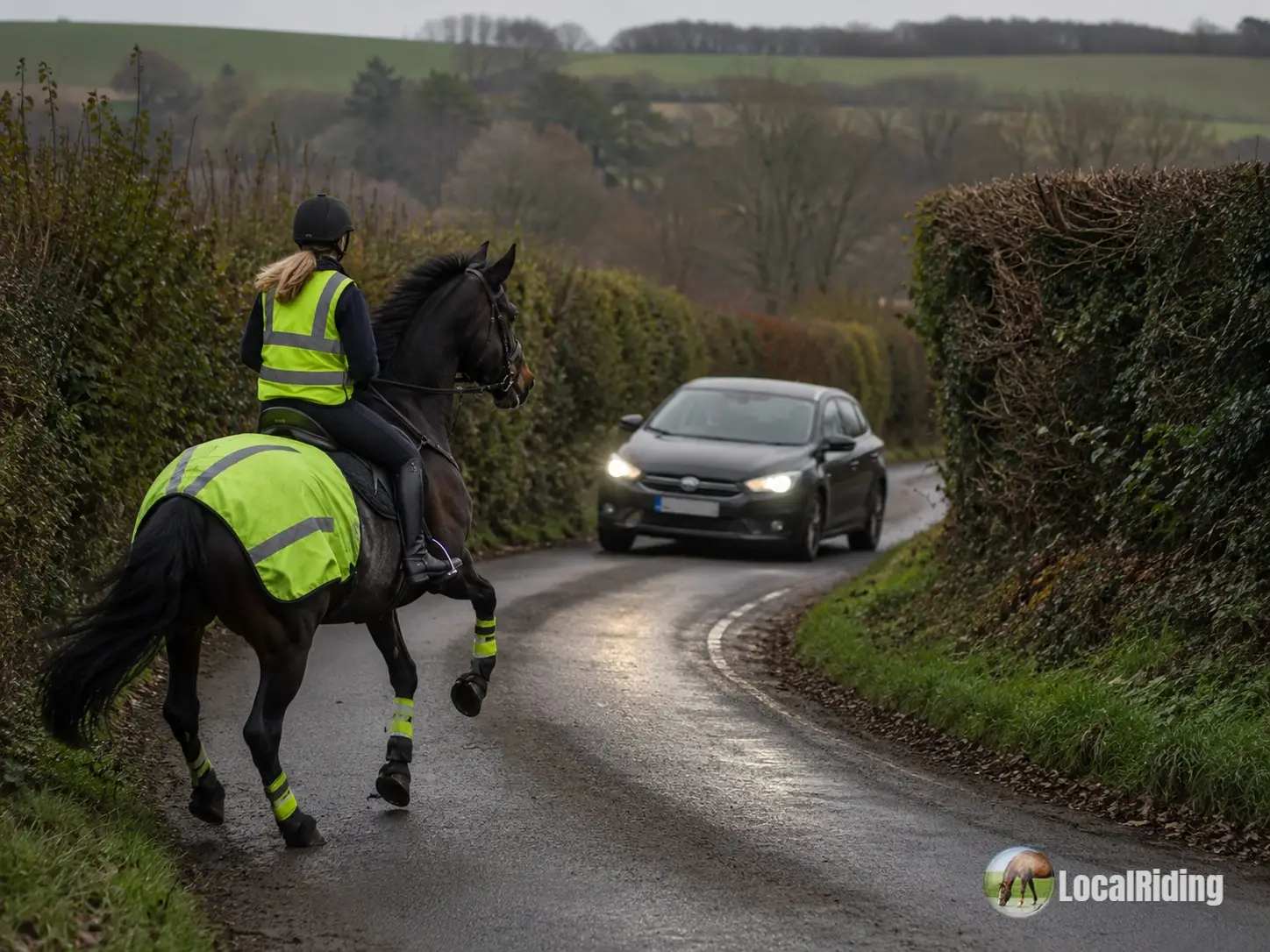 Rider and horse in matching hi-vis and reflective leg bands approaching a car around a blind bend on a narrow UK country lane lined with hedges
Around bends and blind corners, head-on visibility matters most — full hi-vis on both horse and rider helps drivers see you in time.
Listen for traffic and ride in a position where you can be seen as early as possible. On narrow roads, riders may need to ride more centrally to discourage unsafe squeezing past.
Junctions
Look behind before changing direction, signal clearly, and do not assume a driver will wait. Be aware of vehicles emerging from side roads or turning across your path.
Parked cars
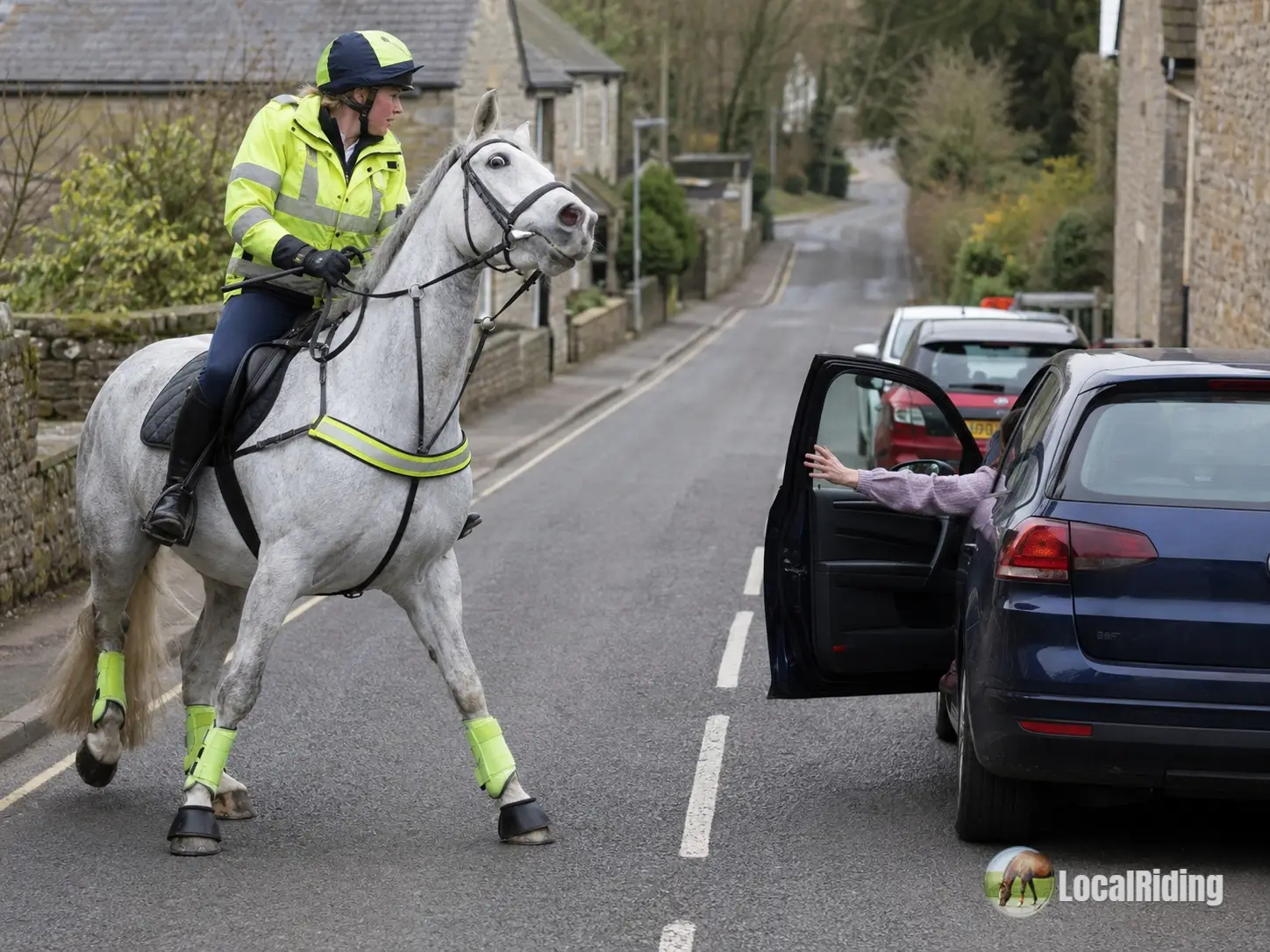 Grey horse spooking on a UK village street as a person opens a parked car door directly in front of horse and rider in hi-vis
Parked cars are unpredictable — opening doors, alarms and people stepping out can all spook a horse without warning.
Allow space for opening doors and sudden vehicle movement. Horses may also react to reflections, alarms, engines starting, or people stepping out unexpectedly.
Large vehicles
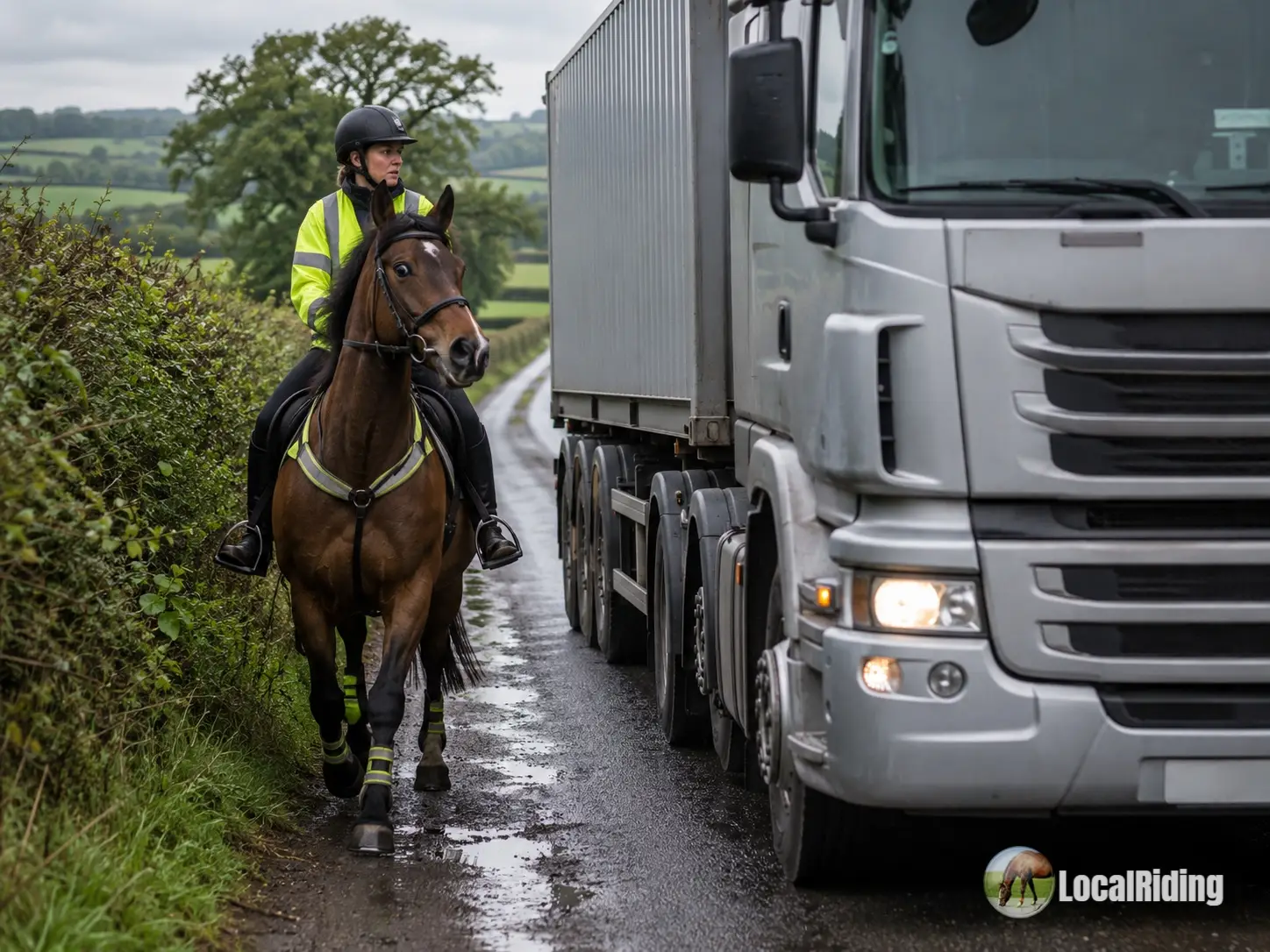 Rider in hi-vis on a bay horse pressed against a hedge as a large articulated lorry passes on a narrow wet UK country lane
Large vehicles on narrow lanes are intimidating for horses — wear hi-vis, signal early and don't be afraid to ask drivers to slow or wait.
Tractors, lorries, buses and trailers can be intimidating for horses. If needed, signal for the driver to slow or wait, then move to the safest available position.
What to do after a near miss or road incident
If you are involved in an incident or serious near miss, prioritise safety first. Move yourself and your horse to a safe place if you can do so without further danger.
- Check yourself, your horse and anyone else involved for injury.
- Call emergency services if anyone is injured or the road is blocked.
- Call your vet if your horse may be injured, shocked or lame.
- Record the vehicle registration, location, time and description of what happened.
- Ask for witness details if safe to do so.
- Take photographs of the scene, injuries, damage and road layout if appropriate.
- Report dangerous driving or a collision to the police.
- Report equestrian road incidents to the British Horse Society if appropriate.
Even if your horse appears unharmed, monitor them afterwards for stiffness, swelling, cuts, stress or behavioural changes.
Quick road safety checklist for riders
- Wear an approved riding hat and suitable footwear.
- Use hi-vis and reflective equipment on both horse and rider.
- Check tack before leaving the yard.
- Choose the safest route and time of day.
- Ride with a steady companion if your horse is inexperienced.
- Keep to the left unless road conditions require a safer position.
- Signal clearly and early.
- Thank considerate drivers when safe.
- Avoid pavements, footpaths and cycle tracks unless permitted.
- Report dangerous incidents and near misses.
Frequently asked questions
Do drivers have to pass horses at 10mph?
The Highway Code says drivers should slow down to a maximum of 10mph when passing a horse and allow at least 2 metres of space where safe. Although some Highway Code rules are advisory rather than direct offences, the Code can be used as evidence when assessing liability or careless driving.
Can horse riders ride two abreast on the road?
Yes, riders may ride two abreast in appropriate situations, such as escorting a young or inexperienced horse or rider. However, riders should move into single file on narrow or busy roads and when going around bends.
Can horse riders use pavements?
No. Horse riders must not take a horse onto a footpath or pavement. Use bridleways and equestrian crossings where available.
Should horse riders wear hi-vis in daylight?
Yes. The Highway Code recommends light-coloured or fluorescent clothing in daylight and reflective clothing at night or in poor visibility. Hi-vis helps drivers identify horses earlier.
What should I do if a driver passes too close or too fast?
Stay calm, keep control of your horse, and move to safety if possible. If the incident was dangerous, record the vehicle details, time and location, seek witnesses or camera footage, and report it to the police where appropriate.
Final advice
Horse riders have a legitimate place on UK roads, but safe road use depends on preparation, visibility, training and communication. Know the Highway Code, make yourself and your horse easy to see, choose routes carefully, and never assume that a driver understands how to pass a horse safely.
The safest pass is slow, wide and patient: 10mph, at least 2 metres, and no horn or revving.
Debbie Irwin
Livery Yard Manager & Equestrian Professional
Debbie has run professional showing yards and mixed livery yards in Lincolnshire and Essex for over 30 years. She has competed and taught at various levels. She writes about practical horse health, yard life, livery and everyday horse health and management.
Support Debbie on Ko-fi ☕Found this guide helpful? LocalRiding is run independently without ads. If you'd like to chip in towards the site's upkeep, you can buy Debbie a hot drink on a cold day on Ko-fi, she'll really appreciate it.