
Horse health
Equine Dental Care: What Every UK Horse Owner Must Know
Dental problems are more common in horses than many owners realise, and they can have a profound effect on health, behaviour, and performance. This guide explains what UK horse owners need to know.
By Debbie Irwin · 15 May 2026 · 12 min read
Dental problems are more common in horses than many owners realise, and they can affect comfort, weight, behaviour, ridden performance and long-term health. Because horses are prey animals, they may hide mouth pain until a problem is well established.
This guide explains why equine dental care matters, how to spot warning signs, how often UK horses should have dental checks, what happens during an examination, and how to choose a qualified dental professional.
Why equine dental care matters
Horses evolved to graze for many hours a day, grinding fibrous forage with large cheek teeth. Their teeth erupt gradually throughout much of their lives, and normal chewing helps wear the teeth down. However, modern management, individual mouth shape, age, diet and dental abnormalities can lead to uneven wear.
Sharp enamel points, hooks, ramps, wave mouth, missing teeth, loose teeth, diastemata, periodontal disease, fractured teeth and retained caps can all cause pain or reduce chewing efficiency. Dental pain may then show as weight loss, quidding, poor performance, resistance to the bit, behavioural changes or difficulty eating.
Routine dental care should be treated as a core part of horse ownership, alongside farriery, worm control, vaccination, saddle fit and general health checks.
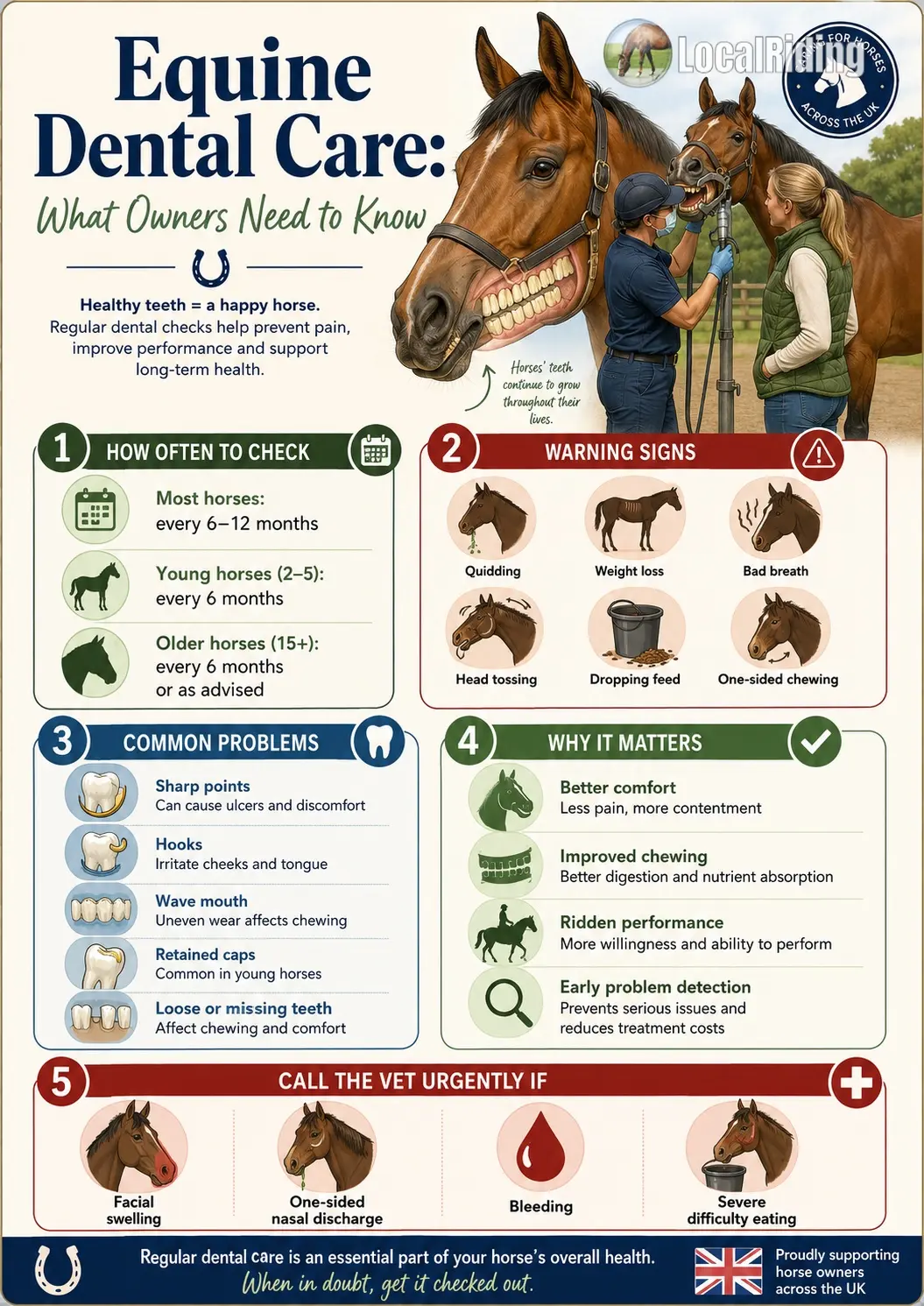 Equine dental care infographic for UK horse owners: how often to check, warning signs, common problems, why it matters and when to call the vet urgently
Equine dental care at a glance — how often to check, warning signs to watch for, common problems and when to call the vet urgently.
How often should a horse's teeth be checked?
Most horses should have a routine dental examination at least once a year. Many horses benefit from checks every six months, especially if they are young, elderly, have known dental problems, have missing teeth, show signs of discomfort, or are in regular work.
General guide
- Foals and youngsters: checks may be needed to monitor development, retained caps, wolf teeth and early abnormalities.
- Horses aged 2–5: often need more frequent checks because the mouth changes rapidly as adult teeth erupt.
- Adult horses: usually require checks every 6–12 months, depending on findings.
- Veteran horses: often need more frequent monitoring due to tooth loss, loose teeth, gum disease and reduced chewing ability.
- Horses with known dental disease: should follow a schedule set by the vet or qualified dental professional.
Do not wait for obvious signs before booking a check. Many dental problems are easier, cheaper and kinder to manage when found early.
Signs of dental problems in horses
Dental pain can appear as feeding problems, ridden issues, behavioural changes or general health concerns. Some horses show several signs; others show very few.
Eating and weight signs
- Dropping feed from the mouth
- Quidding, which means dropping partly chewed balls of hay or grass
- Slow eating
- Eating on one side of the mouth
- Dipping hay or feed in water
- Reduced appetite
- Unexplained weight loss
- Poor condition despite adequate feeding
- Long fibres or undigested feed visible in droppings
- Choke or repeated feed-related problems
Mouth, head and facial signs
- Bad smell from the mouth
- Excessive salivation or drooling
- Facial swelling
- Lumps along the jaw
- Head tilting while eating
- Nasal discharge, especially one-sided discharge
- Bleeding from the mouth
- Reluctance to have the face, cheeks or mouth handled
Ridden and behavioural signs
- Resistance to the bit or contact
- Head tossing or headshaking
- Opening the mouth or crossing the jaw
- Leaning on one rein
- Difficulty flexing or bending one way
- Reluctance to go forward
- Unexplained tension, napping or evasions
- Difficulty accepting the bridle
- Change in temperament or performance
Important: these signs can have more than one cause. A horse resisting the contact may have dental pain, but saddle fit, back pain, lameness, rider balance and training issues should also be considered. Dental pain should always be ruled out as part of the investigation.
Why horses hide dental pain
Horses may continue eating and working despite significant mouth discomfort. As prey animals, they often mask pain, and some owners only notice a problem when weight loss, quidding or behavioural changes become obvious.
This is why routine examinations are so important. A professional may find sharp points, ulcers, loose teeth, periodontal disease or other painful problems before the horse gives clear outward signs.
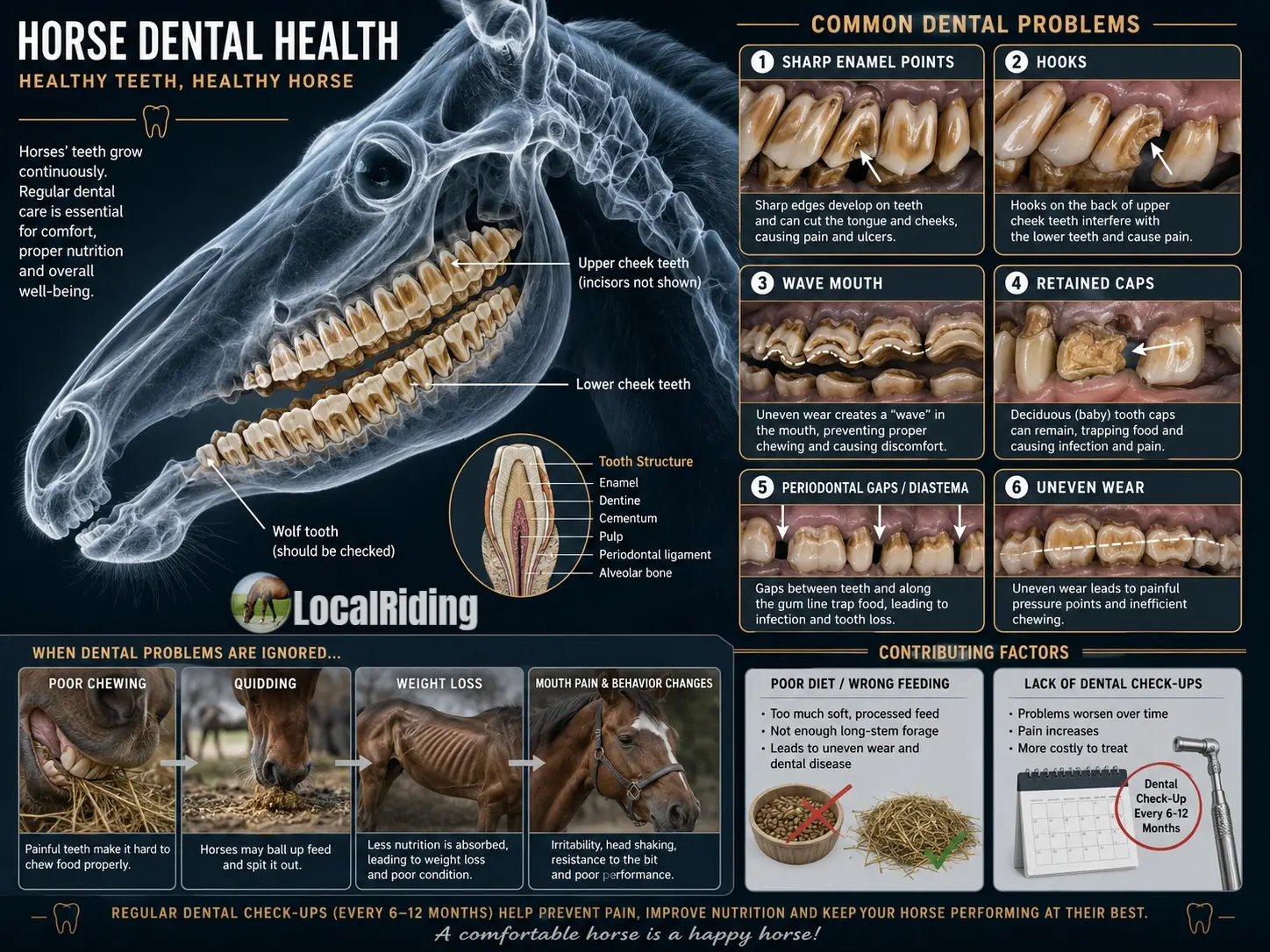 Horse dental health diagram showing upper and lower cheek teeth, wolf tooth, tooth structure and common dental problems such as sharp points, hooks, wave mouth, retained caps and diastema
How a horse's teeth are arranged and the most common dental problems — from sharp enamel points and hooks to wave mouth, retained caps and periodontal gaps.
Common equine dental problems
Sharp enamel points
Sharp points commonly form on the outside edges of the upper cheek teeth and the inside edges of the lower cheek teeth. They can cut the cheeks or tongue, causing ulcers, pain and resistance to the bit.
Hooks and ramps
Hooks and ramps are overgrowths that can interfere with normal jaw movement. They may develop when teeth do not meet evenly.
Wave mouth
Wave mouth occurs when the chewing surface becomes uneven in a wave-like pattern. It can affect chewing efficiency and may need careful staged correction.
Retained caps
Young horses lose deciduous "baby" teeth as adult teeth erupt. Sometimes caps are retained and cause pain, uneven wear or bitting problems.
Wolf teeth
Wolf teeth are small teeth that may sit in front of the first cheek teeth. Not all wolf teeth cause problems, but some can interfere with the bit and may require veterinary removal.
Diastemata
Diastemata are gaps between teeth where feed can become trapped. This can lead to painful gum disease and bad smell from the mouth.
Periodontal disease
Periodontal disease affects the structures supporting the teeth. It can be painful and is a significant issue in some older horses.
Loose, fractured or infected teeth
Loose, broken or infected teeth require veterinary attention. Signs may include bad smell, facial swelling, nasal discharge, quidding, pain or weight loss.
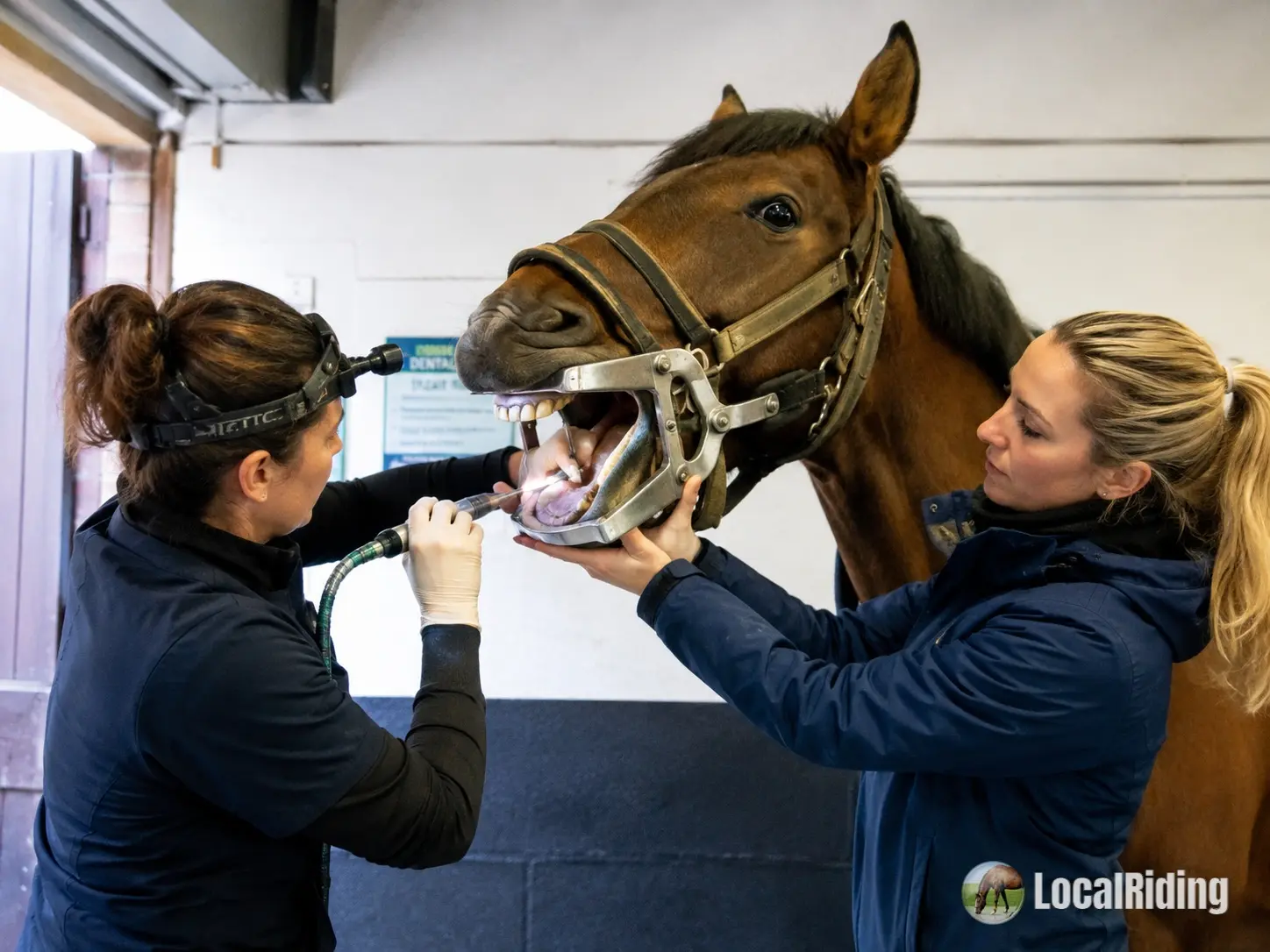 Equine dental technician examining a horse's mouth with a headtorch and full-mouth speculum while the owner holds the horse in a stable
A thorough dental examination uses a full-mouth speculum, good lighting and safe handling to check the whole mouth, not just the front teeth.
What happens during an equine dental examination?
A proper dental examination should involve more than a quick feel of the front of the mouth. The professional should examine the whole mouth using suitable equipment, good lighting and safe handling.
A routine dental visit may include:
- Discussion of the horse's age, diet, workload and history
- Questions about eating, weight, behaviour and ridden performance
- External examination of the head, jaw and facial symmetry
- Use of a full-mouth speculum or gag
- Visual examination of incisors, canines, wolf teeth and cheek teeth
- Assessment of sharp points, hooks, ramps, waves and ulcers
- Checking for loose teeth, gaps, trapped feed and gum disease
- Rasping or floating where appropriate
- Advice on follow-up treatment or review intervals
- A dental chart or written record of findings
Some horses need sedation for a complete and safe examination, particularly if they are painful, anxious, young, unhandled, strong, or require more detailed treatment.
What is floating or rasping?
Floating, also called rasping, means reducing sharp enamel points or minor overgrowths to improve comfort and chewing. This may be done with hand rasps or powered equipment, depending on the professional, the horse and the work required.
The aim is not to make the teeth completely flat. Horses need appropriate grinding surfaces. Good dental work preserves function while removing painful sharpness, correcting imbalances where appropriate, and avoiding excessive reduction.
Does equine dental work require sedation?
Not every horse needs sedation for every routine check, but sedation can allow a safer, calmer and more thorough examination. It may be especially important when the horse is painful, there is an existing dental problem, powered equipment is used, or more detailed treatment is required.
In the UK, injected sedation can only be administered by a veterinary surgeon. An equine dental technician cannot legally inject sedation. Some EDTs work alongside vets so that sedation can be given when needed.
Sedation is not a substitute for pain relief, diagnosis or proper treatment. If extractions, advanced procedures, infection, severe disease or significant pain are involved, veterinary involvement is essential.
Who can perform equine dental work in the UK?
In the UK, equine dental care may be carried out by a veterinary surgeon or, for certain procedures, by an appropriately qualified equine dental technician.
Veterinary surgeons
Veterinary surgeons can examine, diagnose and treat dental disease. They can administer sedation, prescribe medication, perform extractions, investigate infection, take radiographs and carry out advanced procedures within their competence.
Qualified equine dental technicians
Qualified EDTs are commonly members of professional bodies such as the British Association of Equine Dental Technicians (BAEDT) or the Worldwide Association of Equine Dentists (WWAED). Qualified EDTs may perform Category 1 and Category 2 procedures within their training and competence.
Unqualified dental practitioners
Unqualified practitioners are limited in what they may legally do. Owners should be cautious about using anyone who cannot explain their qualifications, insurance, permitted procedures and referral arrangements.
Category 3 procedures
Advanced dental procedures, including many extractions and treatment of dental disease, are veterinary procedures and should be carried out by a vet.
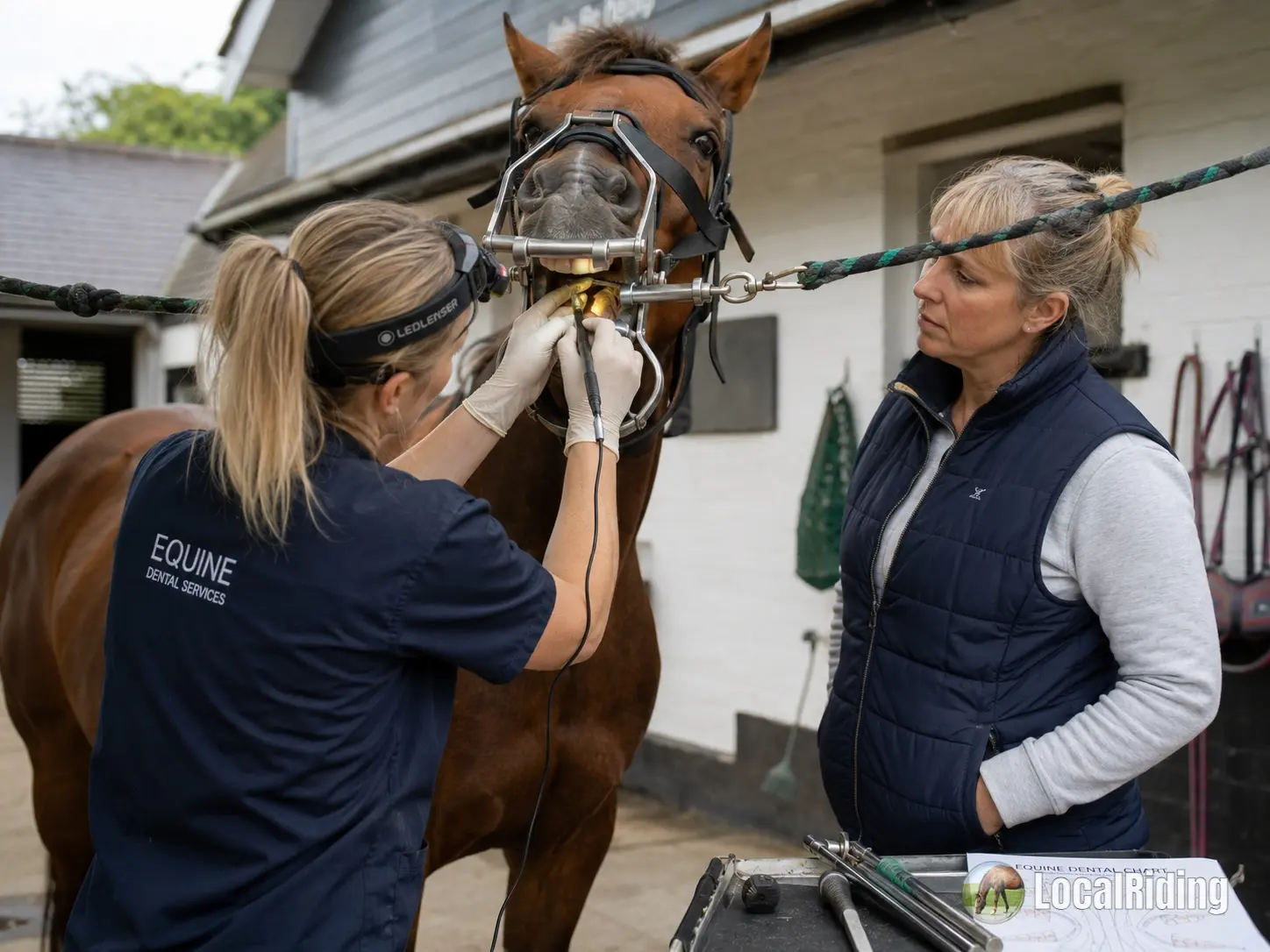 Equine dental professional examining a horse outdoors in the yard with a dental chart and instruments laid out on a table
A qualified professional should keep a dental chart or written record of findings and explain them clearly to you.
How to choose a qualified dental professional
Choosing the right person matters. Poor dental work can cause pain, missed diagnoses, excessive tooth reduction, delayed treatment and welfare problems.
Before booking, ask:
- Are you a veterinary surgeon or a qualified EDT?
- Are you a member of BAEDT, WWAED or another recognised professional body?
- What procedures are you qualified and insured to perform?
- Do you provide a dental chart or written record?
- How do you work with vets if sedation or advanced treatment is needed?
- What follow-up interval do you recommend for this horse?
- Can you explain any findings clearly?
For horses with pain, suspected infection, facial swelling, nasal discharge, severe weight loss, loose teeth or previous dental disease, booking a vet or arranging vet involvement is usually the safest option.
Dental care for young horses
Young horses undergo major dental changes as adult teeth erupt. Between roughly two and five years old, retained caps, sharp points, wolf teeth and eruption problems can affect comfort and training.
Young horses may need checks every six months during this stage. Dental discomfort can be mistaken for resistance, bitting problems or behavioural issues, especially when the horse is beginning ridden work.
Dental care for veteran horses
Older horses often need more careful dental management. Teeth can become worn, loose, missing or uneven, and gaps between teeth can trap food. These problems can reduce chewing efficiency and contribute to weight loss.
Watch veteran horses for:
- Quidding
- Slow eating
- Weight loss
- Bad breath
- Feed packing in the cheeks
- Loose droppings or long fibres in droppings
- Difficulty eating hay or long-stem forage
Veteran horses may need dietary adjustments such as soaked fibre, chopped forage, senior feeds or hay replacers. Any diet change should be made gradually and with appropriate professional advice.
Dental care and ridden performance
Mouth pain can affect how a horse accepts the bit, bends, flexes and works into the contact. A horse with sharp points, ulcers, wolf tooth pain or jaw restriction may resist in ways that look like training problems.
Possible ridden signs include:
- Head tossing
- Leaning or pulling
- Opening the mouth
- Crossing the jaw
- Resistance on one rein
- Difficulty turning or bending
- Reluctance to accept the bridle
- Sudden change in performance
Dental checks should be part of any investigation into new ridden resistance, along with saddle fit, lameness, back pain, rider balance and training factors.
Can dental problems affect weight and digestion?
Yes. Horses with painful or inefficient teeth may not chew forage properly. This can lead to quidding, reduced fibre intake, weight loss and poorer digestion.
Long fibre in droppings, slow eating, feed dropping, or unexplained weight loss should prompt a dental check. In older horses, dental issues are a common reason for needing forage alternatives or soaked feeds.
Preparing your horse for a dental visit
Good preparation helps the examination go smoothly and safely.
Before the appointment:
- Bring the horse in early so they are calm and settled.
- Provide a clean, well-lit area with safe footing.
- Have a safe tie-up point available.
- Remove feed from the mouth if the professional asks you to.
- Have the horse's passport, medical history and previous dental records ready.
- Tell the professional about any eating, behaviour or ridden changes.
- Discuss sedation in advance if your horse is anxious, painful or difficult.
After dental treatment
After routine floating, many horses return to normal quickly, but after sedation or more involved treatment, extra care may be needed.
Aftercare tips
- Follow the vet or EDT's advice on when to feed again.
- If sedated, do not feed until the horse is safe to chew and swallow.
- Offer soft or soaked feed if recommended.
- Monitor for difficulty eating, swelling, bleeding or discomfort.
- Follow any medication instructions exactly.
- Book the recommended follow-up appointment.
- Allow time for the horse to adjust if significant dental correction was performed.
What horse owners should not do
- Do not wait for obvious pain before booking routine checks.
- Do not assume ridden resistance is "naughtiness" without ruling out pain.
- Do not use an unqualified person for advanced dental work.
- Do not allow anyone other than a vet to inject sedation.
- Do not ignore bad breath, quidding, weight loss or facial swelling.
- Do not change bits, tighten nosebands or use gadgets to mask mouth discomfort.
- Do not skip dental care for retired or unridden horses.
When to call a vet urgently
Some dental or mouth-related signs need prompt veterinary attention rather than waiting for a routine dental visit.
Contact your vet if you notice:
- Facial swelling
- One-sided nasal discharge
- Bleeding from the mouth
- Severe difficulty eating
- Choke
- Loose or fractured teeth
- Bad smell from the mouth
- Rapid weight loss
- Signs of pain after dental treatment
- Any suspected tooth root infection
Quick dental care checklist
- Book routine dental checks every 6–12 months.
- Use a vet or qualified EDT.
- Ask for a dental chart or written record.
- Watch for quidding, feed dropping, bad breath and weight loss.
- Include dental checks in any investigation of ridden resistance.
- Arrange more frequent checks for young, veteran or problem horses.
- Use veterinary sedation when needed for safety and a thorough examination.
- Do not delay veterinary advice for swelling, discharge, severe pain or suspected infection.
Frequently asked questions
How often should my horse see a dentist?
Most horses should have their teeth checked every 6–12 months. Young horses, older horses and horses with known dental problems may need more frequent checks.
Who should check my horse's teeth in the UK?
Your horse's teeth should be checked by a veterinary surgeon or a suitably qualified equine dental technician. Qualified EDTs are commonly members of BAEDT or WWAED.
Can an equine dental technician sedate my horse?
No. In the UK, injected sedation can only be administered by a veterinary surgeon. An EDT may work alongside a vet if sedation is needed.
Does rasping hurt a horse?
Correct rasping should not hurt, but dental disease, ulcers, loose teeth or painful abnormalities can make examination and treatment uncomfortable. Sedation may be needed for a safe, thorough procedure.
Can dental problems cause bad behaviour?
Yes. Dental pain can contribute to resistance to the bit, head tossing, difficulty bending, reluctance to work, irritability or changes in behaviour. Other pain and training factors should also be considered.
Do retired horses still need dental checks?
Yes. Retired horses still need to chew properly and remain comfortable. Older horses may actually need closer dental monitoring due to tooth wear, tooth loss and gum disease.
What is quidding?
Quidding is when a horse drops partly chewed balls of hay, grass or feed from the mouth. It is a common sign of dental discomfort or reduced chewing ability.
Are wolf teeth always removed?
No. Some wolf teeth cause no problems. Others may interfere with the bit or become painful. A vet can advise whether removal is necessary.
Final advice for UK horse owners
Dental care is not an optional extra. It is central to your horse's comfort, nutrition, behaviour and performance. Regular checks by a vet or qualified EDT can prevent small problems becoming serious, painful and expensive.
If your horse changes how they eat, behaves differently under saddle, loses weight, smells bad from the mouth or shows facial swelling, arrange a dental examination promptly.
Debbie Irwin
Livery Yard Manager & Equestrian Professional
Debbie has run professional showing yards and mixed livery yards in Lincolnshire and Essex for over 30 years. She has competed and taught at various levels. She writes about practical horse health, yard life, livery and everyday horse health and management.