
Ownership
Horse Insurance in the UK: What You Need to Know
Horse insurance is one of the most important and confusing aspects of horse ownership in the UK. This guide explains the key types of cover and how to choose the right policy.
By Debbie Irwin · 11 April 2026 · 14 min read
Horse insurance is one of the most important financial decisions many UK horse owners make. A good policy can help protect you from large veterinary bills, third-party liability claims, loss of a horse, theft, and other unexpected costs. However, horse insurance can also be confusing because policies vary widely in cover limits, exclusions, excesses, age restrictions and optional extras.
This guide explains the main types of horse insurance available in the UK, what to look for in the small print, how exclusions and pre-existing conditions work, and how to compare policies sensibly before you buy.
Why insure your horse?
Horses are expensive animals to keep, and veterinary treatment can become costly very quickly. A field injury, lameness investigation, colic episode, fracture, tendon injury, eye problem or hospital referral can lead to bills that run into thousands of pounds.
Insurance can help by:
- Contributing towards eligible veterinary fees
- Protecting you if your horse injures someone or damages property
- Helping recover some of the horse's insured value if they die or are stolen
- Providing optional cover for loss of use, tack, trailers or personal accident
- Giving owners more financial flexibility during an emergency
Insurance does not remove every financial risk. Policies have limits, exclusions, excesses and claim conditions. Many owners still need a separate emergency fund for costs that fall outside the policy.
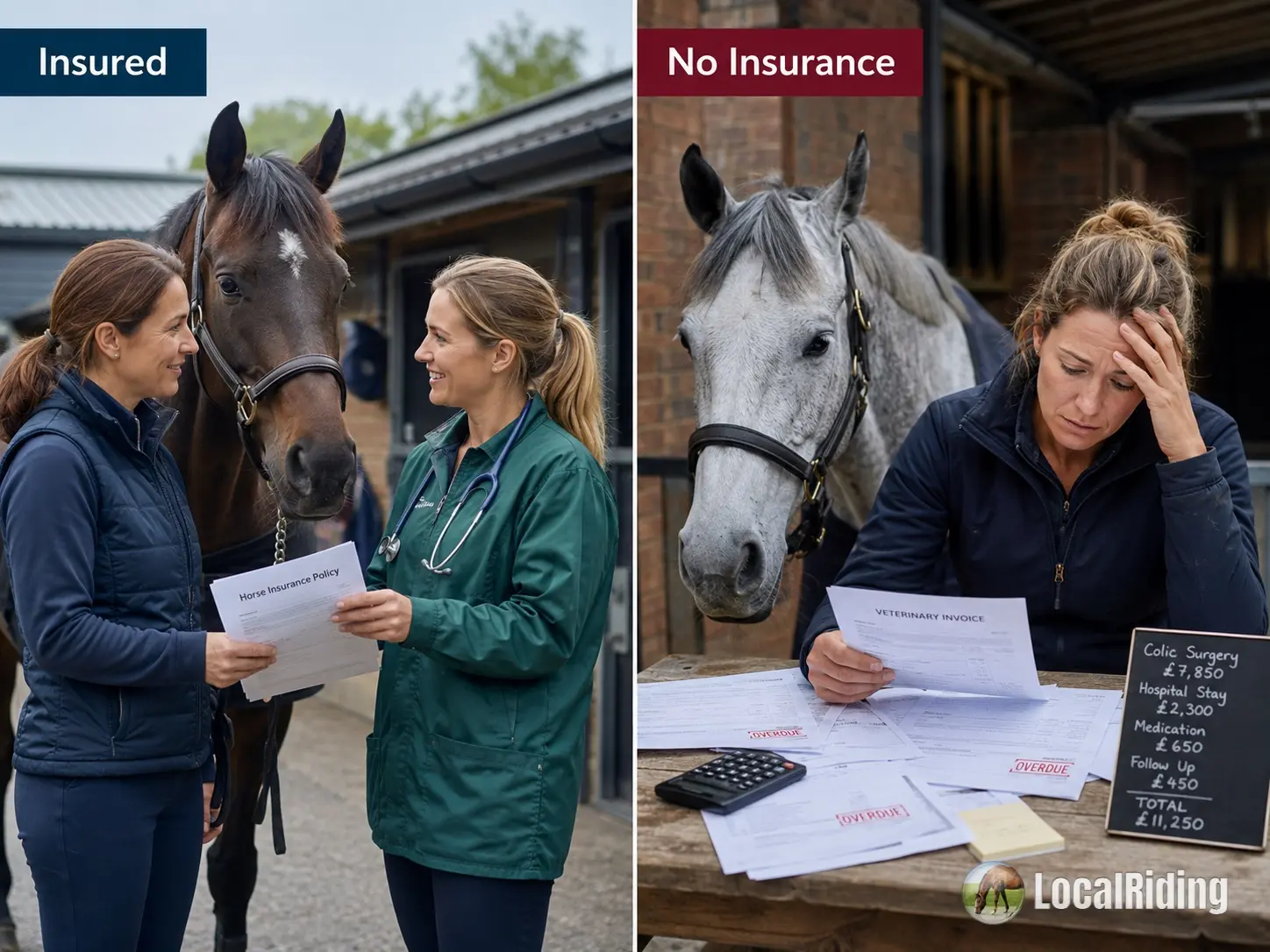 Side-by-side comparison of an insured horse owner discussing care calmly with a vet versus an uninsured owner facing a large overdue veterinary invoice
The difference cover can make: an insured owner planning treatment with their vet, versus an uninsured owner facing an £11,250 colic bill.
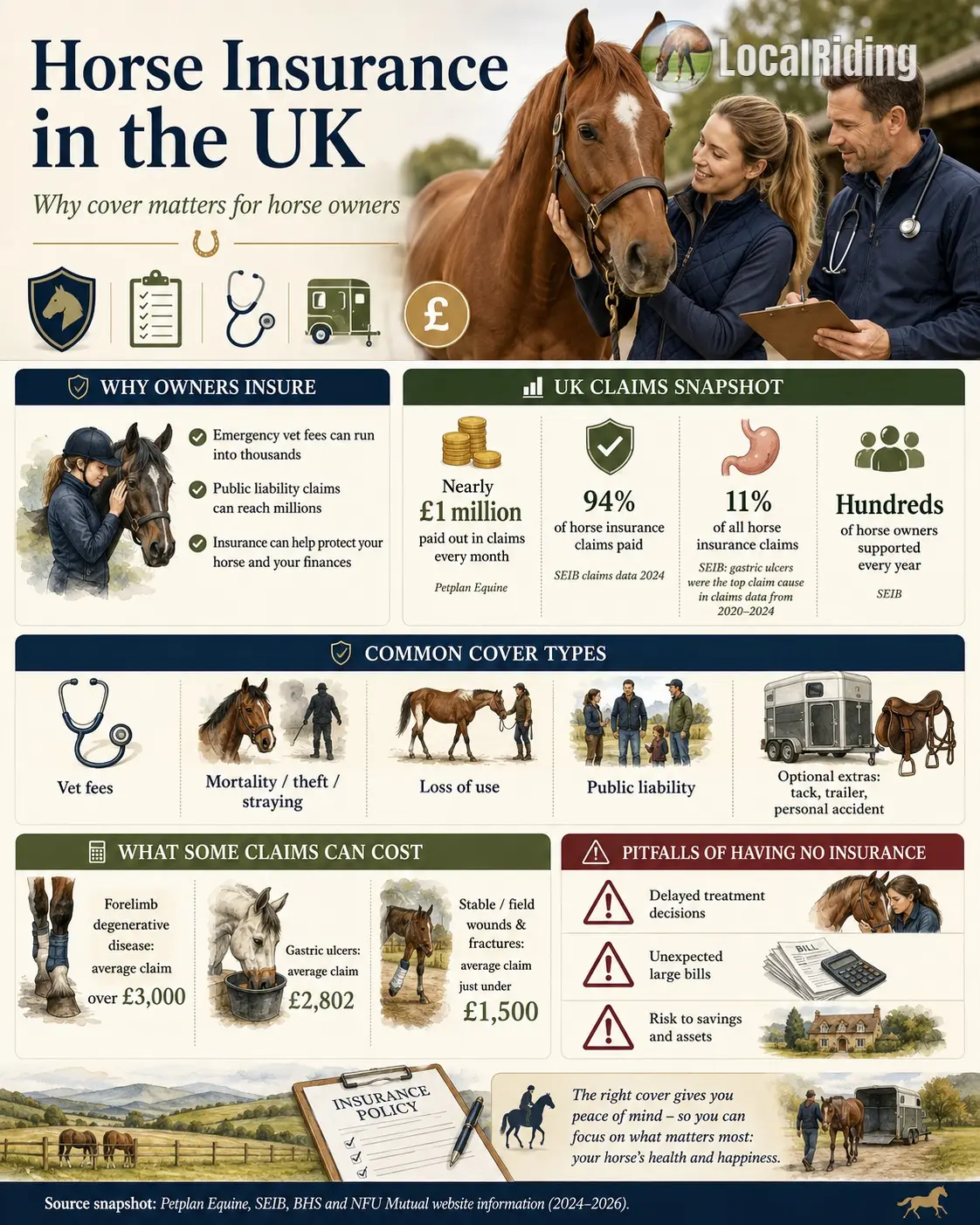 Horse insurance in the UK infographic: why cover matters, UK claims snapshot, common cover types, what claims can cost and the pitfalls of having no insurance
Horse insurance in the UK at a glance — why cover matters, typical claim costs and the risks of going uninsured. Source: Petplan Equine, SEIB, BHS and NFU Mutual (2024–2026).
How much can equine veterinary treatment cost?
Costs vary depending on the condition, location, type of treatment, hospitalisation, medication, diagnostics and whether surgery is required. Referral treatment, emergency call-outs and hospital care can be particularly expensive.
Colic is a good example of why owners often consider insurance. A 2025 report on UK colic surgery costs found an average cost of around £7,905 across reviewed cases, while maximum insurance payouts in the study were commonly between £5,000 and £7,500 depending on company and policy. This highlights an important point: even insured owners may have to contribute if treatment exceeds the policy limit.
When comparing policies, look beyond the monthly premium. A cheaper policy with a low vet-fee limit may leave you exposed if your horse needs referral treatment or surgery.
 A worried horse owner and a vet reviewing a veterinary invoice together in a stable yard
Referral treatment, hospitalisation and surgery can push veterinary bills into the thousands — making the vet-fee limit one of the most important parts of any policy.
Main types of horse insurance cover in the UK
1. Veterinary fees cover
Veterinary fees cover is often the most important part of a horse insurance policy. It helps pay for eligible treatment following illness or injury, subject to the policy wording.
Check whether the policy covers:
- Accidents and injuries
- Illness and disease
- Diagnostics such as X-rays, scans and blood tests
- Referral hospital treatment
- Surgery
- Medication
- Complementary therapy if recommended by a vet
- Dental treatment, if included
- Alternative or specialist treatment, if included
Cover limits may be per condition, per incident, per policy year, or subject to a total annual cap. Some policies offer around £3,000 to £5,000 of vet-fee cover, while others offer higher limits. Some newer or specialist policies may structure limits differently, such as an annual total limit rather than a per-condition limit.
Tip: ask yourself whether the vet-fee limit would be enough for a serious emergency, referral or surgery. If not, decide whether you are comfortable funding the difference yourself.
2. Public liability cover
Public liability cover protects you if your horse causes injury to another person or damages someone else's property and you are legally responsible. This can include incidents such as a horse escaping onto a road, injuring a member of the public, damaging a vehicle, or causing damage while being handled or ridden.
Public liability is especially important because third-party claims can be very expensive. Some horse insurance policies include it as an optional extra. It may also be available through membership organisations, such as equestrian associations, depending on the membership type and terms.
Check:
- The level of liability cover
- Whether cover applies to riding, handling, keeping and ownership
- Whether professional or business use is excluded
- Whether anyone else riding or handling the horse is covered
- Whether there is an excess for property damage claims
3. Mortality cover
Mortality cover pays out if your horse dies or has to be put to sleep on veterinary advice due to an insured illness, injury or condition. Some policies may also include theft or straying, while others treat these as separate benefits.
The payout is usually based on the insured value or market value, depending on the policy. Insurers may require proof of value, vet history or a vetting certificate, particularly for higher-value horses.
4. Theft and straying cover
Theft and straying cover can pay out if your horse is stolen or goes missing and is not recovered within the policy's stated period. It may also contribute to advertising or recovery costs, depending on the insurer.
Read the conditions carefully. The insurer may expect reasonable security, identification records and prompt reporting to the police, local authorities, passport issuer and microchip database where appropriate.
5. Loss of use cover
Loss of use cover pays a percentage of the insured value if your horse becomes permanently unable to perform the insured activity because of illness or injury. For example, a competition horse may become permanently unable to compete, or a riding horse may become permanently unsuitable for ridden work.
This type of cover is more complex than standard vet-fee insurance. It is usually more expensive, often subject to stricter underwriting, and may require a five-stage vetting or additional veterinary evidence.
Check:
- Whether loss of use is included or optional
- What percentage of the insured value is paid
- What activities the horse is insured for
- Whether the horse must be freeze-marked or otherwise identified
- Whether exclusions apply to specific limbs, conditions or activities
- How the insurer defines permanent loss of use
6. Personal accident cover
Personal accident cover may pay a fixed benefit if you are injured while riding, handling or caring for your horse. Benefits may vary for death, permanent disability, dental injury or hospitalisation.
This is not the same as income protection or private medical insurance. Read the benefit limits and exclusions carefully.
7. Saddlery, tack and equipment cover
Tack insurance can cover saddles, bridles, rugs and other equipment against theft, loss or damage. The policy may require tack to be stored securely, such as in a locked tack room or vehicle, and may apply single-item limits.
Check whether the policy covers:
- Theft from a tack room
- Theft from a vehicle or trailer
- Accidental damage
- Competition or show-day losses
- High-value saddles or specialist equipment
8. Trailer or horsebox cover
Some equine insurers offer trailer cover or horsebox-related options, while others treat vehicle insurance separately. A horsebox is a road vehicle and will usually need appropriate motor insurance. A trailer may need separate cover for theft, damage or recovery.
Do not assume your horse insurance automatically covers your trailer, horsebox, contents or breakdown recovery.
Understanding policy limits
The headline vet-fee limit is one of the most important parts of the policy, but you need to understand how it applies.
Common limit structures
- Per condition: a maximum amount for each illness, injury or condition.
- Per incident: a maximum amount for each separate incident.
- Per policy year: a maximum amount in each insurance year.
- Lifetime or ongoing cover: less common in traditional horse policies, but some policies may offer continuing cover in a different structure.
- Time-limited cover: treatment may only be covered for a fixed period after the condition first appears.
A policy offering £5,000 per condition may work very differently from a policy offering £10,000 per year across all claims. Neither is automatically better; it depends on your horse, risk tolerance and how the policy wording applies.
Excesses and co-payments
The excess is the amount you pay towards a claim. Some policies have a fixed excess, while others may include a percentage contribution, especially for older horses or certain types of claim.
Common excess types
- Fixed excess: you pay a set amount per claim or condition.
- Percentage excess: you pay a percentage of the eligible claim.
- Combined excess: you pay a fixed amount plus a percentage.
- Higher excess for older horses: some insurers increase owner contribution as the horse ages.
A higher voluntary excess may reduce your premium, but only choose an excess you could comfortably pay in an emergency.
Pre-existing conditions and exclusions
Pre-existing conditions are one of the biggest sources of confusion in horse insurance. A pre-existing condition is usually any illness, injury, symptom, abnormality or veterinary finding that existed before the policy started, whether or not a formal diagnosis had been made.
Insurers typically exclude pre-existing conditions. This means that if your horse has previously had lameness, colic, sarcoids, respiratory disease, eye problems, back pain, tendon injury, ulcers or another recorded issue, the insurer may exclude related future claims.
Examples of possible exclusions
- Excluding a specific limb after previous lameness
- Excluding colic after a previous colic episode
- Excluding skin tumours after sarcoid treatment
- Excluding respiratory claims after previous breathing problems
- Excluding back or sacroiliac claims after previous treatment
- Excluding both eyes if one eye had a related condition
Always disclose your horse's veterinary history honestly. Failure to disclose relevant information can lead to claims being rejected or cover being cancelled.
What insurers may ask for
When you take out horse insurance, the insurer may ask for details about your horse, ownership, value, health and intended use.
You may need to provide:
- Horse's age, breed, height and sex
- Purchase price or market value
- Passport and microchip details
- Veterinary history
- Previous claims history
- Current use, such as hacking, riding club, hunting, eventing or breeding
- Competition level
- Whether the horse is on loan, shared or used professionally
- Vet certificate or vetting report for higher-value horses
Some insurers require a two-stage or five-stage vetting certificate for horses over a certain value, or for policies that include permanent loss of use.
Choosing the right level of cover
There is no single best policy for every horse owner. The right cover depends on your horse's age, value, health history, intended use, your finances, and how much risk you are willing to carry yourself.
Questions to ask before buying
- How much could I afford to pay if my horse needed emergency treatment?
- Would I consider referral, surgery or intensive hospital care?
- Is the vet-fee limit realistic for the treatment I would want available?
- Does the policy cover illness as well as injury?
- Does the policy cover my horse's current activities?
- Are competitions, hunting, breeding, loaning or business use included?
- What exclusions apply from the start?
- What happens when the horse gets older?
- Can I pay the excess or percentage contribution?
- Do I need separate public liability cover?
Examples of UK horse insurance providers
The UK market includes specialist equine insurers, brokers and wider rural insurers. Examples include Petplan Equine, KBIS, NFU Mutual, Agria, SEIB, The Insurance Emporium, Equesure and other specialist providers or brokers.
Do not choose a provider based only on brand familiarity or the cheapest premium. Compare the actual policy wording, claim limits, exclusions, age rules, excesses, customer service, claims process and whether the cover suits your horse's use.
When comparing providers, check:
- Vet-fee limit
- Whether limits are per condition, per year or per incident
- Public liability limit
- Mortality, theft and straying terms
- Loss of use availability and requirements
- Excess and co-payment structure
- Age restrictions
- Competition and activity exclusions
- Pre-existing condition exclusions
- Waiting periods
- Claims procedure
- Whether your vet can claim directly
Keeping premiums manageable
Horse insurance premiums are affected by many factors, including the horse's age, value, breed, use, location, claims history and the cover selected.
Ways that may reduce cost
- Choose a realistic insured value.
- Select only the optional extras you genuinely need.
- Consider a higher excess if you can afford it.
- Compare cover limits and wording, not just monthly cost.
- Review whether you need loss of use cover.
- Keep routine care up to date, including dentistry, farriery and vaccinations.
- Ask whether multi-horse or membership discounts are available.
- Maintain good management records.
Reducing cover can lower the premium, but it also transfers more risk back to you. Make sure any saving is worth the potential exposure.
Older horses and veteran insurance
Cover often changes as horses age. Some insurers reduce vet-fee cover, increase excesses, introduce co-payments, or limit illness cover for older horses. Others offer veteran-specific policies.
If your horse is older, check:
- Maximum age for new policies
- Whether illness cover is still available
- Whether accident-only cover replaces full vet-fee cover
- Whether the excess or co-payment increases
- Whether mortality cover is still available
- How chronic conditions are treated at renewal
Loan horses, shared horses and riding someone else's horse
If you loan, share or regularly ride a horse you do not own, insurance responsibilities should be written down clearly. Do not rely on assumptions.
Clarify:
- Who pays the insurance premium
- Who is named on the policy
- Who can authorise veterinary treatment
- Who pays the excess
- Who receives any mortality or loss-of-use payout
- Whether the rider or sharer is covered for public liability
- Whether the horse's activities match the policy
A written loan or share agreement can prevent disputes during an emergency.
Making a claim
Each insurer has its own claims process. Contact the insurer as soon as possible if your horse needs treatment that may lead to a claim. Some policies require pre-authorisation for certain procedures, referral treatment, complementary therapy or non-emergency surgery.
Claim checklist
- Notify your insurer promptly.
- Check whether pre-authorisation is needed.
- Keep all invoices and receipts.
- Ask your vet to complete the veterinary section of the claim form.
- Provide full clinical history if requested.
- Keep copies of all communication.
- Check whether the vet can claim directly or whether you must pay first.
- Track your policy limit so you know how much cover remains.
When insurance may not pay out
Claims may be rejected or reduced if they fall outside the policy wording. Common reasons include:
- The condition was pre-existing.
- The claim relates to an excluded limb, system or condition.
- The treatment took place after the policy time limit expired.
- The policy does not cover that activity or use.
- The owner did not disclose relevant history.
- The excess is higher than the claim value.
- The vet-fee limit has already been reached.
- The treatment was not considered necessary or eligible under the policy.
- The claim was submitted too late.
- The policy had lapsed or premiums were unpaid.
If you disagree with an insurer's decision, ask for the reason in writing and follow the provider's complaints process. If the issue remains unresolved, UK consumers may be able to escalate eligible complaints to the Financial Ombudsman Service.
Insurance and emergency planning
Insurance is only part of emergency planning. You should also decide in advance what treatment options you would consider and how you would fund costs beyond your policy limit.
Keep these details accessible:
- Insurance provider name
- Policy number
- Vet-fee limit
- Excess amount
- Exclusions
- Emergency claims phone number
- Your vet's emergency number
- Referral hospital contact details
- Transport contacts
- Horse passport location
For conditions such as colic, serious wounds, fractures, eye injuries or acute lameness, quick decisions may be needed. Knowing your cover before an emergency helps you act faster.
Quick horse insurance checklist
- Decide what treatment options you would want available.
- Choose a vet-fee limit that reflects realistic emergency costs.
- Check whether cover is per condition, per incident or per year.
- Read the exclusions before buying.
- Disclose full veterinary history honestly.
- Check public liability cover.
- Confirm activities such as hunting, competing, breeding or loaning are covered.
- Understand the excess and any percentage contribution.
- Keep all vet records and invoices organised.
- Review your policy every renewal.
Frequently asked questions
Is horse insurance legally required in the UK?
Horse insurance is not generally a legal requirement for private horse ownership, but public liability cover is strongly advisable. Some yards, events, riding clubs or loan agreements may require proof of insurance.
What is the most important horse insurance cover?
For many owners, veterinary fees and public liability are the most important. Vet-fee cover helps with eligible treatment costs, while public liability protects you if your horse causes injury or property damage and you are legally responsible.
How much vet-fee cover should I choose?
There is no single answer. Many owners look for at least several thousand pounds of cover, but serious referral treatment or surgery can exceed lower limits. Compare the policy limit against the type of treatment you would want available.
Will insurance cover pre-existing conditions?
Usually not. Most horse insurance policies exclude conditions that existed before the policy started, including symptoms or veterinary findings that may later become part of a diagnosis.
Does horse insurance cover colic surgery?
Some policies cover eligible colic treatment or surgery if the condition is not excluded and the horse is within the policy terms. However, costs may exceed the vet-fee limit, so check the maximum payout and exclusions carefully.
Can I insure an older horse?
Yes, but options may be more limited. Some insurers offer veteran horse policies, while others restrict illness cover, increase excesses or offer accident-only cover for older horses.
Should I insure tack separately?
If you own expensive tack, check whether it is covered under your horse policy, home insurance or a separate tack policy. Pay attention to storage requirements and single-item limits.
Can I change insurer if my horse has had previous claims?
You can change insurer, but previous conditions may be excluded by the new insurer. Always compare the exclusions on your existing policy with the terms of any new policy before switching.
Final advice
Horse insurance is not just about finding the cheapest monthly premium. It is about understanding what would happen if your horse became seriously ill, injured someone, needed referral treatment, or could no longer do the job you bought them for.
The best policy is one you understand before you need it: clear limits, suitable cover, honest disclosure, manageable excesses and exclusions you have read carefully.
Sources and further reading
- Petplan Equine: horse insurance cover details, including vet-fee and liability examples.
- KBIS: horse insurance and veterinary fee cover options.
- NFU Mutual: horse insurance overview and optional vet-fee/personal liability cover.
- Agria: horse insurance optional extras including death, theft, straying and loss of use.
- British Horse Society: public liability insurance information for members.
- Horse & Hound: current explanations of mortality cover, loss of use and exclusions.
Debbie Irwin
Livery Yard Manager & Equestrian Professional
Debbie has run professional showing yards and mixed livery yards in Lincolnshire and Essex for over 30 years. She has competed and taught at various levels. She writes about practical horse health, yard life, livery and everyday horse health and management.
Support Debbie on Ko-fi ☕Found this guide helpful? LocalRiding is run independently without ads. If you'd like to chip in towards the site's upkeep, you can buy Debbie a hot drink on a cold day on Ko-fi, she'll really appreciate it.