
Riding
Equestrian Competitions in the UK: A Beginner's Guide
A practical beginner’s guide to UK equestrian competitions, from unaffiliated dressage and showing to British Showjumping and British Eventing.
By Debbie Irwin · 9 September 2026 · 14 min read
Taking your horse to a competition for the first time can feel like a major step, but competing does not have to mean chasing championships or jumping enormous fences. Across the UK there are thousands of competitions aimed at ordinary riders, young horses, first-timers and people who simply want to enjoy doing something different with their horse.
From a local village show or riding club dressage test to British Eventing, British Dressage, British Showjumping and prestigious showing championships, there is a route to suit almost every horse and rider combination.
This guide explains the main equestrian disciplines, the difference between affiliated and unaffiliated competition, how showing and eventing work, and what you need to know before making your first entry.
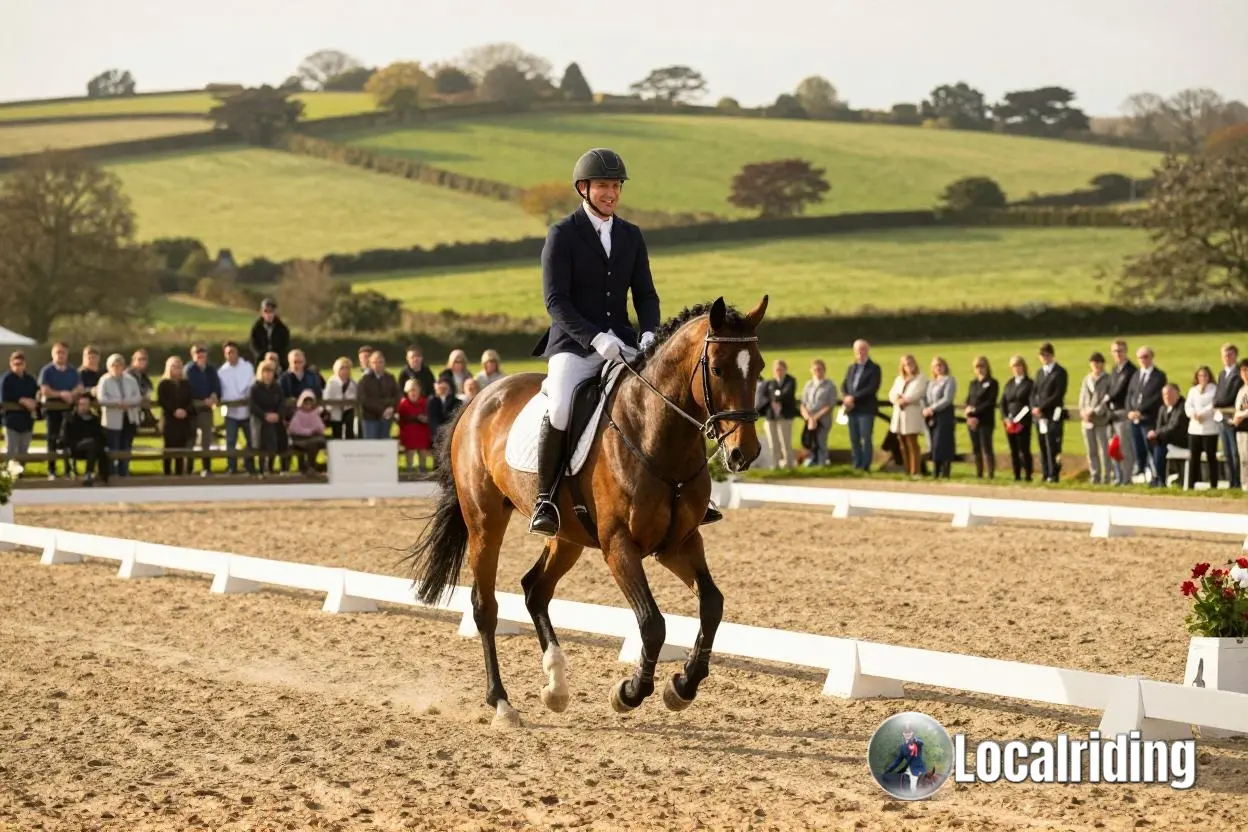 Horse and rider warming up for a dressage competition at a UK equestrian venue
A calm warm-up helps horse and rider settle into an unfamiliar competition environment.
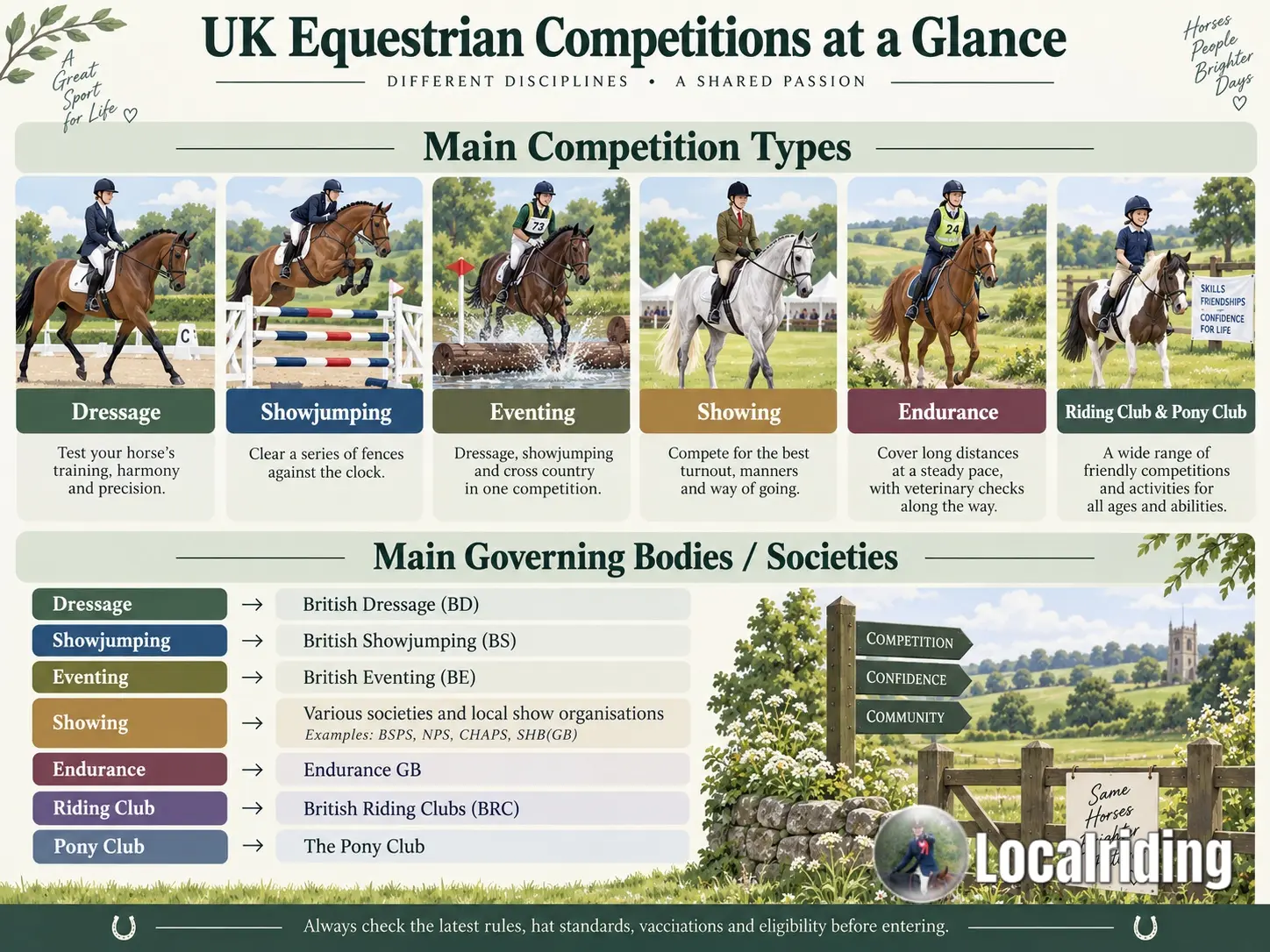 Infographic explaining the main types of equestrian competitions in the UK including dressage, showjumping, eventing and showing
The principal routes into equestrian competition in the UK.
Why Compete With Your Horse?
Competition gives everyday training a purpose. Instead of schooling simply because you feel you ought to, you have a date in the diary and something specific to prepare for.
For the rider, competing develops confidence, accuracy, decision-making and the ability to ride effectively in an unfamiliar environment. For the horse, carefully chosen outings can improve experience, confidence and adaptability.
Competition can also be extremely sociable. Riding clubs, Pony Club branches, local show societies and equestrian centres form an important part of the UK's equestrian community, and many grassroots competitions are specifically intended to encourage inexperienced competitors.
The objective of your first few outings should not necessarily be to win. A horse that travels well, settles at the venue, warms up sensibly and comes home having had a positive experience has achieved something valuable, irrespective of the colour of the rosette.
Affiliated or Unaffiliated: What's the Difference?
One of the first decisions is whether to compete affiliated or unaffiliated.
Unaffiliated competition
Unaffiliated competitions are normally organised by riding clubs, equestrian centres, Pony Club branches, show societies or independent organisers. They often use rules and tests similar to the national governing bodies but may have their own eligibility, dress and equipment requirements.
They are usually the easiest place to start because membership and horse-registration requirements are often lower or non-existent. Classes may also begin at very modest levels, including walk-and-trot dressage, poles on the ground, cross-poles and 40cm or 50cm jumping.
Affiliated competition
Affiliated competitions are conducted under the rules of the relevant governing body or society. Results may form part of an official competition record and can lead to leagues, regional championships and national qualification.
The principal organisations include British Dressage (BD), British Showjumping (BS) and British Eventing (BE), while showing is governed through a number of specialist breed and showing societies rather than one single organisation.
Affiliation brings greater consistency of rules and competition standards, but membership, horse registration and eligibility requirements need to be checked before entering.
British Dressage
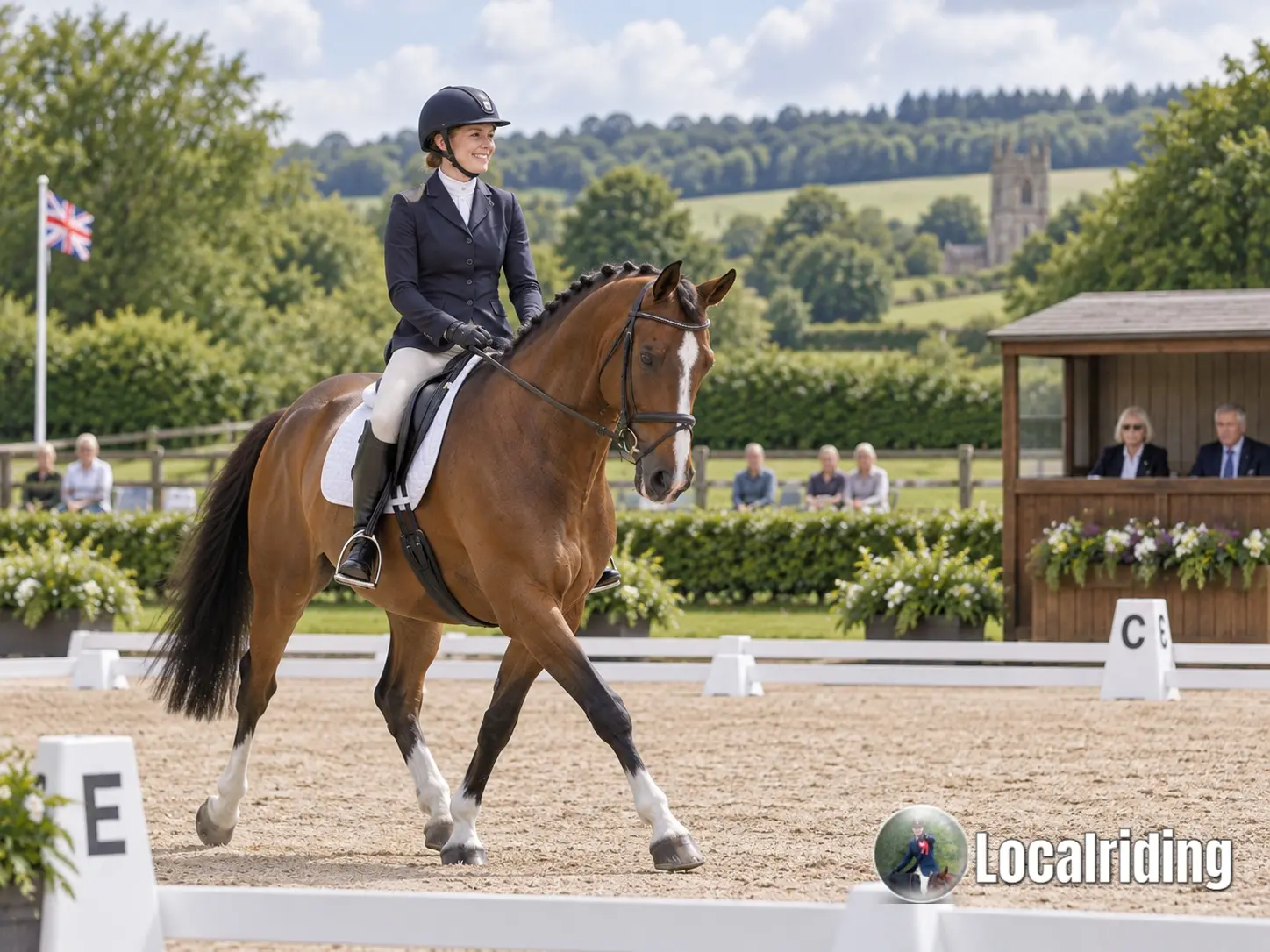 Horse and rider performing a British dressage test in a UK competition arena
Dressage rewards rhythm, accuracy, suppleness and harmony between horse and rider.
Dressage tests the training, balance, suppleness, obedience and harmony between horse and rider. It is also one of the easiest disciplines to try because there is no jumping involved and introductory tests can be performed entirely in walk and trot.
British Dressage national competition progresses through:
- Introductory
- Preliminary
- Novice
- Elementary
- Medium
- Advanced Medium
- Advanced
- Prix St Georges
- Intermediate levels
- Grand Prix
Canter is introduced at Preliminary level, with increasingly demanding lateral work, collection, changes and advanced movements appearing as combinations progress through the levels.
Beginners do not have to begin with full national championship ambitions. British Dressage offers grassroots routes including Quest competition, while unaffiliated venues throughout the country run Introductory and Preliminary tests throughout the year.
A good first dressage outing
If your horse is confidently working at Preliminary level at home, an Introductory or straightforward Preliminary test can make an excellent first competition. Learn the test thoroughly, practise riding accurate shapes and transitions, and concentrate on rhythm and relaxation rather than trying to manufacture an impressive performance.
A calm, accurate test will generally produce a better result than an ambitious one ridden with tension.
British Showjumping
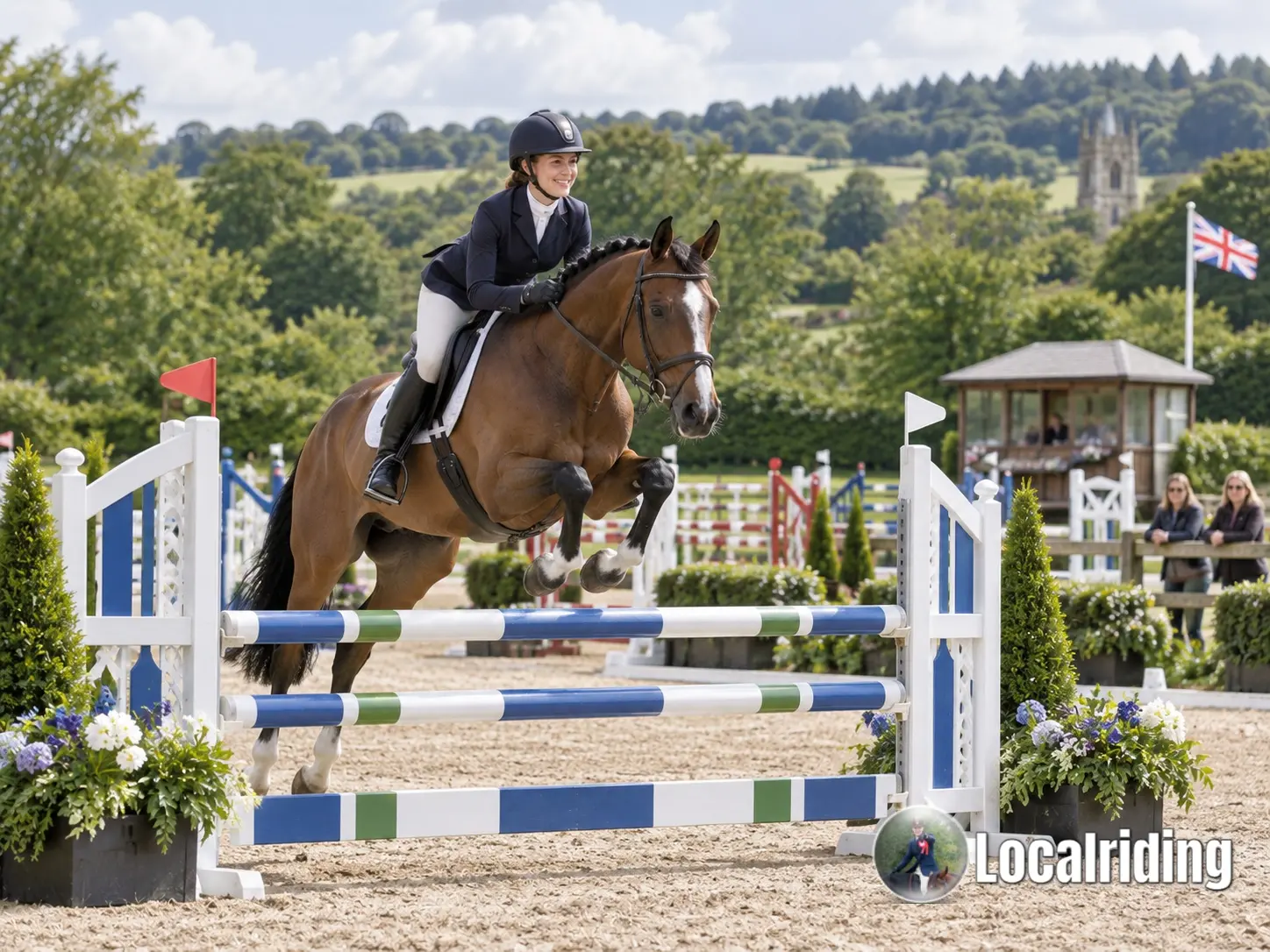 Horse and rider jumping a showjumping fence at a British equestrian competition
Showjumping classes range from grassroots clear rounds to affiliated championship competition.
Showjumping tests the horse and rider's ability to negotiate a course of fences while avoiding jumping and time penalties.
At grassroots level, riders can begin with clear-round jumping, cross-poles and small unaffiliated classes before moving into affiliated competition.
British Showjumping provides Club competition at accessible heights, while established senior affiliated classes include:
- British Novice – starting at approximately 90cm
- Discovery – approximately 1.00m
- Newcomers – approximately 1.10m
- Foxhunter – approximately 1.20m
- Open, amateur and championship classes above and alongside these levels
Eligibility for named affiliated classes can depend on the horse's previous record and winnings, so always check the current British Showjumping rules rather than assuming fence height alone determines eligibility.
Start smaller than you school at home
A useful rule for a first competition is to enter below the height at which horse and rider are comfortably schooling. A horse happily jumping 80cm at home may benefit far more from cruising around a 60cm or 70cm competition than from immediately being asked to reproduce its maximum schooling height in a busy and unfamiliar arena.
Clear-round classes are particularly useful for young or inexperienced horses because the aim is experience rather than placings.
British Eventing
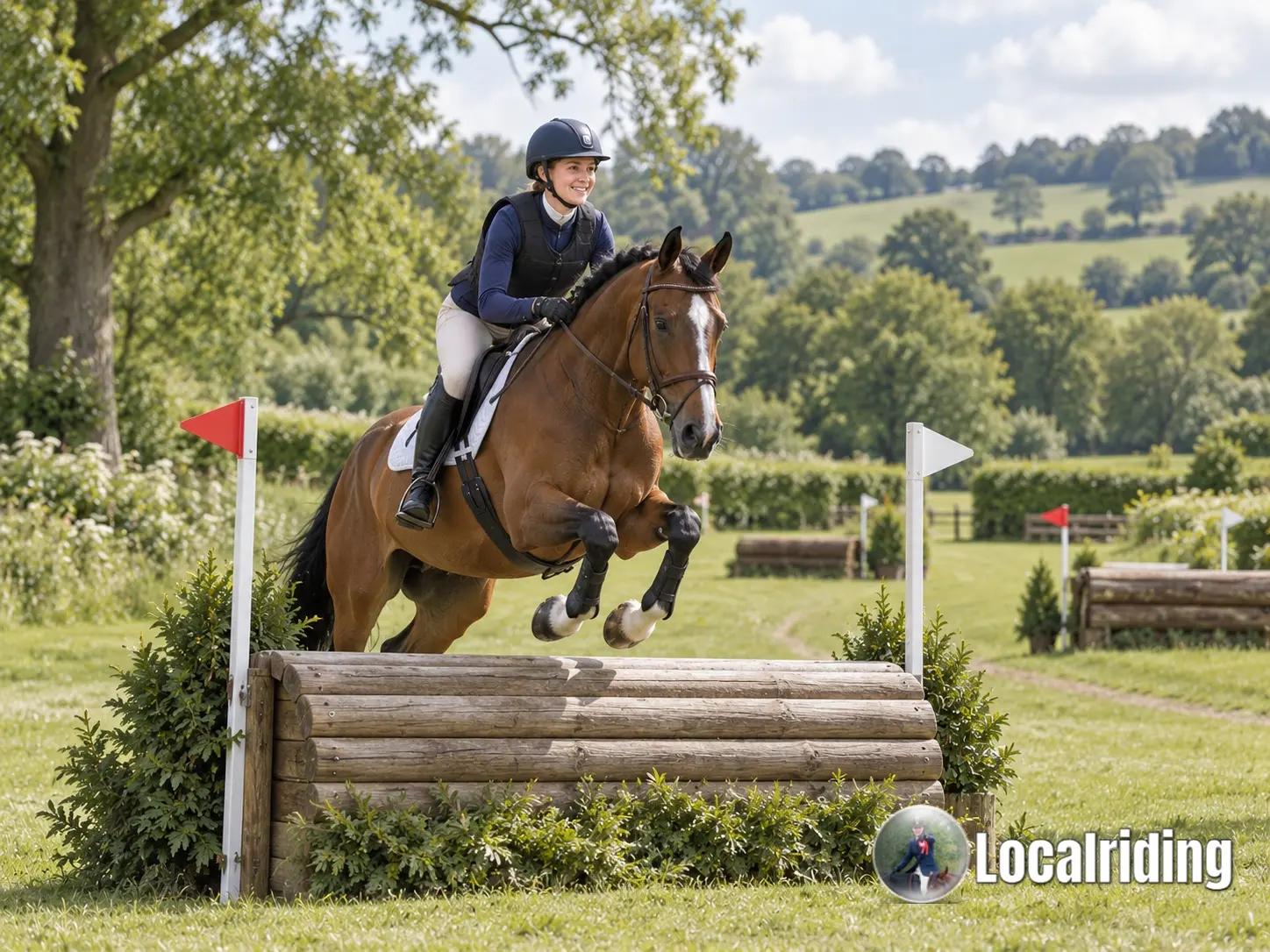 Horse and rider competing across country at a British eventing competition
Eventing combines dressage, showjumping and cross-country in one demanding sport.
Eventing combines three disciplines: dressage, showjumping and cross-country. At national level all three phases are frequently completed in a single day, although international and championship events may run over several days.
The dressage establishes obedience and quality of training. Cross-country tests bravery, fitness, judgement and the partnership between horse and rider over fixed obstacles. Showjumping tests accuracy and carefulness over knock-down fences.
British Eventing's national pathway begins at BE80 and progresses through BE90, BE100 and BE105 before moving into Novice, Intermediate and Advanced competition, with additional bridging classes within the structure.
At BE80, cross-country fences have a maximum height of approximately 80cm, making it the introductory affiliated level. BE90 and BE100 progressively increase the technical and jumping demands, while BE105 provides a bridge towards Novice competition.
International competition uses the FEI star system, eventually reaching CCI5*-L, the highest level of eventing. Britain's two famous five-star horse trials are Badminton and Burghley. Bramham is another major fixture in the British calendar, hosting competition at CCI4* level.
How should a beginner start eventing?
Very few riders should make a full affiliated horse trial their horse's first competitive outing. A more progressive route might be:
- Dressage and showjumping competitions separately.
- Cross-country schooling with a competent instructor.
- Hunter trials or small unaffiliated cross-country competitions.
- Arena eventing or combined training.
- An unaffiliated one-day event.
- GO BE, BE80 or another suitable British Eventing route when horse and rider are ready.
British Eventing currently provides flexible options including GO BE and Pay As You Go, intended to make affiliated eventing more accessible without immediately requiring the traditional full-season commitment.
Do not move up simply because the horse can jump the height. Cross-country competence includes steering, rhythm, balance, adjustability and confidence over different questions such as water, ditches, banks, combinations and changes of terrain.
Safety point: Fixed cross-country fences carry inherently greater consequences than knock-down showjumps. Correct training, appropriate protective equipment, suitable ground conditions and an honest assessment of both horse and rider experience are essential.
Showing Classes
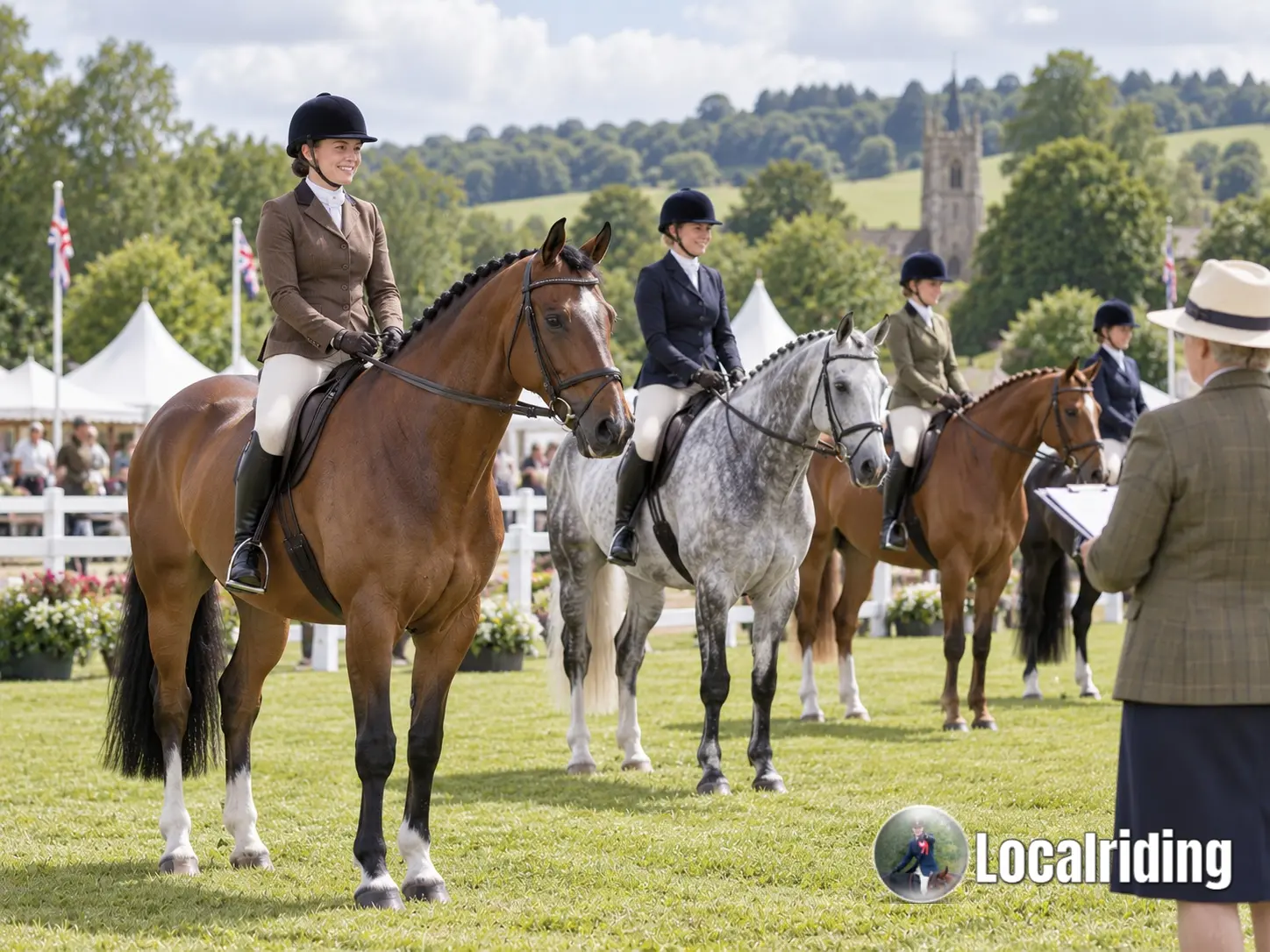 Competitors presenting horses in a showing class at a UK equestrian show
Showing classes assess a combination of type, conformation, manners, way of going and turnout.
Showing is one of Britain's most varied equestrian disciplines. Unlike dressage or showjumping, there is no single competition format. Horses and ponies are judged according to the requirements of their particular class, which may include type, conformation, manners, way of going, suitability, turnout and, in working classes, jumping ability.
Classes available around the country include:
- Show hunters and show hunter ponies
- Working hunters and working hunter ponies
- Riding horses and hacks
- Cobs
- Mountain and Moorland breeds
- Coloured horses and ponies
- Veterans
- Retrained racehorses
- In-hand classes
- Lead rein and first ridden
- Side-saddle classes
- Breed-specific classes
- Youngstock classes
How showing differs from other disciplines
In showing, presentation is part of the competition. The judge is not simply asking whether the horse completed a set task successfully; the overall picture matters.
Correct turnout varies according to the type of horse and class. A native Mountain and Moorland pony, for example, may be shown very differently from a show hack or lightweight hunter.
Before entering, read the schedule carefully and find out:
- Whether the horse is eligible for the class.
- Whether the class is affiliated to a particular society.
- How horse and rider should be turned out.
- Whether the horse will be ridden by a judge.
- Whether conformation will be assessed in-hand.
- Whether individual shows are required.
- Whether membership or registration is necessary.
For ridden showing, horses should have good manners in company. They may be expected to walk, trot and canter as part of a group, stand quietly in a line-up and perform individually when requested.
From local shows to HOYS and the Royal International
A local agricultural, riding club or unaffiliated show is an excellent starting point. At the upper end of British showing, qualification for the Horse of the Year Show (HOYS) and the Royal International Horse Show (RIHS) at Hickstead is highly prized.
These championship routes use designated qualifiers and society-specific eligibility rules, so a competitor cannot assume that winning an ordinary class automatically provides a route to HOYS or the RIHS.
The best way to begin is therefore not to copy top-level show-ring turnout indiscriminately, but to identify precisely what type of horse you have and find classes designed for that type.
British Riding Clubs and The Pony Club
For many competitors, the best route into competition is neither a major affiliated body nor a commercial show centre, but their local riding club or Pony Club branch.
British Riding Clubs run competitions from grassroots levels upwards, including dressage, showjumping, arena eventing, combined training and horse trials. There are individual and team competitions, area qualifiers and national championships.
The Pony Club provides similar pathways for younger riders through dressage, showjumping and eventing as well as disciplines including mounted games and tetrathlon.
Both organisations also offer training, rallies, clinics and team competition, which can make the transition into competitive riding considerably less daunting.
Other Equestrian Competitions to Try
The traditional dressage, showjumping, eventing and showing disciplines are only part of British equestrian sport.
Endurance
Endurance GB organises everything from pleasure rides to competitive endurance. Pleasure rides can begin at relatively modest distances, while advanced international endurance ultimately extends to considerably longer distances requiring specialist conditioning, veterinary monitoring and careful management of pace.
Para Dressage
British Dressage provides a competition structure for para riders from introductory and regional competition through to international championship sport. FEI para dressage uses Grades I to V so that athletes compete within classifications reflecting functional ability.
TREC
TREC tests the practical partnership between horse and rider, traditionally combining navigation with control of paces and obstacles reflecting situations encountered while riding across country. It is particularly attractive to riders who enjoy hacking and practical horsemanship rather than conventional arena competition.
Hunter Trials and Team Chasing
For riders who enjoy cross-country, hunter trials provide an opportunity to compete over fixed fences without the dressage and showjumping phases of a horse trial. Team chasing provides a faster and more specialised cross-country competition and should be approached with appropriate preparation and experience.
Carriage Driving and Side-Saddle
Both have active competition communities within the UK, ranging from local and showing classes to specialist national competitions.
Choosing the Right First Competition
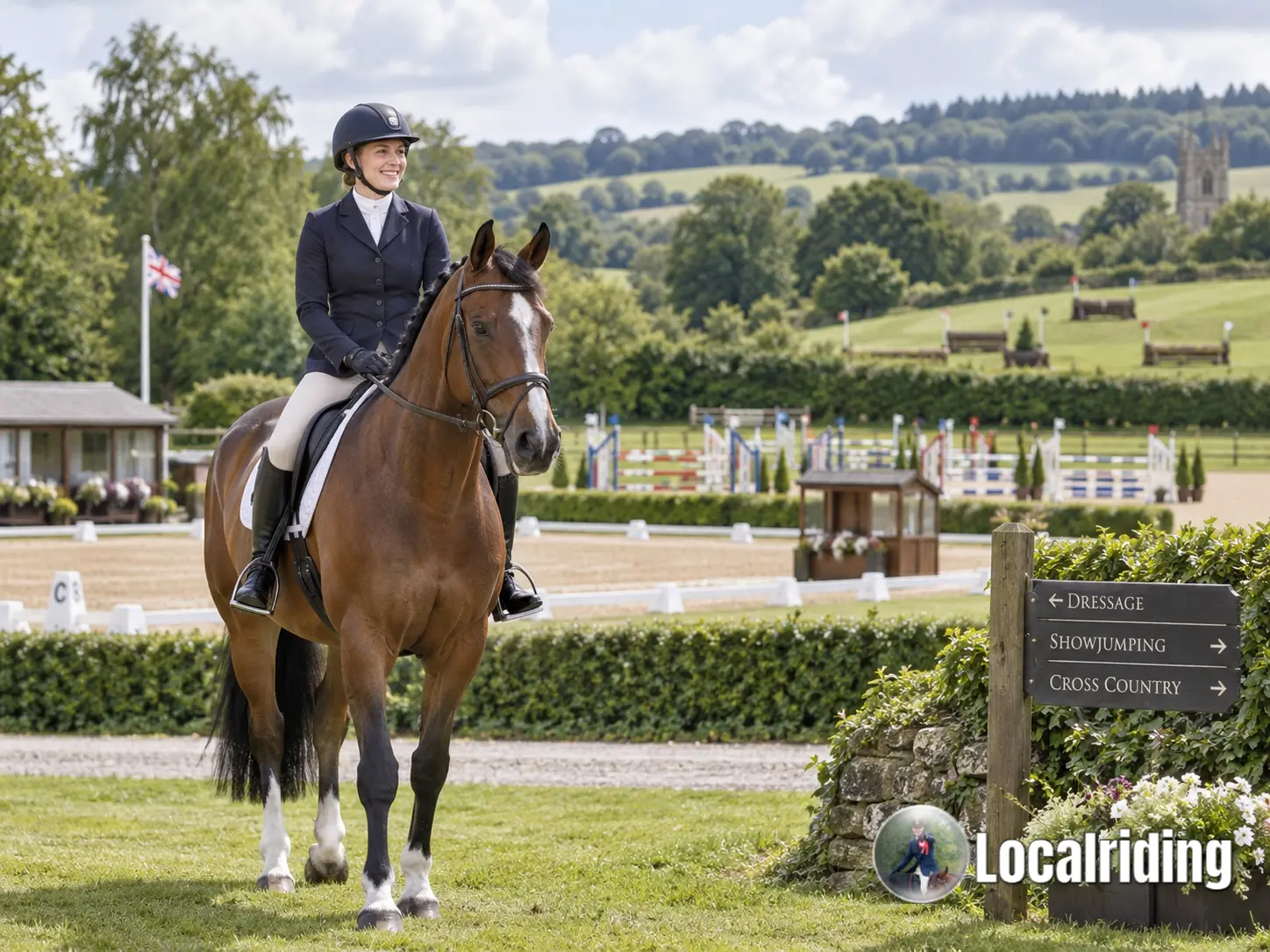 Equestrian venue signpost helping UK riders choose their first horse competition
Choose a first venue and class that allow your horse to perform comfortably within its experience.
Do not choose a class simply because it sounds impressive. Ask what experience will be most useful to your horse.
A sensible first competition should be comfortably within the horse's existing capabilities. Consider:
- How confidently the horse travels.
- Whether it has worked around unfamiliar horses.
- Whether it becomes anxious in a busy warm-up arena.
- Whether it will stand on or beside the horsebox.
- The ground and weather conditions.
- The distance from home.
- The size and atmosphere of the venue.
- Whether the class allows the horse to perform comfortably below its maximum ability.
A small local competition twenty minutes from home may provide far better education than an ambitious championship venue several hours away.
What You Need Before Entering
1. Read the schedule
The schedule is effectively the contract between competitor and organiser. It tells you the classes, eligibility rules, entry closing date, equipment requirements and venue-specific conditions.
2. Check the current rulebook
Rules concerning tack, bits, whips, spurs, protective equipment, dress, qualification and penalties change periodically. Never rely solely on what was permitted the previous season.
3. Check your riding hat
Your hat must meet the standards currently accepted by the organisation running the competition. Some organisations also require hats to carry an approved competition tag.
4. Check your body protector
A body protector is mandatory for certain activities, particularly the cross-country phase of eventing, and it must comply with the current standard specified by the organising body.
5. Check vaccinations and your horse's passport
Vaccination requirements differ between organisations and competition levels. Check them well before entering rather than discovering at the venue that a vaccination date makes the horse ineligible.
Take the horse's passport when travelling and make sure identification and vaccination records are complete.
6. Check memberships and registrations
Depending on the competition, the rider, horse and sometimes owner may require membership or registration. Do not assume that a day ticket or temporary registration gives exactly the same eligibility as full membership.
7. Check your insurance
Make sure appropriate third-party liability and other relevant insurance is in place. Membership of some equestrian organisations includes particular forms of cover, but the extent and exclusions should always be checked.
Preparing the Horse
The best competition preparation is rarely a frantic training session the day before.
Your horse should already understand at home what will be required at the competition. In the final days, concentrate on keeping the horse comfortable, confident and fresh.
For jumping and eventing, fitness must match the work involved. Cross-country in particular can be significantly more physically demanding than jumping the equivalent height in an arena.
If possible, prepare for the environment as well as the actual movements or fences. Horses may encounter loudspeakers, banners, flags, generators, dogs, pushchairs, umbrellas, crowded collecting rings and unfamiliar horses calling to one another.
Experience of different environments can be every bit as important as another schooling session.
What Happens on Competition Day?
Allow considerably more time than you think you need.
- Arrive early. Find the secretary, arenas, warm-up areas and facilities before you need them.
- Check your times. Some competitions provide precise times; others operate approximately or by drawn order.
- Prepare calmly. Avoid creating a rushed atmosphere around an inexperienced horse.
- Warm up for the horse you have that day. A fresh horse may need longer; a quiet or tired horse may need less.
- Know where you are going. Showjumpers and event riders should know their course and dressage riders their test.
- Listen to stewards. They are there to keep the competition running safely and in the correct order.
- Cool the horse down properly afterwards. Check legs, tack areas, respiration and general condition before travelling home.
Competition Etiquette
Good competition etiquette makes events safer and more enjoyable for everyone.
- Pass other horses sensibly in the warm-up.
- Follow the designated direction where one is specified.
- Call clearly before jumping a practice fence.
- Do not monopolise warm-up fences.
- Keep dogs under control.
- Do not block gateways, collecting rings or horsebox access.
- Be polite to volunteers, stewards, judges and other competitors.
- Accept the judge's decision professionally.
- Put your horse's welfare ahead of a rosette.
Many British equestrian competitions depend heavily on volunteers. A word of thanks to the steward standing in the rain for six hours costs nothing and is usually appreciated.
Budgeting for Competition
The entry fee is only part of the cost of competing. Depending on your discipline, you may also need to allow for:
- Membership and horse registration.
- Fuel and transport.
- Training and lessons.
- Competition clothing.
- Safety equipment.
- Vaccinations.
- Farriery.
- Stabling at multi-day competitions.
- Start fees or additional competition charges.
For beginners, competing locally and unaffiliated can substantially reduce the cost while providing much of the same educational value.
Ten Tips for Your First Equestrian Competition
- Enter one level easier than you think you need. Confidence is more valuable than proving a point.
- Read the schedule from beginning to end. Do not rely on social media posts alone.
- Practise loading before competition morning.
- Pack the previous evening. Make a checklist for tack, clothing, passport, water and equipment.
- Arrive early. Rushing makes both horses and riders tense.
- Do not overwork in the warm-up. Save enough horse for the actual competition.
- Ask the steward if you are unsure. It is better to ask than inadvertently break a rule.
- Do not change all your tack for competition day. Use equipment the horse already understands wherever possible.
- Judge success by the horse's experience as well as the result sheet.
- Finish on a positive experience. There will always be another competition.
Final Thoughts
Britain has one of the broadest equestrian competition structures in the world. A native pony, Thoroughbred, cob, warmblood, veteran or family all-rounder can all find somewhere to compete, often at a level far below the elite sport seen on television.
You do not need an expensive competition horse or ambitions for Badminton, Burghley or HOYS to enjoy competing. You need a suitable horse, appropriate preparation, an understanding of the rules and a level at which both horse and rider can perform confidently.
Start locally. Start smaller than you think you need to. Treat every outing as part of the horse's education.
Rosettes are enjoyable, but the most useful result of competition is a horse and rider who come home more experienced, more confident and better prepared for whatever they decide to try next.
Debbie Irwin
Livery Yard Manager & Equestrian Professional
Debbie has run professional showing yards and mixed livery yards in Lincolnshire and Essex for over 30 years. She has competed and taught at various levels. She writes about practical horse health, yard life, livery and everyday horse health and management.
Support Debbie on Ko-fi ☕Found this guide helpful? LocalRiding is run independently without ads. If you'd like to chip in towards the site's upkeep, you can buy Debbie a hot drink on a cold day on Ko-fi, she'll really appreciate it.