
Riding
Horse Riding Clubs in the UK: Benefits, How to Join & Clubs by County
What riding clubs offer, how British Riding Clubs and The Pony Club differ, how to choose a club — plus a searchable directory of nearly 300 UK riding clubs by county.
By Debbie Irwin · 20 March 2026 · 11 min read
Joining a riding club can be one of the most useful things a horse owner or rider does. A good local club can provide affordable training, friendly competition, experienced people to ask for advice, social events, volunteer opportunities and, perhaps most importantly, a community of other people who understand just how much time, effort and emotion goes into horses.
For someone buying or loaning their first horse, that network can be particularly valuable. Instead of trying to learn everything alone, a riding club puts you in contact with riders, coaches, organisers and horse owners with decades of practical experience between them.
At the other end of the spectrum, experienced riders can use British Riding Clubs competitions as a structured route into team competition, championship qualification and disciplines ranging from dressage and showjumping to horse trials, combined training and arena eventing.
This LocalRiding guide explains what riding clubs offer, how British Riding Clubs and The Pony Club differ, how to choose a club and where to start looking around the UK — with a searchable directory of nearly 300 affiliated riding clubs by county.
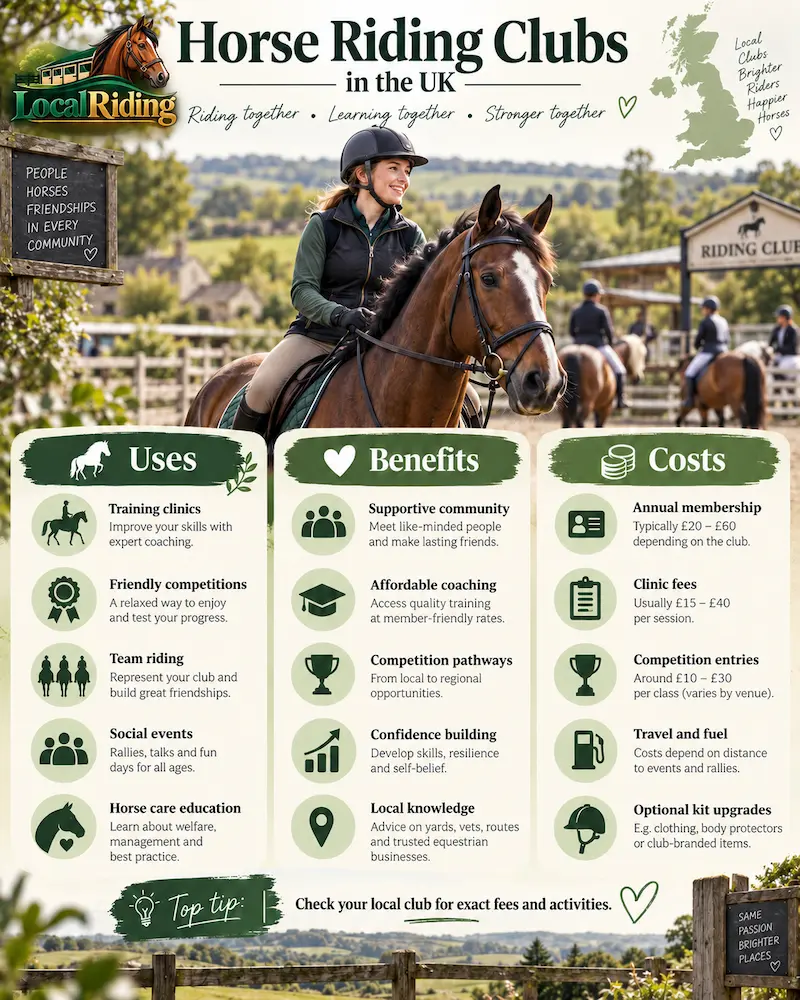 Riding club uses, benefits and costs at a glance
Important: Riding clubs are independent organisations and programmes, membership fees, facilities and geographical catchments change. The examples below are drawn principally from the 2026 British Riding Clubs affiliated-club list. Always check the British Horse Society's current Find a Riding Club service or contact the club directly before travelling or joining.
What Is a Riding Club?
A riding club is essentially a community of equestrians who come together for training, competitions, education, social activities and the enjoyment of horses.
Some clubs have their own showground or club field. Others hire arenas, cross-country courses and equestrian centres throughout their area. Some are strongly competition-orientated, while others place greater emphasis on clinics, hacking, pleasure rides, horse care and social activities.
You do not necessarily need to be an ambitious competitor. British Riding Clubs specifically caters for riders at different levels, including leisure riders, grassroots competitors and riders wanting to progress into higher-level competition.
Why Join a Riding Club?
1. Affordable Training
One of the biggest attractions is access to organised instruction. Clubs commonly arrange group lessons and clinics in:
- dressage;
- showjumping;
- cross-country;
- arena eventing;
- pole work;
- flatwork;
- gridwork;
- rider position and biomechanics;
- confidence building;
- horse and rider fitness.
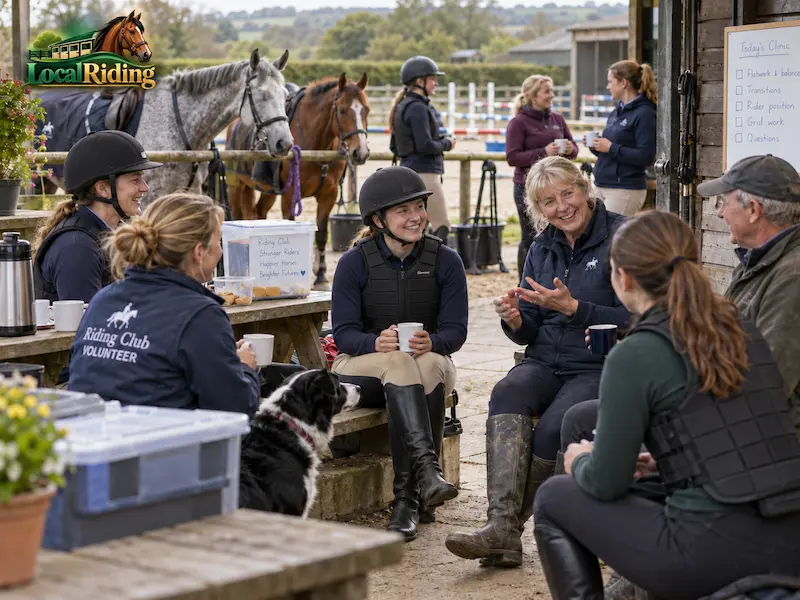 A riding club group teaching session in an outdoor arena
Because the club books a coach for several members, training can often be considerably more affordable than arranging an equivalent private clinic yourself.
2. A Support Network for Horse Owners
Horse ownership inevitably produces questions. Is your horse ready to move up a jumping level? Is a particular behaviour a schooling issue or something worth investigating? Which local venues are suitable for a nervous horse? Where can you find a reliable transporter, saddler, instructor or arena?
A good riding club cannot replace a vet, farrier, qualified saddle fitter or other professional, but it can provide an enormous pool of local knowledge.
For a first-time owner in particular, having experienced horse people nearby can make ownership considerably less isolating.
3. Friendly Competition
Many clubs run their own competitions where riders can gain experience without immediately entering the more formal world of affiliated competition.
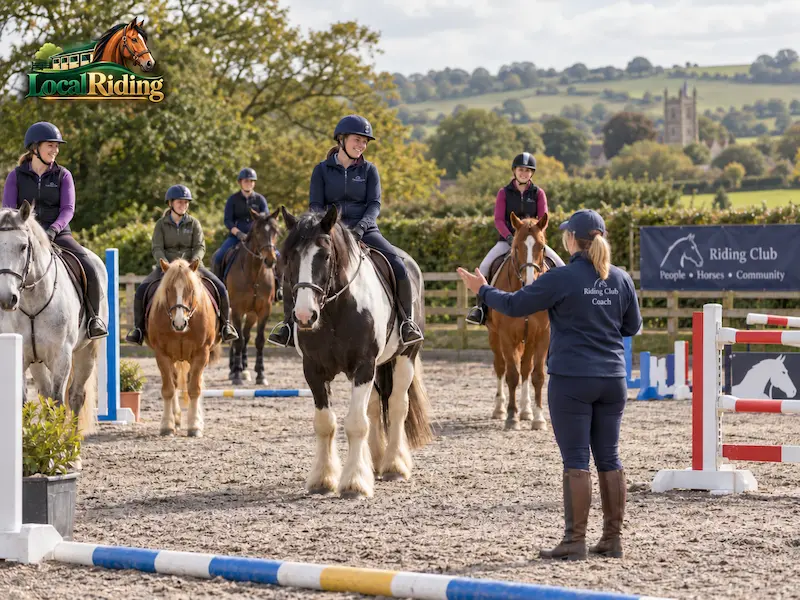 A riding club group jumping lesson
Typical club competitions can include:
- introductory and preliminary dressage;
- dressage to music;
- showjumping at a range of heights;
- clear-round jumping;
- arena eventing;
- combined training;
- horse trials;
- showing;
- team competitions;
- online dressage leagues;
- fun rides and challenges.
For horses that need confidence or riders returning to competition after a break, the atmosphere can be a very useful stepping stone.
4. Team Competition
There is something rather different about competing as part of a riding-club team rather than solely for yourself.
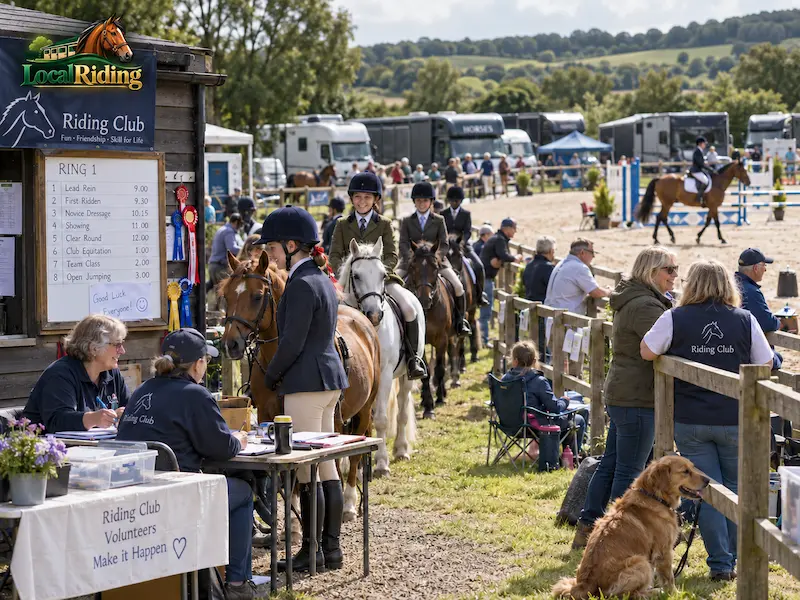 Riders attending a riding club show
British Riding Clubs operates Area qualifiers around the country leading towards national championships. Current BRC competition programmes include dressage from introductory level upwards, showjumping, arena eventing, horse trials, combined training and combined challenge classes.
That creates a genuine progression route while retaining the community atmosphere of representing your local club.
5. Education Beyond Riding
Some of the most useful club activities take place without anyone getting into the saddle.
Clubs may organise talks and demonstrations involving:
- equine nutrition;
- first aid;
- lameness;
- saddle fitting;
- farriery;
- dentistry;
- pasture management;
- loading and travelling;
- horse fitness;
- veterinary topics;
- equine behaviour;
- stable management.
These are particularly useful for owners trying to improve their overall horsemanship rather than simply their riding.
6. Social Contact
Horse ownership can be surprisingly solitary. Early mornings, winter evenings and long hours at the yard do not always fit neatly into normal social life.
Riding clubs bring together people who already share that lifestyle.
Friendships develop through training sessions, competitions, volunteering, course building, scoring, fence judging and the inevitable hours spent drinking tea while waiting for the next class.
British Riding Clubs: The Main Adult Club Network
British Riding Clubs (BRC) is part of The British Horse Society but individual affiliated clubs retain their own identities and local character.
The network extends across Great Britain and Northern Ireland and includes hundreds of clubs and centres.
Membership benefits vary between the national organisation and the individual club, but BRC currently provides members with access to club, Area and national competition, training and other membership benefits.
BRC membership also provides public liability insurance while members are taking part in affiliated BRC-organised activities. Owners should not confuse this with comprehensive personal, horse or general third-party insurance for every circumstance; check the current policy wording and maintain any separate cover appropriate to your needs.
BRC Competitions
BRC currently operates six national championship programmes covering winter and summer competition.
Disciplines include:
- dressage;
- showjumping;
- arena eventing;
- horse trials;
- combined training;
- combined challenge.
There are also grassroots opportunities and online competitions, so joining BRC does not mean you have to be jumping large fences or riding advanced dressage.
The Pony Club: Not Just for Small Children and Ponies
The Pony Club remains one of the most important training organisations in British equestrianism, but there are two common misconceptions about it.
First, members do not necessarily need to own a pony. Pony Club Centre membership allows young riders without their own horse or pony to participate through participating riding centres.
Second, Pony Club is not restricted to young children. Membership is currently available until the day before a member's 26th birthday.
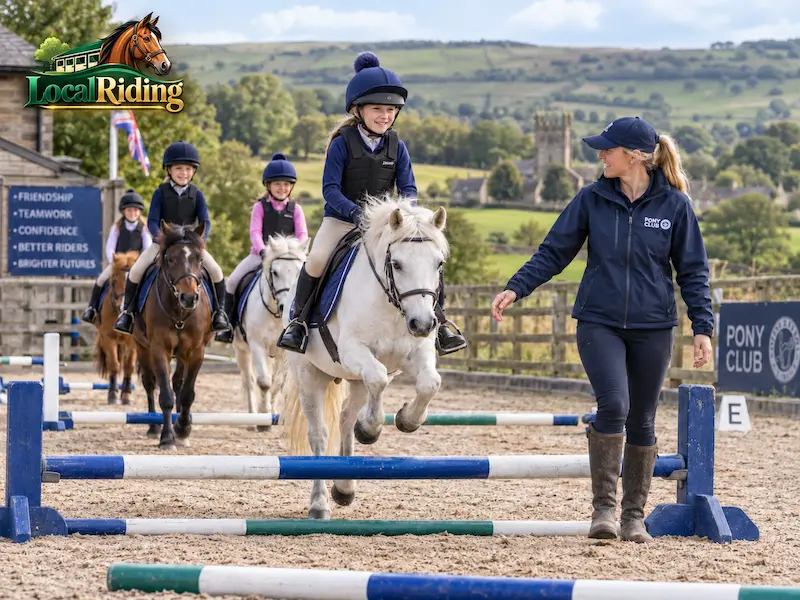 A Pony Club group jumping lesson
Membership routes include Branch Riding, Branch Non-Riding, Centre and Centre Plus membership.
The training pathway combines riding with horse care, achievement badges, tests and awards, and members can participate in disciplines including:
- dressage;
- showjumping;
- eventing;
- endurance;
- mounted games;
- polocrosse;
- polo;
- pony racing;
- tetrathlon.
For young horse owners, it can provide exactly the mixture of riding instruction, horsemanship and structured progression that is difficult to reproduce through lessons alone. If you are weighing up the costs of a first pony alongside club membership, our First Pony Budget Calculator can help you plan.
Do I Need My Own Horse to Join a Riding Club?
It depends on the club and activity.
Many conventional riding-club training sessions and competitions assume that you have your own horse, loan horse or another horse available to ride.
However, joining a club can still be worthwhile even if you are temporarily without a horse. Some clubs allow social or non-riding membership and need volunteers for almost every event they run.
For riders under Pony Club age limits, Pony Club Centres offer a particularly useful route for those who do not own a horse or pony.
What Should You Look for in a Riding Club?
The nearest club is not automatically the best club for you.
Before joining, look at its calendar and ask yourself whether its programme matches what you actually want to do.
Consider:
- How far are its usual training venues from your yard?
- Does it offer your preferred discipline?
- Does it cater for your current level?
- Are nervous or novice riders welcome?
- Are there clinics suitable for young or inexperienced horses?
- Does it organise hacking, pleasure rides or non-competitive events?
- Does it send teams to BRC Area competitions?
- How frequently does it hold training?
- What does membership cost?
- Are members expected to volunteer?
- Does it have junior as well as senior membership?
- Does the atmosphere feel supportive?
A small friendly club with the right programme may be much more useful to you than a large club whose activities do not match your horse or ambitions.
UK Riding Clubs by County and Region
The directory below is intended to help owners discover what exists around them. BRC formally divides its affiliated clubs into 23 Areas, and those Areas do not always follow modern county boundaries. Some clubs also serve riders from two or three neighbouring counties.
Consequently, treat the county headings as a practical LocalRiding guide rather than a statement of an individual club's formal geographical boundary. Search by county or club name, or open a county to browse its clubs.
289 clubs across England, Wales, Scotland and Northern Ireland. Open a county to see its clubs.
England
Wales
Scotland
Northern Ireland
Directory based principally on the 2026 British Riding Clubs affiliated-club list. Clubs change — always confirm current details with the British Horse Society's Find a Riding Club service or the club itself before travelling or joining.
Pony Club Branches Around the UK
If you are under 26, it is also worth looking beyond conventional riding clubs and checking your nearest Pony Club Branch or Centre.
The Pony Club operates through 19 geographical Areas and has a large network of local Branches and riding-school-based Centres.
Examples of Branches around the country include:
- Angus;
- Bennachie;
- Caithness;
- Deeside;
- Fife Hunt;
- Inverness-shire;
- Moray & Nairn;
- Strathearn;
- Albrighton Hunt;
- North Shropshire Hunt;
- South Staffordshire Hunt;
- Warwickshire Hunt;
- Brecon & Talybont Hunt;
- Crickhowell & District;
- Monmouthshire;
- Ashford Valley;
- East Kent Hunt;
- East Sussex;
- Mid Surrey;
- Romney Marsh;
- West Kent;
- South Berkshire;
- Hampshire Hunt;
- Isle of Wight;
- Wokingham;
- Amman Valley & District;
- Carmarthen Bay;
- Gogerddan;
- Llandeilo & District;
- Pembrokeshire Hunt;
- Swansea & District;
- Tivyside;
- East Antrim;
- East Down;
- Fermanagh Harriers;
- Mid Antrim;
- North Down;
- Seskinore Harriers.
Pony Club Centres are equally worth investigating if you do not own a pony, because they allow riders to take part through participating riding schools.
How to Join a Riding Club
Joining is normally straightforward.
- Search your postcode. Use the current British Riding Clubs finder rather than relying solely on county boundaries.
- Look at several clubs. Compare their calendars, training venues and disciplines.
- Contact the membership secretary. Ask what level of rider the club caters for and where most activities take place.
- Check the membership year and fee. Individual clubs set their own fees and arrangements.
- Ask about volunteering. Some clubs require or strongly encourage members to help at events.
- Join before entering member-only activities. Competition eligibility and insurance arrangements may depend upon current membership.
Your Horse Does Not Need to Be a Competition Horse
This point deserves emphasising.
A riding club shouldn't be regarded simply as somewhere for accomplished competition riders.
A cob that enjoys poles, an older horse returning to work, a young horse needing outings, a happy hacker trying its first dressage test and a serious event horse can all potentially benefit from the right club.
What matters is finding a club whose programme fits the horse and rider.
Getting the Most from Your Membership
Attend Training Regularly
It is easy to pay the annual subscription and then only appear for competitions. The greatest value often comes from regular training.
A coach who sees you more than once can help identify patterns rather than simply fixing whatever happens in one particular lesson.
Volunteer
Riding clubs could not function without volunteers.
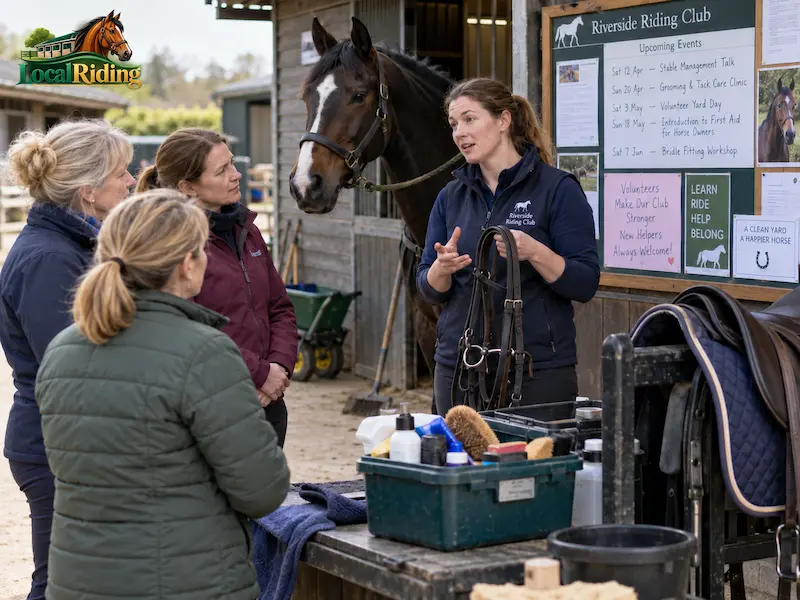 An instructor briefing riding club volunteers at a show
Helping at an event may involve:
- setting up arenas;
- pole picking;
- warm-up stewarding;
- writing for a dressage judge;
- scoring;
- checking competitors in;
- fence judging;
- course building;
- collecting score sheets;
- helping with refreshments.
It is also one of the quickest ways to get to know other members.
Try Something New
If you normally do dressage, try a pole clinic. If you normally jump, attend a flatwork session. If you compete regularly, go on a pleasure ride.
One advantage of club membership is that it creates relatively low-pressure opportunities to experiment.
Represent Your Club
If your club enters BRC teams, consider putting your name forward.
You do not necessarily need to be the strongest rider in the club. Different competitions have different levels, and grassroots classes exist specifically to make organised competition more accessible.
Use the Human Network
Perhaps the greatest benefit is the least formal one.
Talk to people.
Ask about local hacking. Ask which venues have good parking. Find out where people school cross-country. Learn which clinics other owners have found useful.
Local equestrian knowledge is extraordinarily valuable and much of it is never published online.
Online Equestrian Communities
Facebook groups, local WhatsApp groups, forums and other online communities can complement a physical riding club very effectively.
They can be useful for:
- finding local events;
- buying and selling tack;
- finding transport;
- sharing road and bridleway information;
- locating services;
- finding training partners;
- hearing about clinics and cancellations.
However, online advice deserves caution. A confident social-media answer is not necessarily a correct one.
Questions involving illness, lameness, medication, nutrition, saddle fit or welfare should be directed to the appropriate qualified professional where necessary.
Riding Clubs Are About More Than Rosettes
Competition is an important part of the riding-club movement, but it is not really what makes clubs valuable.
The real strength lies in bringing horse people together.
A good club gives an inexperienced rider somewhere safe to learn. It gives an established rider fresh goals. It gives a new horse useful outings. It gives owners people to call when they need local knowledge. It gives volunteers a way of remaining involved with horses even when they are not riding.
And, perhaps most importantly, it turns what can sometimes be a very individual sport into a community.
If you have never joined your local riding club, search around rather than assuming there is only one option. Many parts of Britain have several clubs within travelling distance, each with a different character, programme and membership.
The best riding club is not necessarily the nearest or the biggest. It is the one that makes you want to take part.
Useful Official Resources
- British Riding Clubs: use the British Horse Society's Find a Riding Club service to search by location and distance.
- BRC Area information: useful if you want to understand Area qualifiers and the competition structure in your region.
- The Pony Club: use its Find a Pony Club service to search for local Branches and Centres.
- LocalRiding: browse our guides and tips for more practical horse-owner information, from feeding and hoof care to buying, budgeting and competing.
Club names and affiliation can change. The directory in this article is intended as a discovery guide rather than a substitute for the current official British Riding Clubs or Pony Club directories. Check current membership, venues and activity programmes directly before travelling.
Debbie Irwin
Livery Yard Manager & Equestrian Professional
Debbie has run professional showing yards and mixed livery yards in Lincolnshire and Essex for over 30 years. She has competed and taught at various levels. She writes about practical horse health, yard life, livery and everyday horse health and management.
Support Debbie on Ko-fi ☕Found this guide helpful? LocalRiding is run independently without ads. If you'd like to chip in towards the site's upkeep, you can buy Debbie a hot drink on a cold day on Ko-fi, she'll really appreciate it.