
Ownership
Horse Trailer and Transport Guide for UK Horse Owners
Transporting your horse safely is a vital skill for every UK horse owner. This guide covers trailers, lorries, and everything you need to know about moving horses on UK roads.
By Debbie Irwin · 7 April 2026 · 13 min read
Transporting your horse safely is an essential skill for many UK horse owners. Whether you are travelling to the vet, a lesson, a competition, a fun ride or a new yard, good preparation protects your horse, your vehicle, your passengers and other road users.
This guide covers the key choices between trailers and horse lorries, current UK towing rules, loading and unloading, journey planning, welfare checks, essential kit and what to do in an emergency.
Trailer or horse lorry: which is best?
The right transport depends on your budget, driving licence, vehicle, number of horses, journey length, storage, maintenance costs and how often you travel.
Horse trailer
A horse trailer is often the most economical option for UK owners who travel occasionally or regularly with one or two horses. It requires a suitable towing vehicle and good reversing, hitching and towing skills.
Advantages of a trailer
- Usually cheaper to buy than a horsebox or lorry
- Lower running costs when used occasionally
- Can be stored separately from the towing vehicle
- Useful for one or two horses
- Often easier to maintain than a larger lorry
Disadvantages of a trailer
- Requires a suitable towing vehicle
- Can be affected by wind, road camber and poor loading balance
- Reversing and manoeuvring take practice
- Limited space for tack, equipment and people
- Some horses travel better in a lorry than a trailer
Horse lorry or horsebox
A horsebox or lorry can be more convenient for frequent travel, competition days and longer journeys. It may offer more space, better storage, living facilities and easier access to the horses, depending on the design.
Advantages of a lorry
- Often more stable and spacious for longer journeys
- May include tack storage, changing space or living area
- No separate towing vehicle required
- Can be easier for some horses to load into
- Useful for regular competitors or multi-horse households
Disadvantages of a lorry
- Higher purchase price and maintenance costs
- Insurance, tax, plating, MOT or inspections may be more complex
- May require a different licence category depending on weight
- Can be harder to park and store
- Older vehicles may need careful mechanical checks
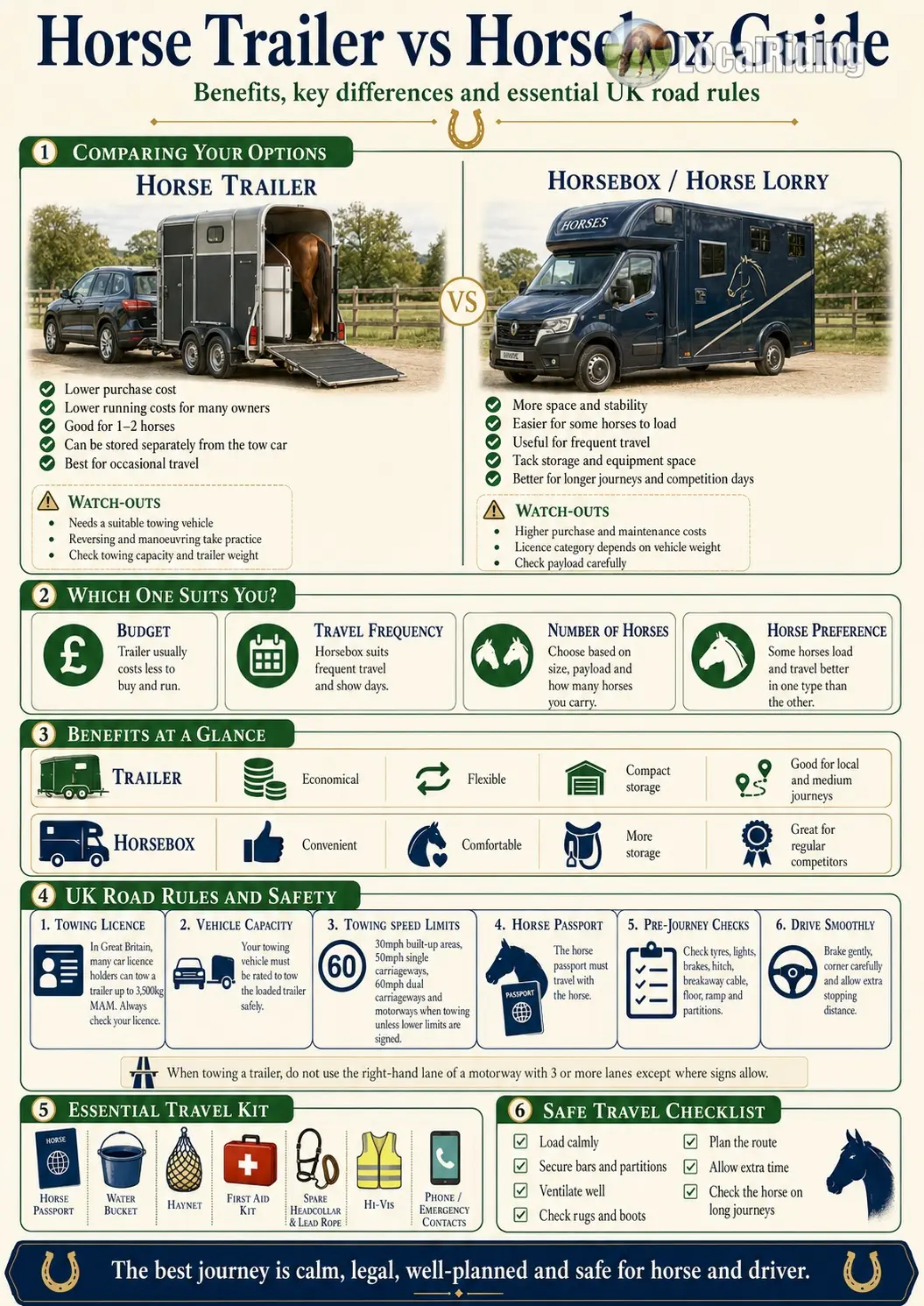 Horse trailer vs horsebox guide infographic: comparing options, which suits you, benefits at a glance, UK road rules and safety, essential travel kit and a safe travel checklist
Horse trailer vs horsebox at a glance — benefits, key differences, UK road rules and the essential kit for safe travel.
UK towing regulations for horse trailers
Older advice often says that drivers who passed their test after 1 January 1997 need an additional trailer test. That is now outdated for many drivers in Great Britain.
Current GOV.UK guidance states that drivers who got their licence from 1 January 1997 can tow a trailer up to 3,500kg MAM, known as a category BE vehicle. If category BE is not shown on your physical licence, DVLA will add it when you renew.
Drivers who passed before 1 January 1997 can usually drive a vehicle and trailer combination up to 8,250kg MAM, but you should always check your own licence categories because individual entitlements can vary. GOV.UK's horsebox and trailer guidance gives the pre-1997 and post-1997 position for horse transport owners.
Important towing terms
- MAM: Maximum Authorised Mass. This is the maximum legal weight of the vehicle or trailer when fully loaded.
- Gross trailer weight: The actual loaded weight of the trailer, including horse, tack, water, hay, equipment and partitions.
- Towing capacity: The maximum weight your vehicle is approved to tow. This is set by the vehicle manufacturer.
- Noseweight: The downward force the trailer puts on the towball. This must be within the vehicle and towbar limits.
- Payload: How much weight can be carried after allowing for the unladen weight of the trailer or lorry.
Legal is not always safe
Even if your licence allows you to tow, you must still make sure the combination is safe, legal and suitable. Check:
- Your driving licence categories
- Your vehicle's towing capacity
- The trailer's plated MAM
- The actual loaded weight of horse, trailer and equipment
- Tyre condition and pressures
- Trailer brakes, lights and breakaway cable
- Insurance cover for towing
- Whether you have enough experience to tow safely
If you are new to towing, professional trailer training is strongly recommended even where it is not legally required.
Driving licence rules for horse lorries
Horsebox licence requirements depend on the vehicle's weight and your licence entitlements. Many small horseboxes are plated at 3.5 tonnes, while larger lorries may require C1, C, C1E or other entitlements.
Always check the plated weight of the horsebox and your own licence before driving. Do not assume a "small" horsebox has enough payload for two horses, passengers, fuel, water, tack and equipment. Payload is one of the most common safety issues with 3.5-tonne horseboxes.
Horse welfare and legal documents
GOV.UK states that horses must not be transported in a way that may cause harm or distress, and that a horse passport must travel with the horse, pony or donkey whenever it is transported.
Carry these documents and details
- Horse passport
- Owner and emergency contact details
- Vet contact details
- Insurance information
- Breakdown cover details
- Competition, clinic or yard address
- Any relevant health or medication information
If you transport horses as part of a business or economic activity, additional welfare-in-transport rules may apply. GOV.UK guidance says transporter authorisation is required for certain journeys over 65km as part of an economic activity, and vehicle approval is required for some longer journeys.
Choosing safe horse transport
Whether you use a trailer or lorry, the horse area must be safe, strong, well-ventilated and suitable for the size and type of horse.
Check the horse area
- Solid floor with no rot, weakness or soft patches
- Good grip underfoot
- Secure partitions
- Safe breast bars and breech bars
- No sharp edges, protruding bolts or broken fittings
- Adequate headroom and width
- Good ventilation without strong draughts
- Working lights inside and outside
- Ramp or step-up suitable for the horse
- Doors and ramps that fasten securely
Check floors regularly, especially in older trailers and lorries. A weak floor is a serious safety risk.
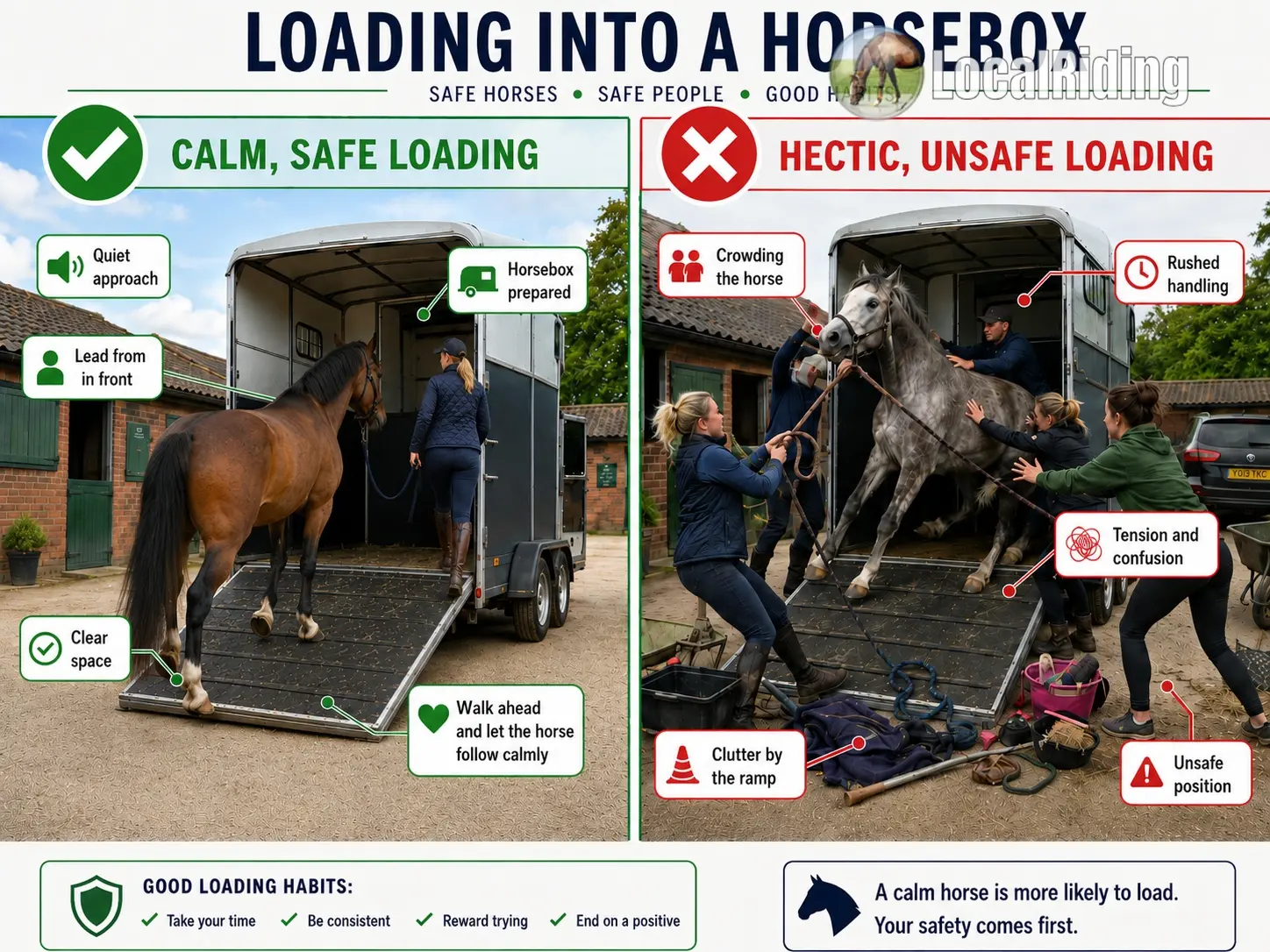 Side-by-side comparison of calm, safe loading into a horsebox versus hectic, unsafe loading with a crowded, rushed horse
Calm, well-prepared loading versus a rushed, crowded approach — a relaxed horse is far more likely to load safely.
Preparing your horse for travel
Loading should be trained before the day you need to travel. Do not wait until an emergency vet trip or competition morning to discover your horse is worried about the trailer.
Loading practice
- Start with short, calm sessions in a safe area.
- Let the horse investigate the ramp or step without pressure.
- Reward calm steps towards the vehicle.
- Practise walking on and backing off before closing partitions.
- Build up to standing quietly inside.
- Practise with the ramp closed only when the horse is settled.
- Take short journeys before attempting longer travel.
A horse who loads calmly is safer for everyone. If your horse panics, rushes backwards, rears, spins or becomes dangerous, get help from an experienced trainer or behaviour professional.
Loading and unloading safely
Loading and unloading are high-risk moments. Plan the process and avoid rushing.
Before loading
- Park on level, firm ground where possible.
- Apply the handbrake and switch off the engine if appropriate.
- Open doors, ramps and partitions safely.
- Check the ramp surface is not slippery.
- Make sure haynets, partitions and breast bars are secure.
- Put on travel boots or bandages if your horse is used to them.
- Use a well-fitted headcollar and suitable lead rope.
- Wear gloves, hat and sturdy footwear.
During loading
- Keep the area quiet and clear.
- Use calm, confident handling.
- Do not stand directly behind the horse.
- Do not wrap the rope around your hand.
- Load the most difficult or largest horse first if travelling two, unless your vehicle layout requires otherwise.
- Secure the partition, breast bar and breech bar before tying short enough to prevent turning, but not so short the horse cannot balance.
Unloading
- Check the area behind the ramp is clear.
- Untie only when the breech bar, ramp or partition arrangement makes it safe to do so.
- Use two competent people where possible.
- Back the horse down slowly if using a rear unload trailer.
- Give the horse time to adjust before walking away.
Should horses travel facing forward, backward or herringbone?
Different transport designs allow horses to travel forward-facing, rear-facing or herringbone. Many horses travel well in different positions, while some have clear preferences. The most important factors are space, balance, ventilation, secure partitions, good driving and calm training.
In a standard two-horse trailer, horses usually travel facing forward. In some lorries, they may travel herringbone or rear-facing. Watch how your horse travels and adjust within the limits of your vehicle design and safety standards.
What should your horse wear for travel?
Travel gear should protect the horse without causing overheating, rubbing or panic.
Common travel equipment
- Well-fitted headcollar
- Travel boots or bandages if the horse is comfortable wearing them
- Tail guard or tail bandage
- Poll guard if needed and safe
- Light rug, cooler or no rug depending on temperature
- Fly rug or fly protection in warm weather if appropriate
Not every horse needs full travel boots. Some horses move more safely without bulky boots if they are not used to them. Introduce travel gear before travel day.
Bedding, grip and ventilation
Good footing helps horses balance. Rubber matting is common, but some bedding may still be useful to absorb urine and improve comfort.
Transport bedding options
- Rubber matting: provides cushioning and grip if in good condition.
- Shavings: absorb urine and can improve comfort, but avoid excessive dust.
- Paper bedding: lower dust option for some horses.
- Straw: less common in trailers but may be used in some lorries.
Ventilation should be good but not draughty. Horses can overheat in transport, especially in warm weather, traffic delays or when over-rugged.
Feeding and watering during travel
For many journeys, a small, safely tied haynet helps keep the horse occupied and supports normal gut function. Tie haynets high enough to avoid legs becoming caught, but not so high that the horse must strain.
Travel feeding tips
- Offer forage for longer journeys if safe to do so.
- Use a small-hole haynet if appropriate.
- Do not hang haynets where the horse could get a foot caught.
- Carry water, especially in warm weather or for journeys over an hour.
- Offer water at stops on longer journeys.
- Avoid large hard feeds immediately before travel.
Journey planning on UK roads
Driving with a horse on board takes more planning than driving a car. The British Horse Society notes that driving a horsebox or towing a trailer is very different from normal car driving because of the additional size and weight involved.
Plan your route to avoid:
- Low bridges
- Narrow lanes with poor passing places
- Steep hills where possible
- Unsuitable tracks or soft verges
- Sharp turns and awkward reversing points
- Busy town centres at peak times
- Roadworks and closures
Allow extra time for:
- Loading calmly
- Final safety checks
- Slower driving
- Rest breaks
- Possible delays
- Unloading and settling the horse on arrival
Driving safely with horses on board
A horse is a live passenger who must balance every time you accelerate, brake or turn. Smooth driving is one of the most important welfare measures.
Safe driving habits
- Accelerate gradually.
- Brake early and smoothly.
- Take corners slowly and wide.
- Leave a larger stopping distance.
- Avoid sudden lane changes.
- Drive below the limit where conditions require it.
- Be extra careful in wind, rain, ice or poor visibility.
- Watch for trailer sway.
- Stop safely if the horse becomes distressed or the vehicle feels unstable.
Practise driving the empty trailer or lorry before travelling a horse. Reversing, parking, hill starts and tight turns all feel different with a trailer or loaded horsebox.
Pre-journey vehicle and trailer checklist
Use a checklist before every journey, even short ones.
Vehicle and trailer checks
- Tyres, including spare, are legal and correctly inflated.
- Wheel nuts are secure.
- Lights and indicators work.
- Brakes are working.
- Breakaway cable is correctly attached.
- Towbar and hitch are secure.
- Number plate is correct and visible.
- Mirrors give adequate rear visibility.
- Ramp, doors and catches are secure.
- Partition, breast bar and breech bar are correctly fitted.
- Floor is sound and not slippery.
- Ventilation is set appropriately.
- Fuel or charge level is sufficient.
- Breakdown cover is valid for horse transport.
Essential kit to carry
- Horse passport
- Spare headcollar and lead rope
- First aid kit for horse and humans
- Water and bucket
- Hay or haynet
- Knife or safety cutter
- Torch or headtorch
- Hi-vis vest or jacket
- Gloves
- Spare rug or cooler
- Basic tools
- Spare fuses and bulbs if appropriate
- Phone charger or power bank
- Emergency contacts
- Breakdown membership details
Long journeys and welfare stops
For longer journeys, plan stops where you can check the horse safely. Do not unload in unsafe areas such as motorway services unless absolutely necessary and only if it is safe and appropriate.
At safe stops, check:
- The horse is standing normally.
- The horse is not sweating excessively.
- Ventilation and temperature are comfortable.
- Travel boots or bandages have not slipped.
- Haynet and water arrangements are safe.
- Partitions and bars remain secure.
- The vehicle and trailer are still roadworthy.
For long commercial or economic journeys, additional welfare rules may apply, including authorisations, competence certificates and vehicle approval. Check current GOV.UK and APHA guidance before travelling.
Travelling in hot or cold weather
Hot weather
- Travel at cooler times of day if possible.
- Increase ventilation safely.
- Avoid over-rugging.
- Carry extra water.
- Allow for traffic delays.
- Monitor sweating and breathing.
Cold weather
- Use appropriate rugs without overheating the horse.
- Check road conditions before travelling.
- Avoid ice, snow and high winds where possible.
- Keep the horse dry before loading.
- Use safe bedding for grip and comfort.
What to do if your horse travels badly
Poor travelling can have many causes, including pain, fear, poor balance, unsuitable transport, bad previous experiences, noise, lack of space, overheating or rough driving.
Signs your horse may be struggling
- Scrambling or slipping
- Repeated kicking or pawing
- Sweating heavily
- Calling, trembling or panicking
- Refusing to load next time
- Arriving stiff, sore or distressed
- Leaning heavily on partitions
- Damage to boots, rugs or vehicle fittings
If this happens, do not simply force more journeys. Investigate the cause. Consider veterinary checks, saddle/back checks if soreness appears after travel, different partition arrangements, improved driving, trailer camera footage, professional loading help or a different vehicle layout.
Emergency planning
Every journey should have a contingency plan.
In an emergency:
- Stop only where it is safe to do so.
- Put on hi-vis before leaving the vehicle.
- Call breakdown assistance that covers horse transport.
- Call the police if you are in a dangerous location or blocking traffic.
- Call your vet if the horse is injured, distressed or unwell.
- Do not unload on a motorway or dangerous roadside unless instructed by emergency services and it is safe.
- Keep yourself and other people safe first.
Quick transport checklist
- Check your licence, vehicle and trailer weights.
- Check insurance and breakdown cover.
- Inspect tyres, brakes, lights, hitch and floor.
- Carry the horse passport.
- Load calmly and secure partitions, bars and ramps.
- Drive smoothly, allowing extra stopping distance.
- Carry water, forage, first aid kit and emergency contacts.
- Check the horse safely on longer journeys.
- Unload calmly and monitor the horse after arrival.
Frequently asked questions
Can I tow a horse trailer on a normal car licence?
In Great Britain, GOV.UK guidance states that drivers who got their car licence from 1 January 1997 can tow a trailer up to 3,500kg MAM. Drivers who passed before 1 January 1997 can usually drive a vehicle and trailer combination up to 8,250kg MAM. Always check your own licence categories, your vehicle towing capacity and the trailer's plated weight.
Do I need my horse's passport when travelling?
Yes. GOV.UK states that the horse passport must be kept with the horse, pony or donkey whenever it is transported.
Is a trailer or lorry better for a nervous traveller?
It depends on the horse. Some travel better in a lorry because it feels more stable or spacious; others are happy in a trailer. Consider loading design, space, direction of travel, ventilation, partition setup and driving style.
Can I travel a horse alone?
You can travel alone if it is legal and safe, but it is often better to have a competent helper, especially with inexperienced horses, long journeys or difficult loaders. If travelling alone, plan how you will check the horse safely.
How often should I check my trailer?
Do basic safety checks before every journey and arrange regular professional servicing. Pay particular attention to tyres, brakes, hitch, lights, floor, ramp, partitions and breakaway cable.
Should I unload my horse during a long journey?
Only unload where it is safe and planned. Many roadside locations are unsuitable. For some journeys, it may be safer to check the horse on board rather than unload in an unfamiliar or dangerous place.
Final advice
Safe horse transport is about more than owning a trailer or lorry. It involves legal checks, vehicle maintenance, calm loading, thoughtful route planning, smooth driving and constant attention to your horse's welfare.
The best journey is calm, legal, well-planned and uneventful — with your horse arriving relaxed, safe and ready for what comes next.
Debbie Irwin
Livery Yard Manager & Equestrian Professional
Debbie has run professional showing yards and mixed livery yards in Lincolnshire and Essex for over 30 years. She has competed and taught at various levels. She writes about practical horse health, yard life, livery and everyday horse health and management.
Support Debbie on Ko-fi ☕Found this guide helpful? LocalRiding is run independently without ads. If you'd like to chip in towards the site's upkeep, you can buy Debbie a hot drink on a cold day on Ko-fi, she'll really appreciate it.