
Horse health
Horse Worm Control in the UK: Testing, Treatment, Parasite Life Cycles and Paddock Management
Modern UK worm control is testing-led, not calendar worming. Learn how faecal worm egg counts, targeted seasonal treatments, poo picking and quarantine protect your horse and slow wormer resistance.
By Debbie Irwin · 24 March 2026 · 11 min read
Updated UK guide: How to manage worms responsibly using faecal worm egg counts, targeted treatments, paddock hygiene and veterinary advice.
Why Worm Control Matters
Effective worm control is one of the most important parts of horse health management. Internal parasites can cause weight loss, poor coat condition, diarrhoea, colic, reduced performance, irritation, gut damage and, in severe cases, death. Youngstock, elderly horses, underweight horses and those with other health problems may be especially vulnerable.
However, modern worm control is no longer about giving every horse a wormer every few months “just in case”. Overuse of wormers has contributed to anthelmintic resistance, meaning some parasites are no longer reliably killed by products that used to be effective. This makes strategic, testing-led worm control essential on UK yards.
The aim is to protect horse health while preserving the effectiveness of wormers for the future. That means testing where possible, treating only when needed, using the correct active ingredient, dosing accurately, managing pasture well and working with your vet or suitably qualified person.
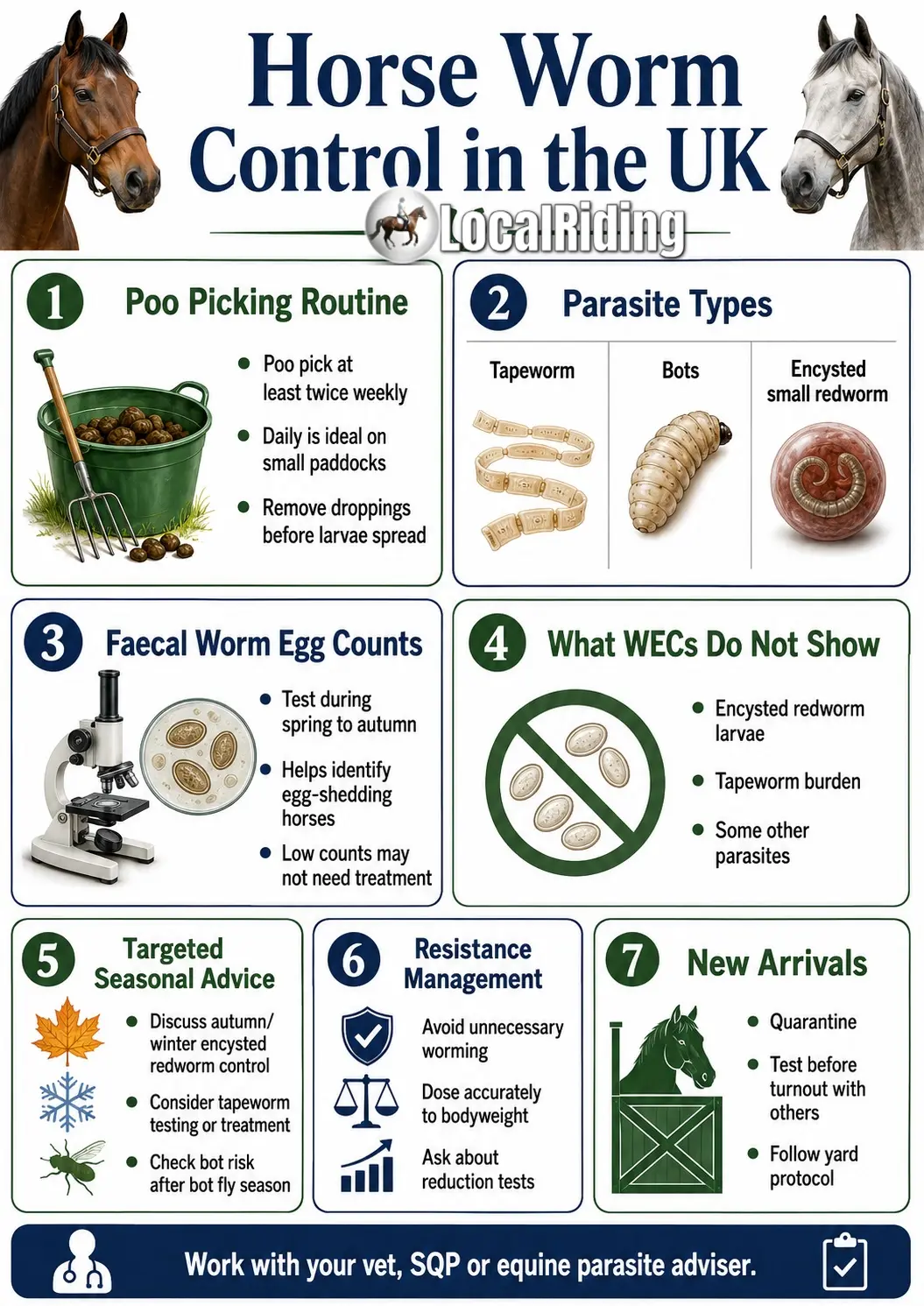 Horse worm control in the UK infographic covering poo picking routine, parasite types, faecal worm egg counts, targeted seasonal advice, resistance management and new arrival protocol
This Is Not Veterinary Advice
This article is for general information only and does not replace advice from your vet, SQP or qualified equine parasite adviser. Worming plans should be tailored to the individual horse, age group, yard, grazing system, test results, local resistance patterns and health history.
Understanding the Parasite Life Cycle
To manage worms properly, it helps to understand how parasites spread. Most equine worm problems are linked to the cycle between the horse, droppings and pasture.
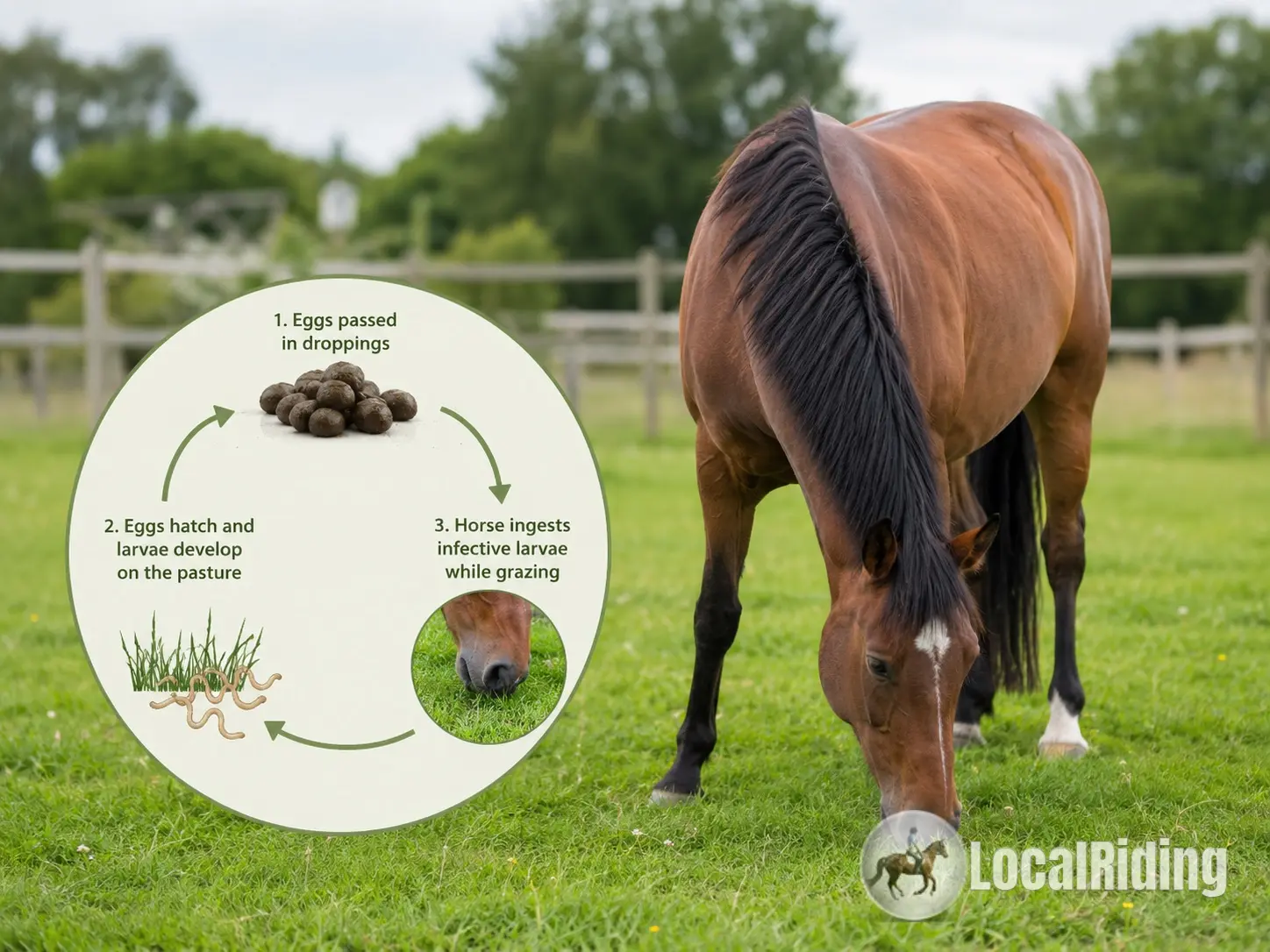 Diagram of the equine parasite life cycle showing worm eggs passed in droppings, larvae developing on pasture and a horse ingesting infective larvae while grazing
Small Redworm Life Cycle
Small redworms, also called cyathostomins, are among the most important parasites affecting UK horses. Adult worms live in the large intestine and produce eggs, which are passed out in droppings. On the pasture, these eggs hatch into larvae. Under suitable conditions, the larvae develop into an infective stage and move onto the grass. Horses then ingest the larvae while grazing.
Once swallowed, larvae develop inside the horse. Some small redworm larvae can burrow into the gut wall and become encysted. They may remain there for weeks or months before emerging. A mass emergence of encysted larvae can cause serious illness known as larval cyathostominosis, which may involve diarrhoea, weight loss, colic and severe debility.
A standard faecal worm egg count can detect eggs produced by adult egg-laying worms, but it does not reliably detect encysted small redworm larvae. This is why late autumn or winter risk assessment is important, even when egg counts are low.
Large Redworm
Large redworm used to be a major cause of serious disease in horses. Its larvae can migrate through blood vessels supplying the gut, causing damage and potentially severe colic. It is now less common in many managed UK horse populations, but it remains an important parasite to consider in poorly managed or untested groups.
Roundworm in Foals and Young Horses
Roundworm, or Parascaris, is most important in foals, weanlings and youngstock. Eggs are passed in droppings and can survive for long periods in the environment. Horses ingest infective eggs from contaminated surfaces or pasture. Larvae migrate through the liver and lungs before returning to the intestine to mature.
Heavy roundworm burdens can cause poor growth, coughing, a pot-bellied appearance, dull coat, weight loss and, in severe cases, intestinal blockage. Young horses need a different parasite control plan from adult horses, so veterinary guidance is particularly important.
Tapeworm
Tapeworms have an indirect life cycle involving forage mites. Tapeworm eggs are released onto pasture, mites ingest the eggs, and horses become infected when they accidentally eat infected mites while grazing. Adult tapeworms live around the junction between the small and large intestine and can be associated with colic and gut irritation.
Tapeworm is not reliably assessed by a standard worm egg count. Blood or saliva testing may be used, or treatment may be recommended based on risk and veterinary advice.
Pinworm
Pinworm usually causes irritation rather than serious internal disease. Adult female worms lay eggs around the anus, which can make the horse rub its tail and hindquarters. Worm egg counts may not reliably detect pinworm, so diagnosis may involve clinical signs or a sticky tape test.
Bot Fly Larvae
Bot flies lay yellowish eggs on the horse’s coat, often on the legs, shoulders or mane area. The horse licks or rubs the eggs, larvae enter the mouth, then migrate to the stomach. They later pass out in droppings to pupate in the ground. Bot treatment is usually considered seasonally and should be discussed with your vet or SQP.
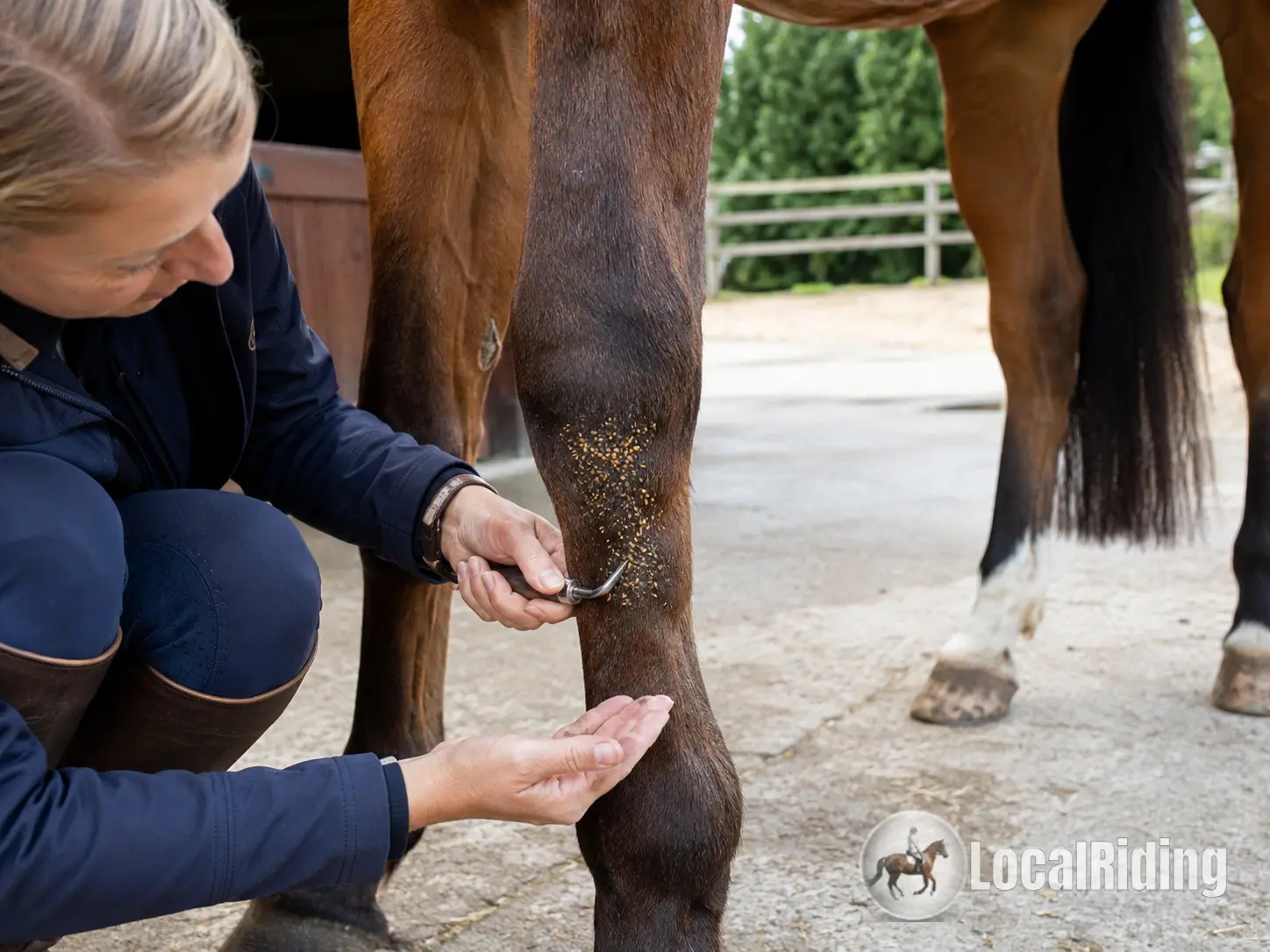 Horse owner removing yellow bot fly eggs from a horse's leg with a bot knife in a UK yard
The Role of Poo Picking in Worm Control
Regular poo picking is one of the simplest and most effective ways to reduce pasture contamination. Many worm eggs and larvae depend on droppings as part of their life cycle. Removing droppings from the field helps break that cycle before larvae spread onto the grazing.
Poo picking also keeps paddocks more palatable, reduces rough latrine areas, helps limit weeds and makes it easier to monitor droppings for changes in consistency or quantity. It is especially important on small UK paddocks, overstocked fields, livery yards and areas where horses graze the same ground for long periods.
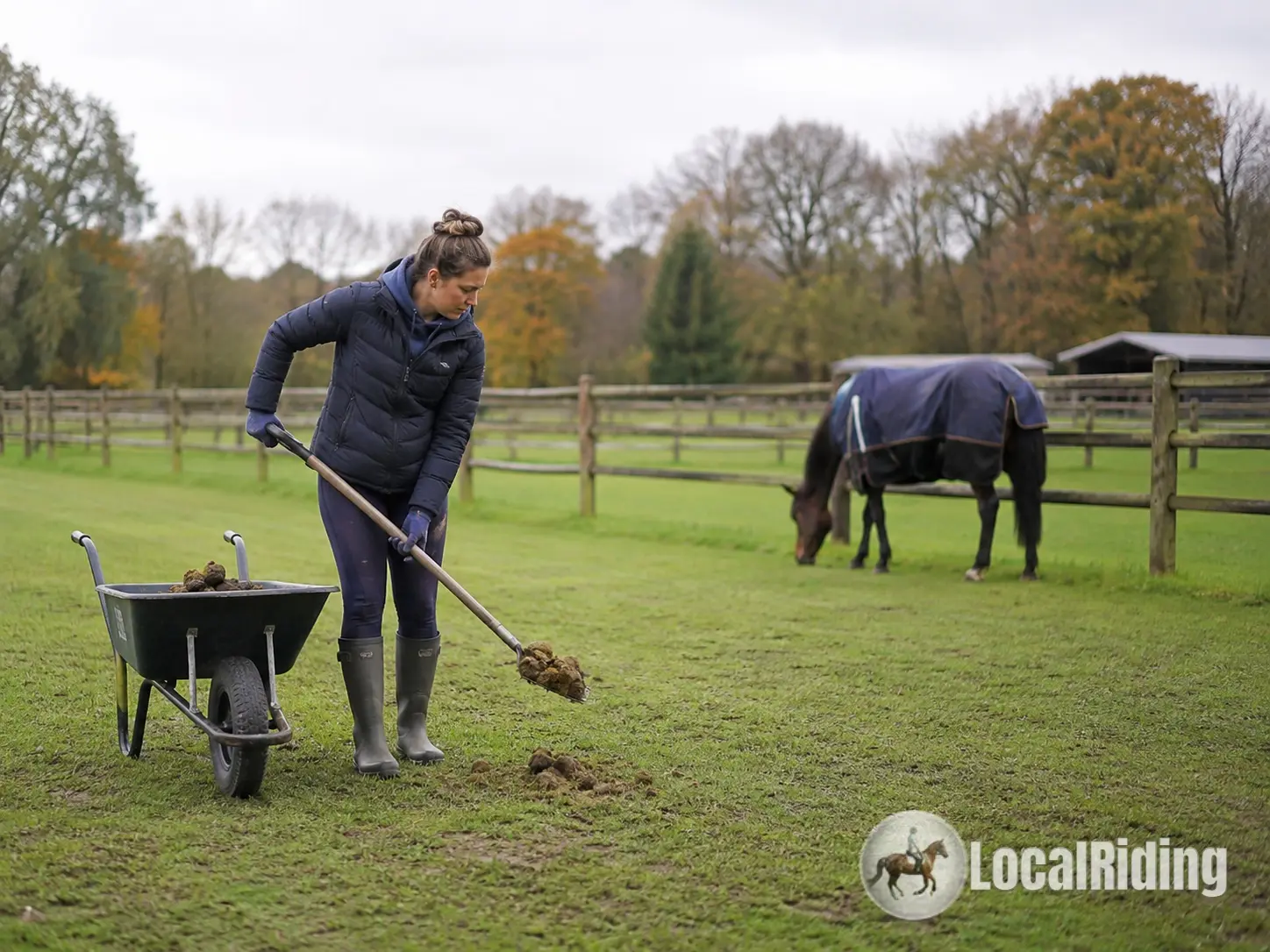 Horse owner poo picking a UK paddock with a wheelbarrow and fork while a rugged horse grazes behind
How Often Should Paddocks Be Poo Picked?
As a practical UK yard target, poo pick at least twice weekly, and ideally more often during mild, damp weather when larvae can develop and survive well. Daily poo picking is excellent where practical, especially in smaller paddocks or for horses with known parasite issues.
Good Paddock Hygiene Practices
- Poo pick regularly, especially in small or heavily grazed fields.
- Avoid overstocking paddocks.
- Rest and rotate grazing where land allows.
- Do not spread fresh horse manure back onto grazing land used by horses.
- Manage muck heaps carefully and keep them away from grazing areas.
- Co-grazing or alternate grazing with sheep or cattle may help in some setups, where safe and appropriate.
- Quarantine and test new arrivals before mixing them with the main herd.
Poo picking does not replace testing or treatment, but it reduces the number of infective larvae available to be eaten. It is a vital part of sustainable worm control.
Faecal Worm Egg Count Testing
The cornerstone of modern UK worm control is the faecal worm egg count, often called a FWEC, WEC or worm egg count. This test uses a small sample of fresh droppings to estimate how many worm eggs a horse is shedding.
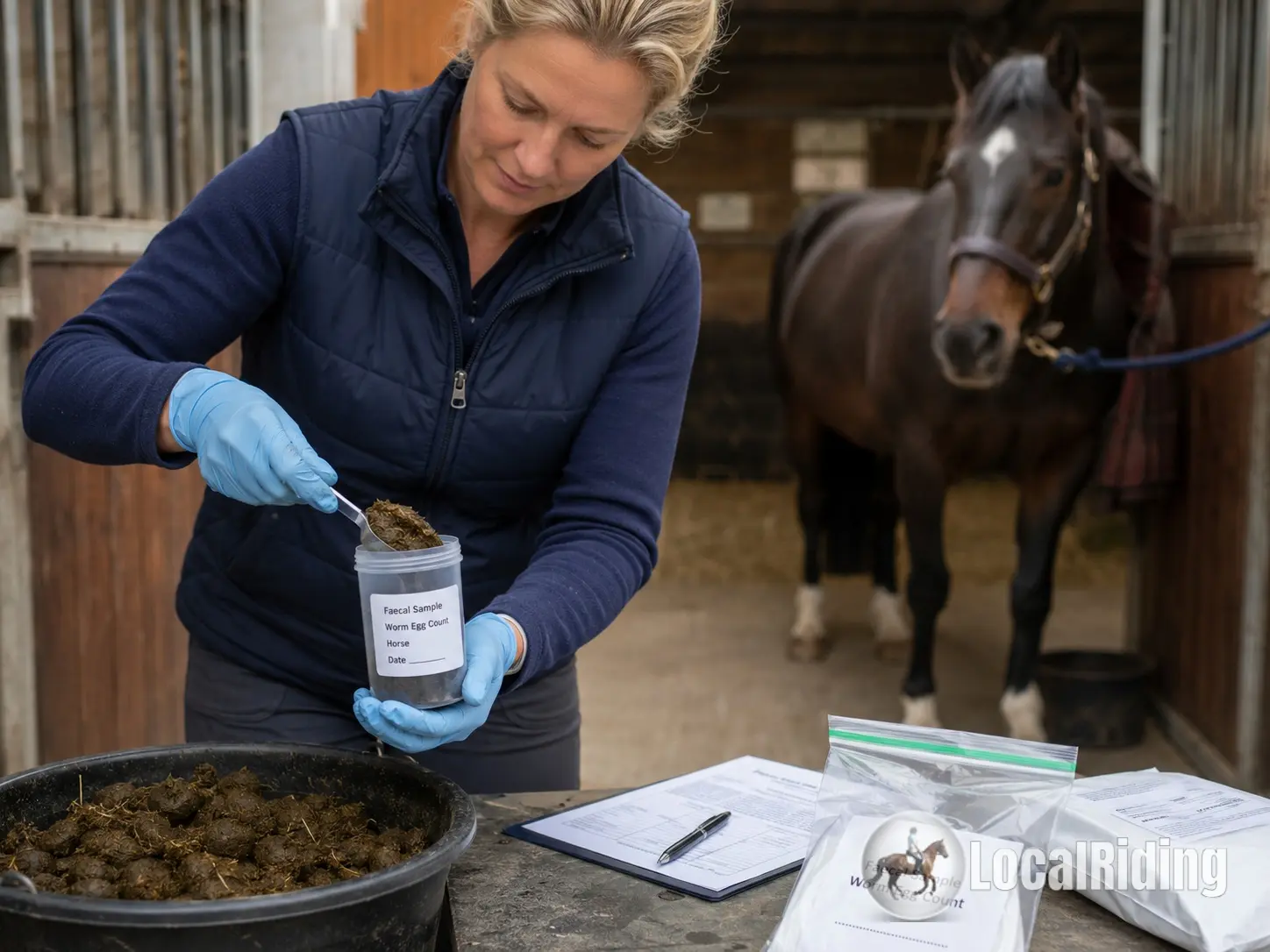 Horse owner collecting a fresh faecal sample into a labelled pot for a worm egg count test at a UK stable
Worm egg counts are most useful for detecting strongyle-type eggs, including small redworm eggs, and roundworm eggs. They help identify horses that are shedding higher numbers of eggs and contaminating the pasture.
How Often Should You Test?
Most adult horses should have worm egg counts during the grazing season, typically from spring to autumn. The exact testing frequency depends on the horse, yard risk, previous results, pasture management and veterinary advice. Many yards test approximately every 8–12 weeks during the main grazing season.
Understanding Egg Count Results
Thresholds vary slightly between laboratories and veterinary practices, but many UK programmes use a result of around 200 eggs per gram as a common treatment threshold for adult horses. A low result does not mean the horse has no worms at all; it means the horse is not shedding many detectable eggs at that time.
Do not interpret results in isolation. A young horse, new arrival, sick horse, poor doer or horse kept on high-risk pasture may need a more cautious approach than a healthy adult horse with a long history of low counts.
Limitations of Worm Egg Counts
- They do not reliably detect encysted small redworm larvae.
- They do not reliably assess tapeworm burden.
- They may not detect pinworm reliably.
- Egg shedding can vary between samples and over time.
- A low count does not guarantee the horse is completely parasite-free.
Worm egg counts are extremely useful, but they are one part of a wider parasite control plan.
Targeted Seasonal Worm Control
Modern worm control is based on targeted treatment rather than routine blanket worming. This means using test results, risk assessment and seasonal parasite knowledge to decide whether treatment is needed.
Spring and Summer
During the main grazing season, use worm egg counts to monitor strongyle and roundworm egg shedding. Treat horses with significant counts using a product recommended by your vet or SQP. Continue regular poo picking and pasture management to reduce reinfection.
Autumn
Autumn is a useful time to review the whole yard’s parasite programme. Consider worm egg counts, tapeworm testing, pasture risk, new arrivals, youngstock and whether any horses have had unexplained weight loss, colic or poor condition.
Late Autumn and Winter
Encysted small redworm risk is usually considered in late autumn or winter. Because standard worm egg counts do not detect encysted larvae, your vet or SQP may advise a specific treatment or risk-based approach. Moxidectin is commonly used for encysted small redworm, but it is a valuable active ingredient and should not be used unnecessarily.
Fenbendazole has historically been used as a five-day course for encysted larvae, but resistance is widespread in many areas. Use it only under professional advice, ideally where it is expected to be effective.
Tapeworm Control
Tapeworm should be managed separately from routine worm egg counts. Testing may involve saliva or blood tests, or treatment may be advised based on risk. Praziquantel is commonly used for tapeworm treatment, sometimes in combination products. Always choose products with professional guidance.
Bot Control
Bot treatment may be considered after the bot fly season, depending on local risk and visible bot eggs. Remove bot eggs from the coat where possible and discuss treatment timing with your vet or SQP.
Choosing Wormers: Active Ingredients Matter
Horse wormers should be chosen by active ingredient, not just brand name. Different products target different parasites, and using the wrong one may be ineffective or unnecessary.
Main Wormer Groups Used in Horses
- Benzimidazoles: Such as fenbendazole. Resistance is common in small redworm populations.
- Macrocyclic lactones: Such as ivermectin and moxidectin. These are important products and should be protected from overuse.
- Pyrimidines: Such as pyrantel. Used for some adult worm burdens and sometimes tapeworm at specific doses.
- Praziquantel: Used for tapeworm, often found in combination wormers.
Do not rotate wormers blindly. Old-fashioned rotation without testing can still lead to unnecessary treatment. Instead, choose the correct product for the parasite being targeted, based on testing and advice.
Anthelmintic Resistance: Why It Matters
Anthelmintic resistance occurs when worms survive treatment that should normally kill them. These surviving worms reproduce, passing resistant genes to the next generation. Over time, a yard can end up with parasite populations that are difficult to control.
Resistance is a serious issue because there are limited wormer classes available for horses and few new products being developed. Once resistance becomes established, it is difficult to reverse.
How to Reduce Resistance Pressure
- Use worm egg counts rather than routine blanket treatment.
- Treat only horses that need treatment, unless specific seasonal treatment is advised.
- Use the correct active ingredient for the target parasite.
- Dose accurately using a weight tape or weighbridge where possible.
- Avoid underdosing, which encourages survival of partially resistant worms.
- Check whether treatment has worked using faecal egg count reduction testing when advised.
- Maintain refugia — a population of worms not exposed to wormer — to slow resistance development.
Faecal Egg Count Reduction Testing
A faecal egg count reduction test checks whether a wormer has worked. It involves taking a worm egg count before treatment, treating with the chosen wormer, then repeating the count after a set interval. The reduction in egg count indicates how effective the treatment has been.
This is especially useful on yards where resistance is suspected, where horses continue to show high counts after treatment, or where a yard wants to build a more evidence-based parasite control programme.
Quarantine for New Horses
New arrivals are one of the biggest risks to a yard’s parasite control programme. A new horse may bring resistant parasites onto previously well-managed pasture.
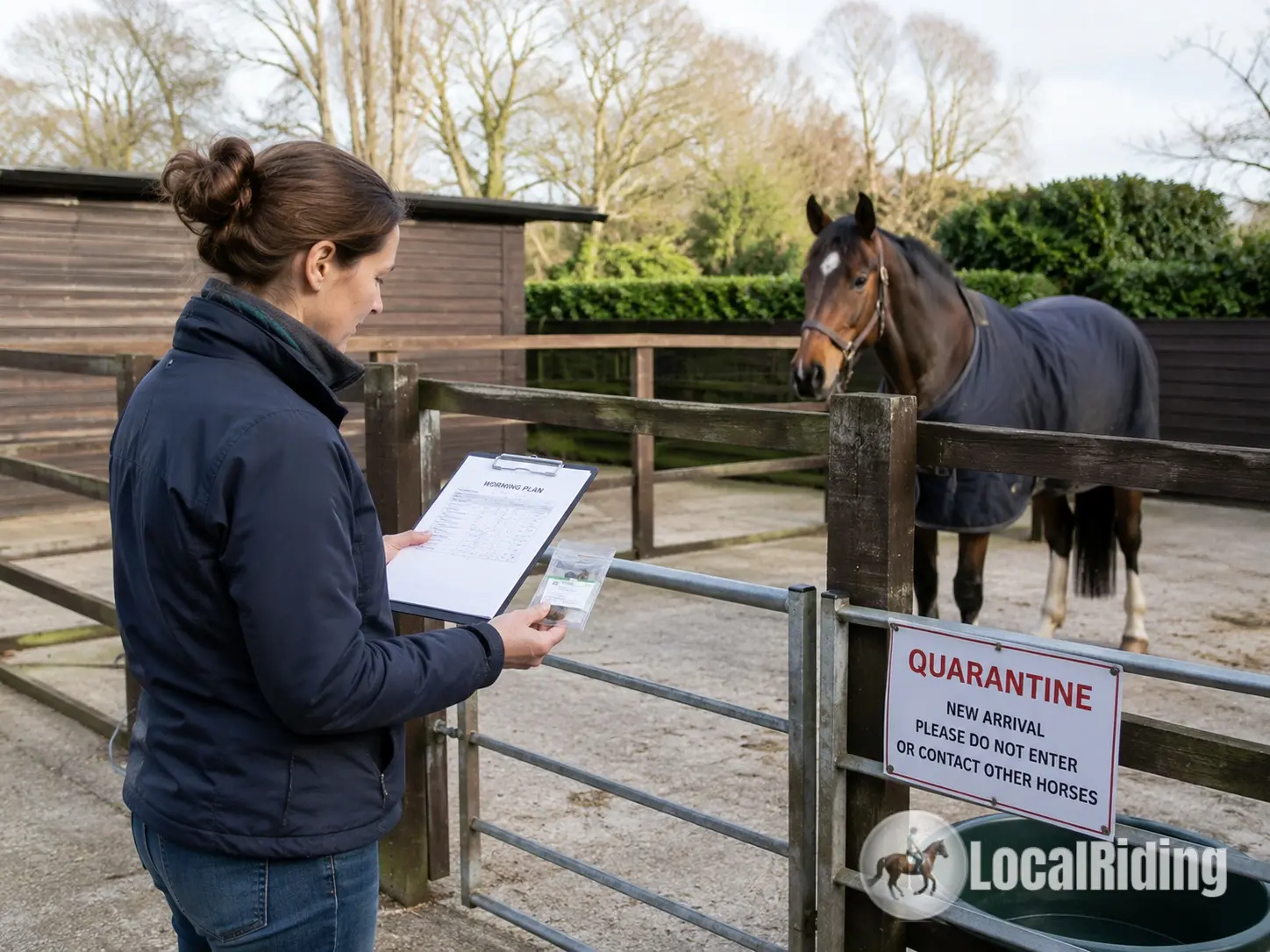 Yard manager reviewing a worming plan beside a quarantine pen holding a newly arrived horse at a UK livery yard
New Arrival Protocol
- Keep the new horse separate initially.
- Carry out a worm egg count.
- Discuss tapeworm and encysted redworm risk with your vet or SQP.
- Treat if advised.
- Perform a follow-up test if needed to confirm treatment effectiveness.
- Do not turn the horse onto shared grazing until parasite status has been considered.
Yard-Level Worm Control
Worm control works best when the whole yard follows a coordinated plan. One horse with a heavy worm burden can contaminate shared pasture and increase risk for others.
A Good Yard Plan Should Include
- Regular worm egg counts for all horses during the grazing season.
- Clear records of test results and treatments.
- Accurate weights for dosing.
- Poo picking at least twice weekly, ideally more often.
- Quarantine and testing for new arrivals.
- Tapeworm testing or risk-based control.
- Late autumn or winter planning for encysted small redworm.
- Professional advice from a vet, SQP or equine parasite adviser.
Consistency matters. A yard with regular testing, good records and clean paddocks is usually in a much stronger position than a yard relying on occasional blanket worming.
Common Worm Control Mistakes
- Worming without testing: This increases unnecessary wormer use and resistance pressure.
- Using the same wormer repeatedly: This can encourage resistant parasite populations.
- Underdosing: Guessing weight often leads to giving too little product.
- Ignoring paddock hygiene: Dirty paddocks increase reinfection risk.
- Not testing new arrivals: New horses can introduce resistant worms.
- Assuming low WEC means no worm risk at all: Encysted redworm and tapeworm need separate consideration.
- Using combination wormers unnecessarily: These may expose parasites to active ingredients that are not needed.
When to Call the Vet
Contact your vet if your horse has unexplained weight loss, diarrhoea, recurrent colic, poor growth, a dull coat, a heavy worm burden, suspected resistance, signs of larval cyathostominosis, or if a foal or young horse may have roundworm. Veterinary input is also important for horses with a history of colic, laminitis, metabolic disease or poor condition.
Final Thoughts
Effective worm control in the UK is no longer about automatic calendar worming. The modern approach is testing-led, targeted and supported by good paddock management. Faecal worm egg counts help identify horses that are shedding significant numbers of eggs, while seasonal risk assessment covers parasites that standard egg counts do not reliably detect.
Regular poo picking is one of the most practical actions any horse owner can take. By removing droppings before parasite larvae spread across the grazing, you reduce pasture contamination, support horse health and reduce reliance on wormers.
The best worm control plan is one built around your horse, your pasture, your yard and your test results. Work with your vet or SQP, keep accurate records and use wormers responsibly so they remain effective for the horses that truly need them.
Debbie Irwin
Livery Yard Manager & Equestrian Professional
Debbie has run professional showing yards and mixed livery yards in Lincolnshire and Essex for over 30 years. She has competed and taught at various levels. She writes about practical horse health, yard life, livery and everyday horse health and management.
Support Debbie on Ko-fi ☕Found this guide helpful? LocalRiding is run independently without ads. If you'd like to chip in towards the site's upkeep, you can buy Debbie a hot drink on a cold day on Ko-fi, she'll really appreciate it.