
Livery
Choosing the Right Livery Yard: What Every Horse Owner Should Know
Finding the right livery yard means finding a safe, well-managed home where your horse can thrive. What to look for, what to ask and the warning signs to watch for.
By LocalRiding Team · 12 September 2026 · 15 min read
Finding the perfect livery yard isn't simply about choosing somewhere to keep your horse. It's about finding a safe, well-managed environment where your horse can thrive, your budget remains manageable, and you can enjoy your riding.
Whether you're buying your first horse, moving to a new area or considering a change of yard, choosing the right livery is one of the most important decisions you'll make as a horse owner.
A beautiful yard with an immaculate arena might look appealing, but appearances don't always tell the whole story. The quality of daily care, availability of turnout, condition of the grazing, experience of the yard manager and atmosphere among liveries can be far more important.
This guide explains what to look for, what to ask and which warning signs should make you think twice before signing a livery agreement.
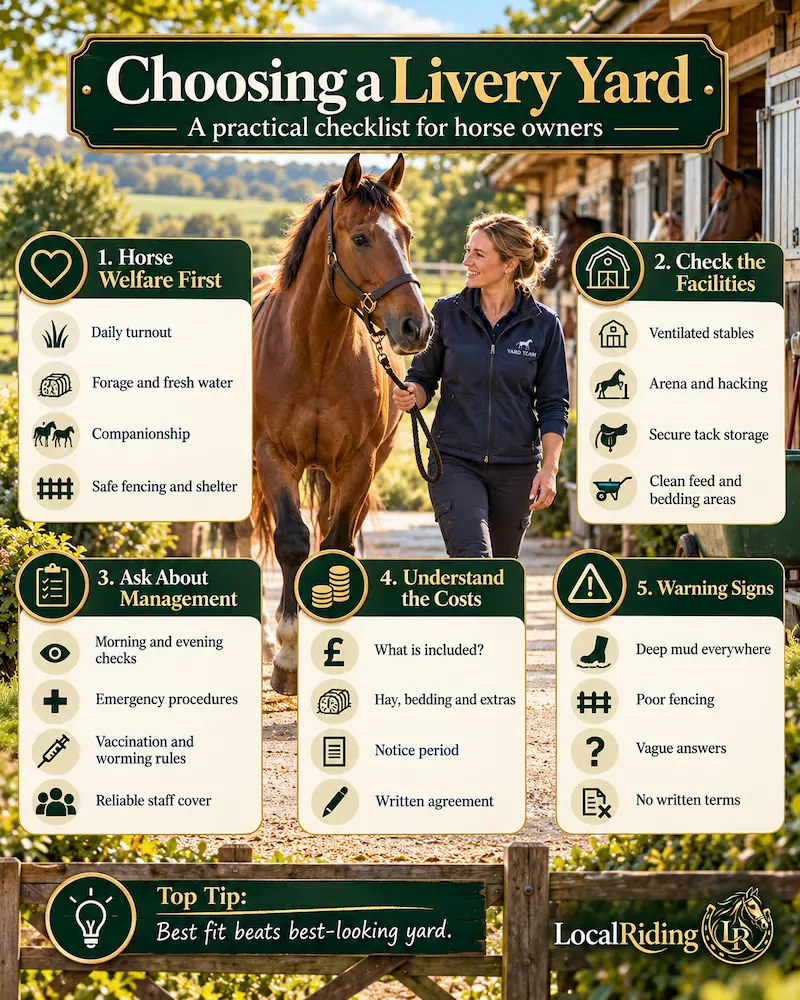 Choosing a livery yard: a practical checklist covering horse welfare, facilities, management, costs and warning signs
1. Understand the Different Types of Livery
Before arranging viewings, think carefully about your circumstances.
How much time can you realistically dedicate to your horse each day? Can you visit before work and again in the evening? What happens when you're ill, away on holiday or working late?
The cheapest livery isn't necessarily the most economical once you account for your time, travel and additional services.
DIY Livery
With DIY (do-it-yourself) livery, you normally rent a stable and grazing while taking responsibility for your horse's daily care.
This generally includes you doing the feeding, mucking out, turning out, bringing in, rug changes and arranging veterinary and farrier visits.
Best suited to: Experienced owners with sufficient time, reliable transport and dependable backup arrangements.
Check whether hay, bedding, electricity, arena use and storage are included. These can make a substantial difference to your monthly costs.
Assisted DIY Livery
Assisted DIY provides the independence of DIY with the option to pay the yard for individual services.
You might arrange for someone to turn your horse out in the morning, bring them in during winter or provide cover when you're working late.
Best suited to: Owners wanting hands-on involvement but needing occasional flexibility.
Ask for a written list of charges. Several small daily fees can quickly become a significant monthly expense.
Part Livery
With part livery, the yard undertakes an agreed proportion of your horse's daily care.
Typical arrangements might include feeding, mucking out, turnout and bringing in on weekdays, leaving you to manage your horse at weekends.
However, there's no universal definition of part livery. What one yard includes as standard may be an optional extra elsewhere.
Best suited to: Working owners who still want regular involvement in their horse's care.
Full Livery
Full livery usually includes the majority of routine daily care, including feeding, mucking out, turnout and bedding management.
Some yards also offer grooming, tack cleaning, exercise or competition preparation, but these services aren't necessarily included.
Best suited to: Owners with limited time or those who prefer an established team to manage their horse's daily routine.
Confirm exactly what 'full' means before accepting a quotation.
Grass Livery
Grass livery allows your horse to live outdoors, normally throughout the year, with suitable shelter, forage and access to fresh water.
Depending on the yard, you may still be responsible for all daily checks and feeding.
Living out can suit many horses extremely well, but successful grass livery depends on appropriate grazing, drainage, shelter, companionship and careful management.
Best suited to: Horses comfortable with outdoor living and owners prepared for the practical demands of year-round field care.
Older horses, those requiring specialist diets and those needing medical supervision may require additional facilities or individual arrangements.
Other Options
Some yards offer retirement livery, rehabilitation livery, schooling livery or competition livery.
These are specialist arrangements and should be assessed against the individual horse's needs, the competence of the staff and the precise services provided.
LocalRiding Tip: Always compare what is actually included in the monthly charge rather than comparing labels such as DIY, part or full livery.
2. Put Your Horse's Welfare First
Your horse's physical and mental wellbeing should take priority over impressive buildings or luxurious facilities.
Horses are social, grazing animals that have evolved to spend much of their day moving, foraging and interacting with other horses.
The British Horse Society promotes the principles of friends, forage and freedom as fundamental aspects of good equine welfare.
When assessing a livery yard, consider how well its management practices support those natural needs.
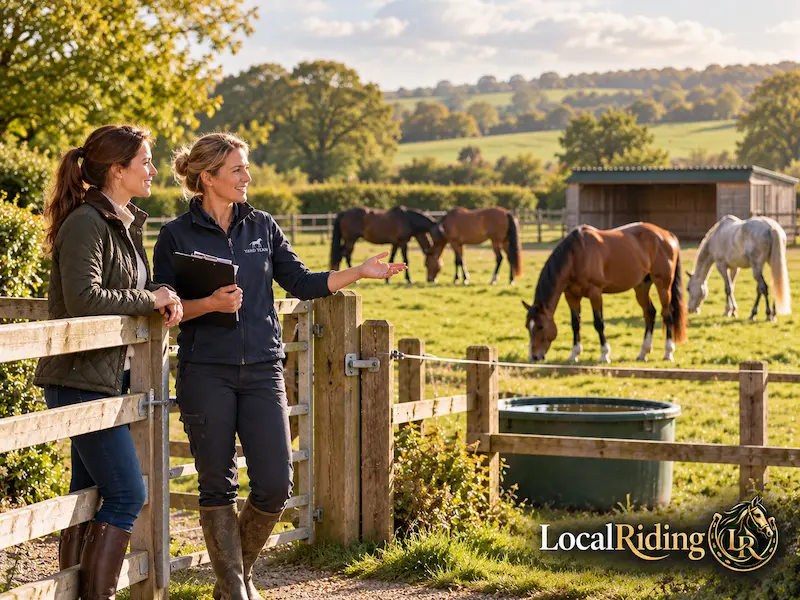 A yard manager shows a prospective livery the paddocks, fencing, water trough and field shelter during a visit
Turnout: One of the Most Important Questions
Turnout policies vary considerably between yards.
Some provide extensive year-round grazing. Others restrict turnout during wet weather or close their fields for extended periods in winter.
Ask:
- How many hours of turnout are normally available each day?
- Is turnout available throughout winter?
- What happens during prolonged wet or freezing weather?
- Are horses turned out individually, in pairs or in compatible groups?
- How are new horses introduced to existing herds?
- Are separate turnout arrangements available for horses with special requirements?
- Is there an alternative exercise or turnout area when fields are closed?
Be cautious of yards where horses spend prolonged periods stabled without adequate movement, social contact or alternative turnout arrangements.
Individual turnout may be necessary for some horses, but visual, auditory and preferably safe physical contact with other horses remains important.
Grazing and Field Management
Look beyond the amount of land available.
Well-managed grazing involves controlling stocking density, monitoring grass condition, removing droppings where practical and protecting the ground from excessive damage.
Inspect:
- Fencing, gates and water troughs.
- Drainage and persistent muddy areas.
- Availability of natural shelter, shade or field shelters.
- Signs of poisonous plants, rubbish or hazardous materials.
- Evidence of overgrazing.
- Safe access between fields and stables.
Ask whether paddocks are rested or rotated and what provisions are made during periods of drought or poor grass growth.
There is no single acreage-per-horse figure that guarantees suitable grazing. Soil type, grass quality, stocking density, supplementary feeding and pasture management all matter.
A relatively small, well-managed turnout system can sometimes provide better conditions than a larger, neglected field.
Winter Turnout and Mud Management
Winter can expose weaknesses in an otherwise attractive yard.
Deep mud around gates, feeding areas and water troughs can contribute to hoof and skin problems, restrict movement and make everyday handling difficult.
Look for evidence of preventative management, such as:
- Reinforced gateways and suitable hardstanding.
- Well-drained turnout areas.
- Rotational grazing.
- Safe alternative turnout during prolonged wet weather.
- Suitable locations for winter feeding.
Ask specifically what happened during the previous winter rather than accepting general assurances that turnout is available all year.
A little seasonal mud is normal. Persistent deep mud without an apparent management plan is a different matter.
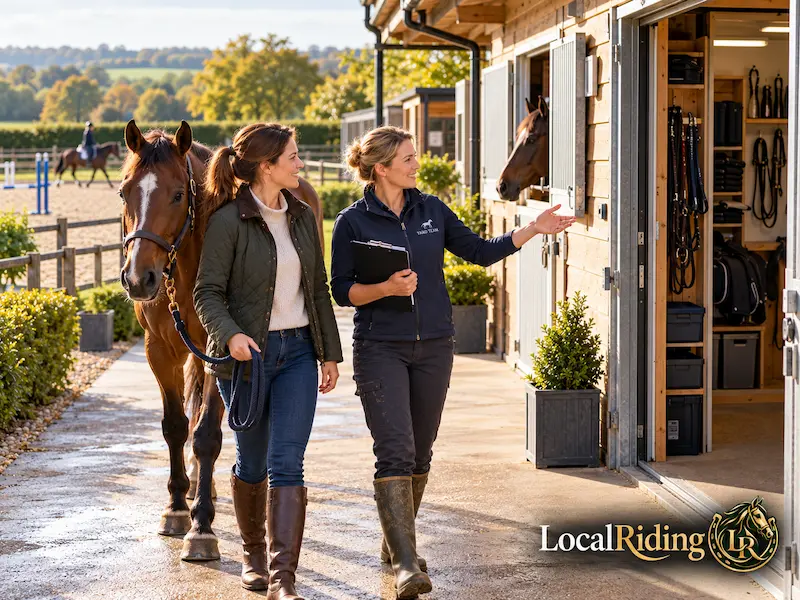 Viewing the stables and a secure, well-organised tack room at a UK livery yard
3. Check Stables, Facilities and Security
A well-managed yard doesn't need to be expensive or luxurious, but its facilities should be safe, maintained and appropriate for the horses using them.
Stable Safety and Ventilation
Inspect the stables carefully.
Look for sound floors, secure doors, safe fittings, adequate drainage, natural light and sufficient space for the horse to move comfortably, turn around and lie down.
Ventilation is particularly important. Stables should have good airflow without creating uncomfortable conditions for the horse.
A strong smell of ammonia, damp bedding or excessive dust may indicate inadequate stable management.
Ask how often stables are mucked out and whether the bedding system is suitable for horses with respiratory sensitivities.
Feed, Hay and Bedding Storage
Check that forage and bedding are stored somewhere dry and protected from contamination.
Feed rooms should be secure from pests and inaccessible to horses.
Ask whether owners must buy hay and bedding from the yard or may purchase their own.
If the yard supplies forage, establish whether quantities are restricted, how additional forage is charged and whether alternative forage can be provided for horses with specialist requirements.
Tack Rooms and Security
Tack, rugs and equipment represent a considerable investment.
Check for secure tack storage, suitable locks, lighting and sensible control over access to the premises.
CCTV, alarms and secure perimeter gates can offer additional protection, although no system guarantees against theft.
Ask whether your equipment is covered under the yard's insurance or whether you need your own policy.
Riding Facilities
Consider which facilities you genuinely need.
An illuminated arena may be essential if you ride after work during winter. For another owner, safe access to extensive bridleways might be far more valuable.
Check:
- Arena size, surface condition, drainage and lighting.
- Booking arrangements and priority use.
- Availability of jumps and schooling equipment.
- Indoor schooling facilities, if required.
- Safe mounting and grooming areas.
- Horsebox and trailer parking.
- Wash-down facilities and suitable lighting.
- Access to off-road hacking and bridleways.
Visit after rainfall where possible. An arena that looks excellent in dry weather may perform very differently following several days of rain.
Hacking and Road Safety
If hacking forms part of your routine, investigate the surrounding area.
Are there safe routes directly from the yard, or must you negotiate busy roads?
Check the suitability of nearby bridleways, road crossings, gates and seasonal ground conditions.
A yard with modest facilities but excellent hacking may offer considerably more enjoyment than one with an impressive arena surrounded by dangerous roads.
4. Understand the True Cost of Livery
The advertised livery price is only the starting point.
Two yards quoting similar monthly fees may offer very different levels of service.
Before committing, request a complete breakdown of regular charges and possible extras.
Costs to Investigate
| Expense | What to Clarify |
|---|---|
| Basic livery | Weekly or monthly rate and included services |
| Hay or haylage | Included quantity and additional charges |
| Bedding | Included allowance, type and restrictions |
| Turnout and bringing in | Included or charged individually |
| Rug changes | Number included and extra fees |
| Feeding | Whether hard feed and supplements are included |
| Arena use | Included, booking fee or separate membership |
| Vet and farrier assistance | Charge for holding or supervising |
| Holiday cover | Availability and daily cost |
| Electricity and hot water | Any separate charges |
| Horsebox parking | Availability and additional fee |
| Emergency care | Charges for unscheduled assistance |
Remember that farrier visits, vaccinations, dental care, worming management, routine veterinary costs, insurance and equipment will normally remain your responsibility unless specifically included.
Work out the likely cost over twelve months, including winter expenses, rather than comparing only the advertised weekly rate.
A slightly more expensive yard with included forage, reliable assistance and better turnout could ultimately provide better value.
Ask how often prices are reviewed, how much notice is given before increases and whether deposits or advance payments are required.
5. Find Out Who Will Actually Care for Your Horse
A yard's management and staff are among its most important assets.
Good facilities cannot compensate for inconsistent care or inexperienced handling.
Ask who is responsible for the daily checks and whether suitable cover is available when regular staff are away.
Questions worth asking include:
- Who checks the horses in the morning and evening?
- Who is responsible overnight?
- What happens if a member of staff is ill?
- How are feeding instructions recorded?
- Are staff experienced in recognising colic, lameness and illness?
- How are incidents communicated to owners?
- Can the yard administer prescribed medication when required?
- Is reliable emergency assistance available?
Watch how horses are handled.
Calm, consistent handling, patience and attention to individual behaviour are encouraging signs.
Horses should not be routinely subjected to unnecessary force, intimidation or rough treatment.
A capable yard manager should be comfortable explaining their procedures and discussing any individual requirements your horse may have.
6. Ask About Health, Biosecurity and Emergency Arrangements
Infectious disease prevention is an increasingly important consideration wherever horses from different owners share facilities.
A responsible yard should have sensible procedures for reducing disease transmission and responding to suspected infectious illness.
Biosecurity
Ask about:
- Isolation or separation of new arrivals where appropriate.
- Vaccination requirements.
- Procedures for horses showing signs of infectious illness.
- Shared water buckets, grooming equipment and tack.
- Hygiene arrangements for visiting professionals.
- Attendance at competitions and events during outbreaks.
- How owners are informed of suspected infectious disease.
Equine influenza and strangles are examples of infections that can spread between horses, particularly where horses travel frequently or share facilities.
A written biosecurity procedure is a positive sign, but staff must also follow it consistently.
Worming and Parasite Control
Ask whether the yard uses a coordinated parasite-control programme.
Modern parasite management should take account of individual veterinary advice, faecal egg counts where appropriate, pasture hygiene and the risk of anthelmintic resistance.
Routine blanket worming without regard to individual circumstances is not necessarily the best approach.
Veterinary Emergencies
Establish exactly what happens when a horse becomes ill or injured.
Who calls the vet? Who stays with the horse until help arrives? Can the yard authorise emergency treatment if the owner cannot be contacted?
Provide written veterinary contact details, alternative emergency contacts and clear instructions covering the authority you grant the yard.
Some situations require immediate veterinary attention. There should be no uncertainty about who can take action or how costs will be handled.
Also ask about access for horse ambulances and emergency vehicles, and whether there is a suitable area for a sick or injured horse to be managed safely.
7. Consider the Yard's Atmosphere
One of the most easily overlooked factors is the yard's social environment.
The yard manager, staff and fellow owners may become part of your everyday life for years.
A friendly, supportive atmosphere can make horse ownership significantly more enjoyable.
Conversely, constant disagreements, poor communication or restrictive rules can turn even the best-equipped yard into an unpleasant place.
During your visit, consider:
- Are horses handled calmly and confidently?
- Do owners appear comfortable asking questions?
- Does the manager answer clearly and consistently?
- Are communal areas looked after?
- Are rules applied fairly?
- Is there an atmosphere of cooperation?
Every yard needs reasonable rules for safety, hygiene and shared facilities.
However, owners should understand those rules before arriving and feel confident that concerns can be raised constructively.
A friendly, professionally run yard with modest facilities can be a far better home than an expensive establishment where communication and horse care are poor.
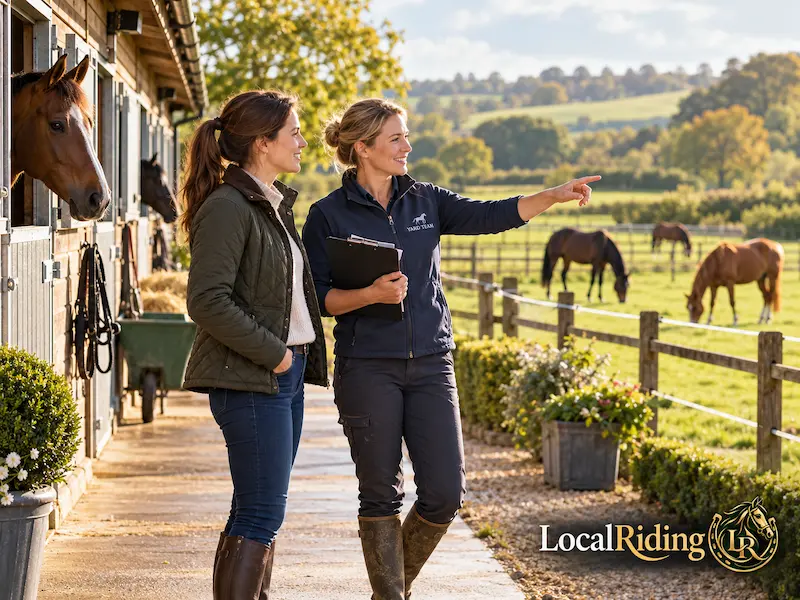 A horse owner tours a livery yard with the yard manager, looking at the stables and turnout
8. Visit More Than Once Before Deciding
Never rely solely on photographs, social media or a single guided tour.
Where practical, visit twice at different times.
A quiet weekday morning may give a very different impression from a busy Saturday afternoon.
Try to observe normal feeding, turnout or bringing-in routines.
Pay attention to the horses already living there.
Do they generally appear healthy, comfortable and appropriately maintained? Is clean water available? Are fields and stables safe?
One horse looking unsettled is not necessarily evidence of poor management. Horses have individual medical, behavioural and dietary needs.
However, recurring problems involving several horses, combined with vague explanations, should prompt further investigation.
Ask whether you can speak to an existing livery client.
You may also find it useful to arrange a short trial period, where the yard offers this and your horse's welfare and contractual arrangements are appropriately protected.
9. Make Sure the Yard Suits Your Individual Horse
Not every good yard is suitable for every horse.
Before deciding, consider your horse's age, temperament, health and normal routine.
A horse prone to laminitis may need carefully controlled grazing and a reliable weight-management system.
A horse with respiratory problems may benefit from excellent ventilation, low-dust bedding and appropriate forage.
An anxious horse may require carefully managed herd introductions and consistent companionship.
An older horse might need extra feeding, shelter and more frequent monitoring.
A horse recovering from injury may require restricted turnout, secure rehabilitation areas or specialist handling.
Discuss these needs openly with the yard manager.
A yard that recognises its limitations and explains what it can reasonably provide is generally more reassuring than one that promises to accommodate everything without considering the practical implications.
The right yard is the one that consistently meets your horse's needs, not necessarily the one with the longest list of facilities.
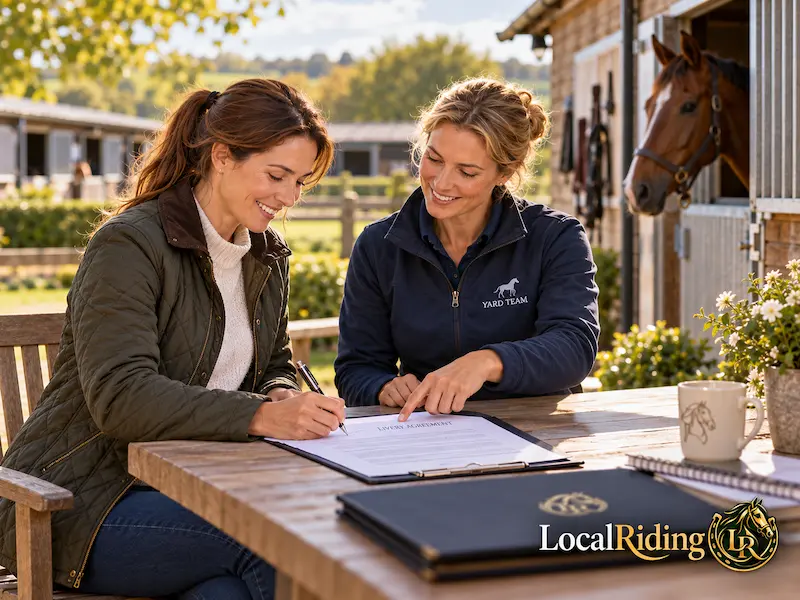 A horse owner signs a written livery agreement with the yard manager
10. Get Everything in Writing
Once you've found a suitable yard, request a written livery agreement before moving your horse.
A clear agreement protects both owner and yard proprietor by setting out responsibilities and avoiding misunderstandings.
It should address:
- Names and contact details of the parties.
- Identification of the horse.
- Type of livery and services included.
- Fees, payment dates and additional charges.
- Deposits and any repayment conditions.
- Arrangements for changing prices or services.
- Responsibilities for feeding, turnout and daily care.
- Veterinary emergencies and authority to seek treatment.
- Insurance obligations and allocation of responsibility.
- Yard rules and access arrangements.
- Notice periods and termination conditions.
- Procedures for disputes and outstanding payments.
Check whether there are arrangements for changes in management, prolonged illness, unexpected yard closure or circumstances requiring your horse to be moved.
Ask about insurance held by the yard, including public liability and suitable care, custody and control cover. Employer's liability insurance may also be relevant where staff are employed.
Your own horse insurance and any relevant third-party liability cover should be reviewed separately.
A written agreement doesn't guarantee that problems won't arise, but it provides an essential reference if expectations differ later.
11. Recognise the Warning Signs
Not every imperfect facility indicates a poorly run yard.
Older buildings, modest arenas and occasional muddy gateways can be perfectly compatible with good management.
However, some observations deserve closer investigation.
Potential Red Flags
- Horses regularly without accessible clean water.
- Unsafe fencing, exposed nails or neglected hazards.
- Persistent deep mud without a management plan.
- Prolonged confinement with inadequate movement or social contact.
- Poor-quality, mouldy or insufficient forage.
- Repeated signs of neglected horse care.
- Rough or inappropriate handling.
- No clear emergency procedure.
- Unexplained extra charges or unwillingness to provide terms in writing.
- Inconsistent answers about turnout, feeding or staffing.
- Pressure to pay a deposit before reviewing the agreement.
Some concerns may have reasonable explanations. For example, a horse may be on veterinary-prescribed restricted turnout or a controlled diet.
Ask questions, consider the answers and assess the overall pattern of management.
If serious welfare concerns remain unresolved, don't ignore them simply because the location or price is attractive.
12. A Practical Checklist for Your Yard Visit
Take this checklist with you when comparing potential yards.
Horse Welfare
- Suitable daily turnout or alternative movement arrangements
- Appropriate companionship and social contact
- Sufficient suitable forage
- Clean, accessible drinking water
- Safe fencing, shelter and grazing
- Sensible winter management
Facilities
- Safe, appropriately sized stables
- Good ventilation and drainage
- Secure tack and feed storage
- Suitable arena or riding facilities
- Safe hacking access
- Adequate parking and access
Management
- Competent, approachable staff
- Clear daily care responsibilities
- Emergency veterinary procedures
- Biosecurity arrangements
- Reliable holiday and illness cover
- Clear rules and communication
Costs and Contract
- Full schedule of fees and extras
- Written livery agreement
- Reasonable notice arrangements
- Insurance responsibilities explained
- Price review arrangements understood
- No unexplained charges or conditions
Final Thoughts: Choose the Yard Where Your Horse Can Thrive
Choosing a livery yard involves balancing several competing priorities: location, cost, facilities, convenience and the quality of care.
It's tempting to focus on the most visible features. A beautiful arena, immaculate stable block or attractive price can make a powerful first impression.
But the things that matter most to your horse are often less glamorous.
Safe turnout. Suitable companionship. Good forage. Fresh water. Competent care. A consistent routine.
For you as an owner, clear communication, manageable costs and confidence in the people caring for your horse are equally valuable.
Take your time, visit more than once and don't be afraid to ask difficult questions.
The best livery yard isn't necessarily the most expensive or impressive. It's the one where your horse is safe, healthy and content — and where you can enjoy being a horse owner.
LocalRiding.com — Helping horse owners make informed decisions about equine care, management and welfare.
LocalRiding Team
LocalRiding.com
Helping horse owners make informed decisions about equine care, management and welfare.