
Breeds
The Native Ponies & Horses of the British Isles: A Complete Breed Guide
Discover native British and Irish horse and pony breeds, their origins, heights, characteristics, uses and which riders they suit. A complete guide.
By Debbie Irwin · 23 October 2026 · 32 min read
From the tiny but incredibly strong Shetland Pony to the magnificent Shire Horse, the British Isles are home to some of the world's most distinctive, versatile and historically important horse and pony breeds.
Centuries of working alongside people, often in difficult landscapes and unpredictable weather, have shaped these remarkable animals. Some carried miners' supplies across rugged moorland; others pulled heavily laden carts, worked farms, transported goods or carried riders across demanding countryside.
Today, many of these traditional breeds have found new roles as family ponies, riding-club companions, competition horses, driving animals and conservation grazers.
But what makes each breed special? Which are best suited to children, novice riders, experienced competitors or adults looking for a dependable all-rounder?
In this LocalRiding guide, we explore the native ponies and horses of England, Scotland, Wales and Ireland, examining their origins, characteristics, traditional and modern uses, and the riders most likely to enjoy owning them.
Understanding native British and Irish breeds
A native breed is one that developed within a particular geographical region over generations, acquiring characteristics suited to its environment and traditional purpose.
Britain's native ponies are particularly well known for their hardiness, strength relative to their size, intelligence and economical use of available forage.
However, native breeds are far from identical. A Welsh Cob bred for energetic ridden work can be a very different proposition from an Exmoor Pony, while a Highland Pony may offer an entirely different riding experience from a Connemara.
It is also important to distinguish between native-breed heritage and formal competition categories. The familiar Mountain and Moorland showing divisions recognise 12 breed sections, including the four Welsh sections. Other native breeds, such as the Eriskay and Kerry Bog Pony, have their own histories and breed standards.
The following guide covers the principal established native breeds, including several traditional working horses and less familiar ponies.
A note about height: Horse and pony heights are measured in hands (hh), with one hand equalling four inches (10.16 cm). Heights given below are breed-standard limits or typical adult ranges, as appropriate. They are not guarantees of how large an individual animal will grow.
Part One: The Native Ponies of England
1. Exmoor Pony — The Hardy Moorland Survivor
- Origin: Exmoor, Somerset and Devon
- Height: Approximately 11.1–12.3hh; breed-standard maximum 12.3hh
- Traditional uses: Pack work, hill farming, transport and livestock management
- Modern uses: Hacking, conservation grazing, driving, showing and recreational riding
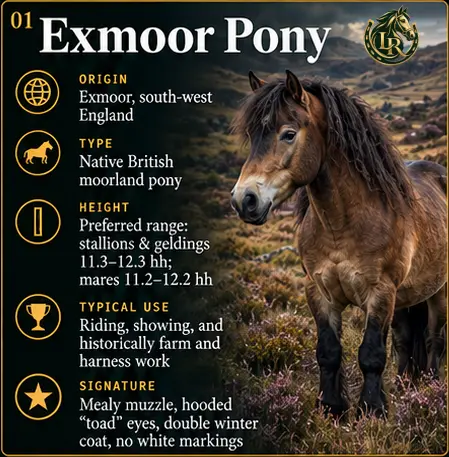 Exmoor Pony standing on open moorland, showing the breed's characteristic mealy muzzle and dense coat
The Exmoor Pony is one of Britain's oldest established native pony breeds, with a history closely associated with the moorland landscape of southwest England.
Its characteristic brown colouring, pale or mealy muzzle, distinctive eyes and dense winter coat make it immediately recognisable.
What makes the Exmoor special?
Exmoors developed in an exposed landscape where the ability to withstand cold, wet conditions and travel across difficult ground was essential.
Their compact bodies, strong limbs and hard feet make them particularly well adapted to rough terrain.
They are also efficient grazers, which makes them valuable in conservation grazing projects where controlled grazing helps manage vegetation and maintain wildlife habitats.
Who is an Exmoor Pony suitable for?
A well-handled, properly trained Exmoor can make an excellent riding pony for a confident child or small adult.
Its intelligence and natural self-preservation can be attractive qualities for experienced owners, but they may also present challenges if a pony has received limited handling.
Best suited to: Confident young riders, smaller adults, native-breed enthusiasts and owners interested in hacking, showing or conservation.
2. Dartmoor Pony — The Dependable Children's All-Rounder
- Origin: Dartmoor, Devon
- Height: Up to 12.2hh
- Traditional uses: Tin mining, pack transport and agricultural work
- Modern uses: Children's riding, Pony Club, showing, jumping and driving
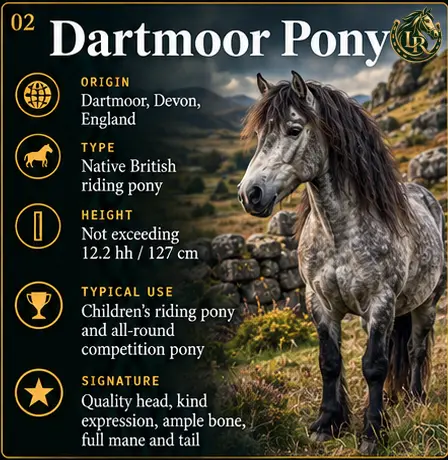 Dartmoor Pony on the Devon moors, a substantial and well-proportioned native riding pony
The Dartmoor Pony has lived and worked on the Devon moors for centuries.
Historically, these ponies were valued for their ability to carry loads across difficult terrain, including supplies associated with Dartmoor's tin-mining industry.
Although relatively small, the pedigree Dartmoor is a substantial, well-proportioned riding pony.
What makes the Dartmoor special?
The Dartmoor combines the toughness of a native pony with the conformation and movement required for comfortable riding.
Many possess an appealing balance of strength, intelligence and willingness to work.
Their relatively compact size makes them suitable for younger riders, while their athletic ability allows them to participate in a variety of Pony Club activities.
Who is a Dartmoor Pony suitable for?
A well-schooled Dartmoor can make a particularly good first or second pony for children.
Nevertheless, as with all native ponies, some individuals are more forward-going or independent than others.
Best suited to: Children progressing through Pony Club, family homes, showing enthusiasts and young riders seeking a capable all-rounder.
Interactive calculatorWork out your own budget with the First Pony Budget Calculator →
Important distinction: Not every pony roaming Dartmoor is a registered pedigree Dartmoor Pony. The moor also supports other types, including Dartmoor Hill Ponies.
3. New Forest Pony — The Versatile Family Favourite
- Origin: The New Forest, Hampshire
- Height: Up to 14.2hh
- Traditional uses: Transport, agricultural work and general-purpose riding
- Modern uses: Pony Club, riding club, dressage, showjumping, eventing and hacking
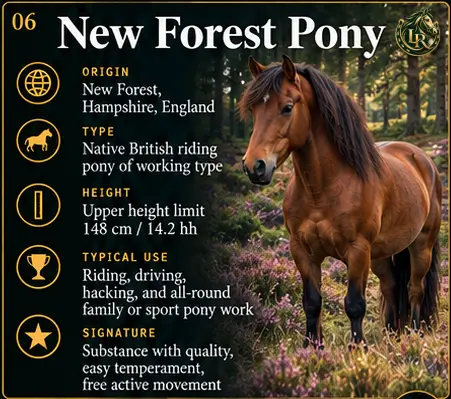 New Forest Pony grazing in the New Forest, a versatile native breed popular with families
New Forest Ponies have grazed the New Forest for centuries, with their breeding and management closely connected to the commoners who exercise traditional grazing rights.
These ponies have become particularly popular because they combine native hardiness with the qualities of a useful riding pony.
What makes the New Forest special?
The breed is notable for its versatility.
A good New Forest Pony can have the stamina for a long countryside ride, the balance required for dressage and the athletic ability to jump a course of fences.
Their generally practical temperament and adaptable nature make them attractive to families wanting one pony capable of doing several jobs.
Who is a New Forest Pony suitable for?
New Forest Ponies are among the breeds worth considering when looking for a genuine family all-rounder.
Smaller examples may suit children, while larger, substantial individuals can carry suitably sized adults.
Best suited to: Pony Club riders, teenagers, small adults, recreational competitors and families wanting a versatile pony.
Part Two: The Native Ponies of Northern England
4. Fell Pony — The Sure-Footed Cumbrian Companion
- Origin: Cumbria and the northern Pennines
- Height: Up to 14hh
- Traditional uses: Pack transport, mining, agricultural work and shepherding
- Modern uses: Hacking, trekking, driving, showing and family riding
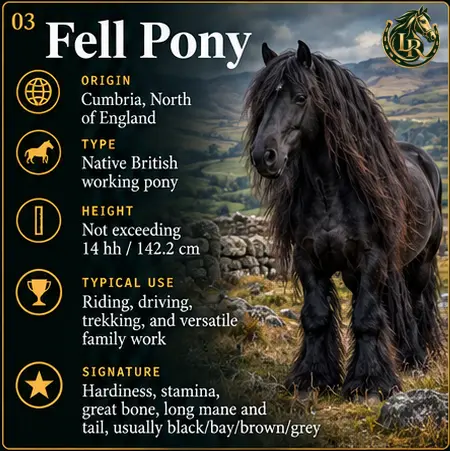 Fell Pony with flowing mane and tail in the Cumbrian hills, a sure-footed native breed
The Fell Pony evolved in the hills of northern England, particularly Cumbria.
Its ancestors carried goods across rough countryside long before modern roads and motor transport became available.
Today, the Fell is recognised for its substantial build, flowing mane and tail, and ability to negotiate demanding terrain.
What makes the Fell special?
Strength, stamina and sure-footedness are central to the Fell's appeal.
The breed's powerful hindquarters and compact, balanced build help it travel efficiently over uneven ground.
Fells are often capable of covering considerable distances without tiring quickly when appropriately conditioned.
Their comfortable size and substance can make them practical mounts for both older children and adults.
Who is a Fell Pony suitable for?
The Fell is particularly attractive to riders who enjoy countryside hacking and trail riding.
Its intelligence and determination mean consistent training remains important.
Best suited to: Confident teenagers, smaller or moderately sized adults, trekking enthusiasts and riders who enjoy native showing or driving.
5. Dales Pony — The Powerful Yorkshire All-Rounder
- Origin: Yorkshire Dales and northern Pennines
- Height: Preferred range 14–14.2hh
- Traditional uses: Lead mining, agricultural work and carrying heavy loads
- Modern uses: Riding, driving, trekking, showing and endurance
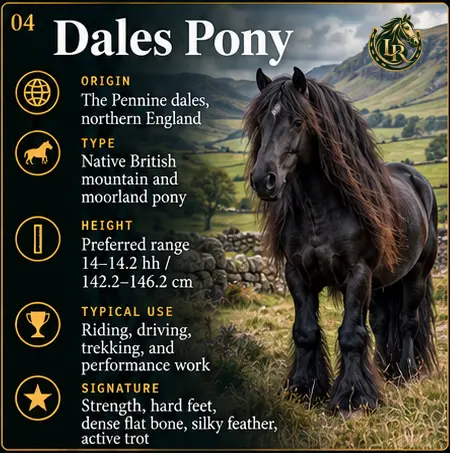 Dales Pony in the Yorkshire Dales, a powerful native breed with strong bone and active movement
The Dales Pony developed in an environment where strength and stamina were essential.
Historically, Dales Ponies carried lead and other goods across northern England's difficult hill country.
Their combination of strength, athleticism and relatively compact size continues to attract riders today.
What makes the Dales special?
Dales Ponies are remarkably substantial animals for their height.
They typically possess strong backs, powerful hindquarters, good bone and active movement.
This makes them well suited to carrying appropriate loads, working in harness and negotiating challenging countryside.
The breed also retains an impressive ability to perform energetic work.
Who is a Dales Pony suitable for?
Dales Ponies can be excellent riding partners for adults who want the substance of a larger horse without necessarily needing its height.
However, they are powerful animals and require competent handling, particularly when young or inexperienced.
Best suited to: Adult riders, confident teenagers, hacking enthusiasts, driving competitors and riders seeking a strong native all-rounder.
Part Three: The Native Ponies of Scotland
6. Shetland Pony — Small in Size, Extraordinary in Strength
- Origin: Shetland Islands
- Height: Maximum 42 inches (approximately 10.2hh)
- Traditional uses: Farm work, carrying peat and goods, and coal mining
- Modern uses: Children's riding, driving, showing, therapy activities and companionship
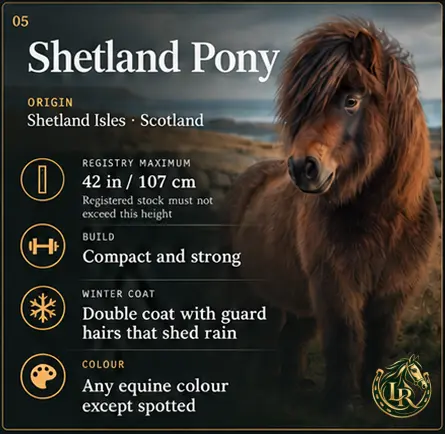 Shetland Pony, small but remarkably strong, developed in the challenging climate of the Shetland Islands
Few horse breeds are as instantly recognisable as the Shetland Pony.
Developed in the challenging climate of the Shetland Islands, these small, powerful animals possess remarkable strength relative to their height.
During the nineteenth century, Shetlands became associated with underground mining work, where their small size and pulling power were highly valued.
What makes the Shetland special?
The Shetland's outstanding characteristics are its strength, hardiness and economical metabolism.
Its compact build and substantial bone allow it to perform tasks that might seem impossible for such a small animal.
Shetlands are also intelligent and can learn quickly, including habits their owners might prefer they did not develop!
Who is a Shetland Pony suitable for?
A suitably trained Shetland can be a wonderful introduction to ponies for a small child.
However, the breed should never be dismissed as an easy animal simply because of its size.
Shetlands can be independent, strong and determined. Adults must provide consistent handling and supervision.
Best suited to: Small children under competent adult supervision, driving enthusiasts and experienced pony owners.
7. Highland Pony — Scotland's Traditional Working Mount
- Origin: Scottish Highlands and Islands
- Height: Approximately 13–14.2hh
- Traditional uses: Carrying deer, farm work, transport and estate work
- Modern uses: Trekking, hacking, driving, showing and recreational riding
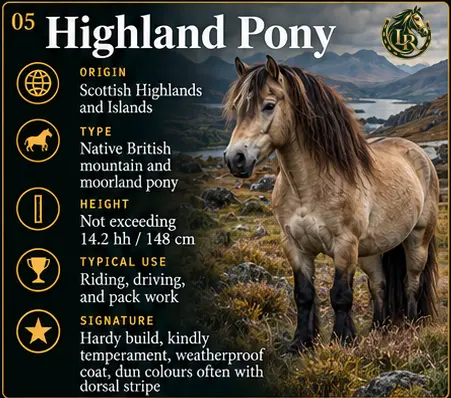 Highland Pony in the Scottish Highlands, a sturdy traditional working breed with a dense coat
The Highland Pony is one of Scotland's most recognisable native breeds.
Traditionally used by Highland estates, these sturdy ponies could transport equipment and carry deer carcasses across difficult mountain terrain.
Their ability to work patiently in challenging environments helped establish their reputation as capable and dependable working animals.
What makes the Highland special?
Highlands combine considerable strength with a generally steady, economical way of working.
Their dense coats, substantial bodies and strong limbs reflect their adaptation to the Scottish climate.
A well-trained Highland can be a comfortable, confidence-inspiring hacking companion, particularly for riders who value steady progress over speed.
Who is a Highland Pony suitable for?
Highlands may appeal to adult riders who prefer a substantial pony rather than a taller horse.
They can be good family ponies, although their strength, sometimes deliberate pace and individual temperament must be considered.
Best suited to: Adult leisure riders, confident teenagers, trekking centres, native showing enthusiasts and those seeking a substantial hacking pony.
8. Eriskay Pony — A Rare Treasure of the Hebrides
- Origin: Eriskay and the Western Isles of Scotland
- Height: 12–13.2hh
- Traditional uses: Crofting, carrying peat and seaweed, and general transport
- Modern uses: Riding, driving, light work, showing and conservation
The Eriskay Pony is one of Scotland's rarest native breeds.
It survived in the Outer Hebrides, where ponies were essential to crofting communities.
They performed varied jobs, from transporting peat and seaweed to helping families move goods across difficult island landscapes.
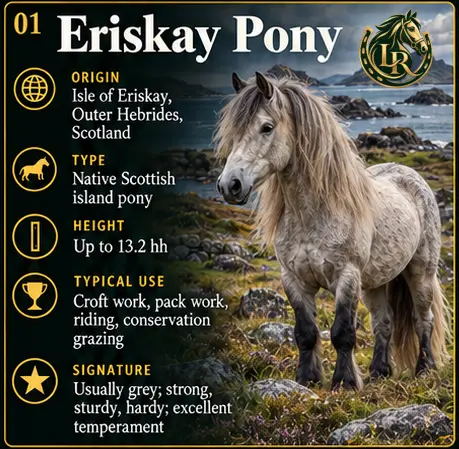 Eriskay Pony, a rare and gentle native pony from the Hebridean island of Eriskay
What makes the Eriskay special?
Eriskays possess the hardy constitution and sure-footedness expected of a traditional island pony.
Their dense winter coats and compact build allow them to cope with exposed conditions.
They are often noted for their willing, amenable temperament.
Unlike more numerous native breeds, preservation of the Eriskay is an important consideration when selecting breeding animals.
Who is an Eriskay Pony suitable for?
An appropriately trained Eriskay can be a rewarding mount for children or lightweight adults.
Owners who appreciate rare breeds and wish to support responsible conservation may find them particularly appealing.
Best suited to: Confident children, lightweight adults, native-breed enthusiasts and owners interested in rare-breed preservation.
Source: Eriskay Pony Society
Part Four: The Native Ponies and Cobs of Wales
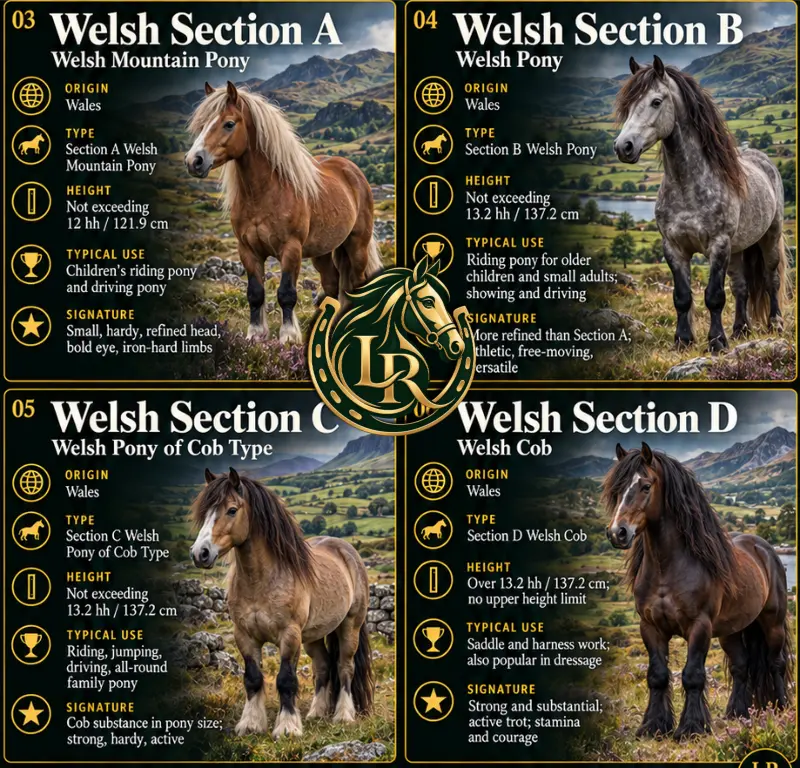
The Welsh Pony and Cob is divided into four distinct studbook sections, each with different height requirements and traditional characteristics.
Although they share a common heritage, the four sections offer quite different riding experiences.
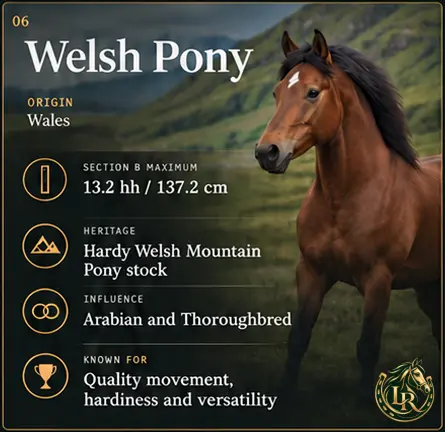 Welsh Pony in the Welsh uplands, an elegant native breed divided into four studbook sections
9. Welsh Mountain Pony — Section A
- Origin: Welsh mountains and uplands
- Height: Up to 12hh
- Traditional uses: Hill farming, transport and agricultural work
- Modern uses: Children's riding, showing, driving and Pony Club
The Welsh Mountain Pony is the smallest of the four Welsh sections.
Generations of living in challenging upland conditions helped shape a pony that combines hardiness with relatively refined conformation and expressive movement.
What makes Section A special?
Section A ponies are known for their quality, agility and lively character.
They often possess impressive movement for their size and are capable of performing well in the show ring.
Their intelligence and athleticism also make them appealing children's riding ponies.
Who is a Section A suitable for?
A quiet, well-trained Section A can make an excellent child's pony.
However, many possess considerable enthusiasm and energy.
Best suited to: Children, small competitive riders, showing families and driving enthusiasts.
10. Welsh Pony — Section B
- Origin: Wales
- Height: Up to 13.2hh
- Traditional uses: Light riding and general-purpose pony work
- Modern uses: Pony Club, showing, dressage, showjumping and children's competitions
The Welsh Section B was developed as a refined riding pony while retaining the strength and character of its Welsh ancestry.
Compared with Section A, it generally provides more height and scope for a growing child.
 Welsh Pony (Section B), a refined and athletic native riding pony from Wales
What makes Section B special?
Its combination of elegance, athleticism and native toughness is particularly appealing.
A good Section B can be a capable jumping pony, while its quality of movement makes it attractive for showing and dressage.
Many are forward-going, responsive rides.
Who is a Section B suitable for?
Section B ponies are often excellent choices for children progressing into more advanced Pony Club activities.
They are particularly suitable for riders who enjoy a more athletic, responsive pony.
Best suited to: Established young riders, competitive children and teenagers, and showing enthusiasts.
11. Welsh Pony of Cob Type — Section C
- Origin: Wales
- Height: Up to 13.2hh
- Traditional uses: Farm work, transport, riding and driving
- Modern uses: Showing, driving, hacking and general-purpose riding
The Section C combines the compact size of a pony with many of the strength and movement characteristics associated with the Welsh Cob.
Its substantial build gives it a very different appearance from the more refined Section B.
What makes Section C special?
Section C ponies can be exceptionally strong for their height.
They are often energetic and expressive, with powerful movement and considerable enthusiasm for work.
Their build can make them suitable for carrying appropriately sized older children and some smaller adults.
Who is a Section C suitable for?
Their power and lively character are often best appreciated by confident riders.
A well-schooled Section C can become an enjoyable all-rounder, but it is important not to mistake a small pony for an automatically easy ride.
Best suited to: Confident teenagers, smaller adults, experienced native-pony riders and driving enthusiasts.
12. Welsh Cob — Section D
- Origin: Wales
- Height: Over 13.2hh, with no upper limit
- Traditional uses: Agricultural work, transport, riding and military-related duties
- Modern uses: Dressage, jumping, showing, driving, hacking and pleasure riding
The Welsh Cob is one of the most distinctive native riding and driving breeds in the British Isles.
Its combination of strength, powerful movement and lively temperament has made it popular with riders seeking a horse or substantial pony with real personality.
What makes Section D special?
Welsh Cobs are renowned for their energetic action, strong hindquarters and ability to work across a range of disciplines.
Their natural presence makes them popular in the show ring, while their strength and athleticism can translate well into dressage, jumping and driving.
They are frequently described as intelligent, bold and willing, although individual temperament varies considerably.
Who is a Section D suitable for?
A well-trained Welsh Cob can make a rewarding adult riding horse.
However, some individuals are powerful, sensitive or particularly forward-going.
For that reason, inexperienced owners should place considerable emphasis on temperament and training when choosing one.
Best suited to: Adult leisure riders, confident teenagers, experienced riders, showing enthusiasts and those interested in dressage or driving.
For the four Welsh sections, see the Welsh Pony and Cob Society and its breed standards.
Part Five: The Native Ponies and Horses of Ireland
Ireland's native equine heritage reflects centuries of farming, transport, hunting and riding over some of Europe's most challenging countryside.
Its traditional breeds range from the athletic Connemara Pony to the powerful Irish Draught, with smaller and less familiar breeds also deserving recognition.
13. Connemara Pony — Ireland's Outstanding All-Rounder
- Origin: Connemara, County Galway, western Ireland
- Height: 12.2–14.2hh (128–148cm)
- Traditional uses: Farm work, transport, carrying loads and general riding
- Modern uses: Showjumping, eventing, dressage, hunting, Pony Club and hacking
The Connemara Pony developed in the rugged west of Ireland, where horses and ponies needed to be strong, resilient and capable of working in challenging conditions.
Today, the Connemara is one of the most respected native performance pony breeds.
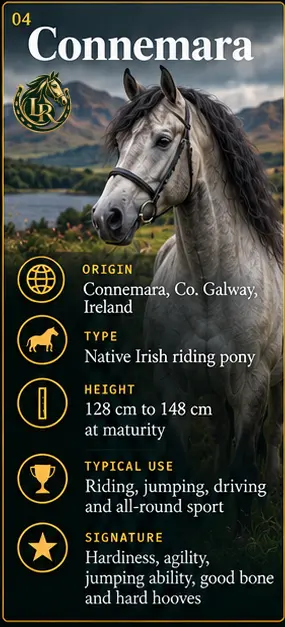 Connemara Pony on the rugged west coast of Ireland, an athletic and versatile native performance breed
What makes the Connemara special?
Connemaras combine strength, athleticism, balance and exceptional versatility.
Their powerful hindquarters and natural jumping ability have made them particularly popular for showjumping, working hunter competitions and eventing.
Many also possess a willing temperament, sufficient stamina for demanding activities and sure-footedness on uneven terrain.
Unlike some specialist competition breeds, a good Connemara can be equally comfortable competing at the weekend and enjoying a relaxed countryside hack.
Who is a Connemara suitable for?
Connemaras can suit a wide range of riders, depending on the individual pony.
A quiet, experienced Connemara might make an excellent family pony, while an athletic competition-bred individual may require a confident, capable rider.
Larger Connemaras can also be suitable mounts for appropriately sized adults.
Best suited to: Confident children, teenagers, adult riders, Pony Club competitors, eventing enthusiasts and those seeking an athletic all-rounder.
Source: Irish Pony Society — Connemara breed standard.
14. Kerry Bog Pony — The Little Pony with a Big History
- Origin: County Kerry, Ireland
- Height: Mares 102–112cm; stallions and geldings 102–117cm, approximately 10–11.2hh
- Traditional uses: Carrying peat, pack work, carting and small-farm work
- Modern uses: Children's activities, driving, showing, companionship and heritage conservation
The Kerry Bog Pony is a small native Irish breed whose survival is an important conservation story.
Traditionally, these ponies worked in the peat bogs of Kerry, where their small size, strength and ability to negotiate difficult ground made them invaluable.
The breed declined dramatically as traditional working practices disappeared, but dedicated breeders helped secure its survival.
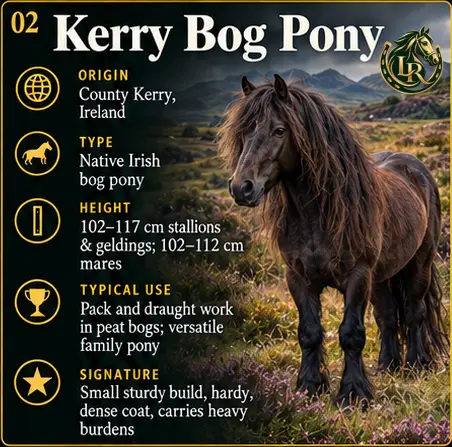 Kerry Bog Pony, a small, hardy and rare native pony from County Kerry in Ireland
What makes the Kerry Bog Pony special?
Kerry Bog Ponies are compact, sturdy and unusually strong for their size.
Their ability to travel over uneven, wet terrain reflects their traditional working environment.
They are also noted for their hardiness and generally willing nature.
Who is a Kerry Bog Pony suitable for?
Their small stature limits their ridden use, but appropriately trained individuals can suit small children.
They can also be excellent candidates for driving and in-hand activities.
Best suited to: Small children with experienced supervision, driving enthusiasts, rare-breed supporters and owners interested in conservation.
Source: Horse Sport Ireland — Kerry Bog Pony Studbook
15. Irish Draught Horse — The Strong and Versatile Working Horse
- Origin: Ireland
- Height: Ideal breed-standard range 15.2–16.3hh
- Traditional uses: Farm work, transport, hunting and general-purpose riding
- Modern uses: Hunting, showing, dressage, leisure riding and sport-horse breeding
The Irish Draught developed as a practical working horse capable of performing several very different tasks.
Farmers needed an animal strong enough to work the land, comfortable enough to ride and athletic enough to jump fences when required.
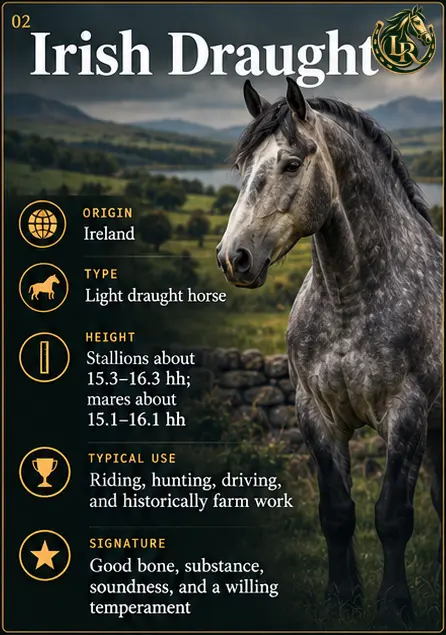 Irish Draught horse, Ireland's strong and versatile native working breed, combining substance with athletic ability
This versatility became the breed's defining characteristic.
What makes the Irish Draught special?
The Irish Draught combines substance and strength with considerably more athletic ability than might be expected from its name.
It is generally known for its robust build, good bone, powerful movement and sensible working temperament.
Its jumping ability and strength have also made it an important foundation breed in the development of the Irish Sport Horse.
Who is an Irish Draught suitable for?
A well-trained Irish Draught can make an excellent adult riding horse.
Its substantial build may appeal to riders who need a larger, stronger mount, although suitability must always be assessed individually.
Some Irish Draughts are relaxed leisure horses; others are powerful, athletic animals that require experienced riders.
Best suited to: Adult recreational riders, hunting enthusiasts, riding-club competitors and riders seeking a substantial, versatile horse.
Source: Horse Sport Ireland — Irish Draught breed standard.
16. Traditional Irish Cob — The Colourful Family and Driving Horse
- Origin: Ireland and Britain, developed through traditional travelling and working communities
- Height: Commonly around 13–16hh, although size varies by registry and type
- Traditional uses: Pulling caravans, carts and general transport
- Modern uses: Hacking, leisure riding, driving, showing and family ownership
The Traditional Irish Cob, closely associated with names such as Gypsy Cob and Gypsy Vanner, was developed for strength, stamina and suitability for harness work.
These horses became particularly associated with travelling communities, where dependable animals were essential for pulling living wagons and transporting families.
The traditional type is recognised for its substantial build, abundant mane and tail, and feathering around the lower legs.
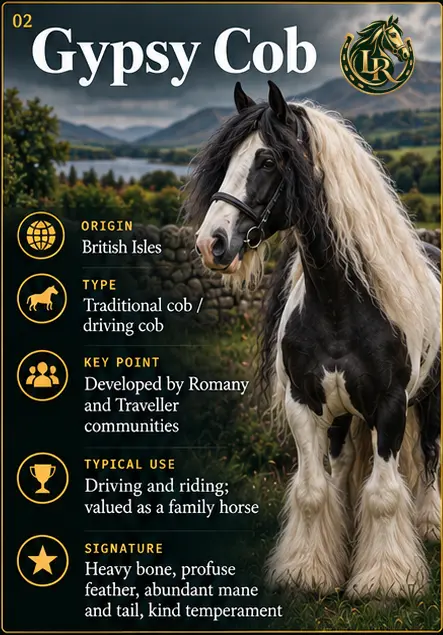 Traditional Irish Cob, also known as the Gypsy Cob, with abundant feathering and a striking coloured coat
What makes the Traditional Irish Cob special?
A good traditional cob combines strength with relatively comfortable movement and a practical working attitude.
The breed's compact, substantial build can make it a useful leisure mount, while its traditional harness background remains relevant to modern driving.
Many owners value their sociable nature and willingness to work, although these qualities depend on breeding, handling and training.
Who is a Traditional Irish Cob suitable for?
A mature, well-schooled Irish Cob can be an attractive choice for recreational riders.
However, not all cobs are quiet or suitable for beginners. Their strength can make poor handling habits difficult to manage.
Best suited to: Adult leisure riders, families, hacking enthusiasts, driving owners and riders who prefer a substantial cob type.
Breed note: Names and registration standards differ between organisations. Irish Cob, Traditional Gypsy Cob and Gypsy Vanner are closely related descriptions, but should not automatically be treated as identical studbook classifications.
The Irish Rare Breeds Society includes the Irish Cob among Ireland's traditional breeds.
Part Six: Britain's Native Heavy and Working Horses
The native heavy horses of Britain played an enormous role in agriculture, trade, industry and transport.
Before widespread mechanisation, these powerful animals were essential to everyday life.
Today, although their traditional jobs have largely disappeared, they remain valuable for driving, forestry, demonstrations, conservation work, showing and, in suitable circumstances, recreational riding.
17. Shire Horse — Britain's Magnificent Gentle Giant
- Origin: England, particularly the Midlands
- Height: Commonly around 16.2–18hh or taller
- Traditional uses: Heavy agricultural work, commercial haulage and industrial transport
- Modern uses: Driving, forestry, showing, heritage work and recreational riding
The Shire is one of the world's most recognisable heavy-horse breeds.
For generations, Shires pulled ploughs, transported agricultural produce and hauled heavily laden wagons through Britain's towns and countryside.
Their strength made them indispensable during the period before tractors and motor vehicles became widespread.
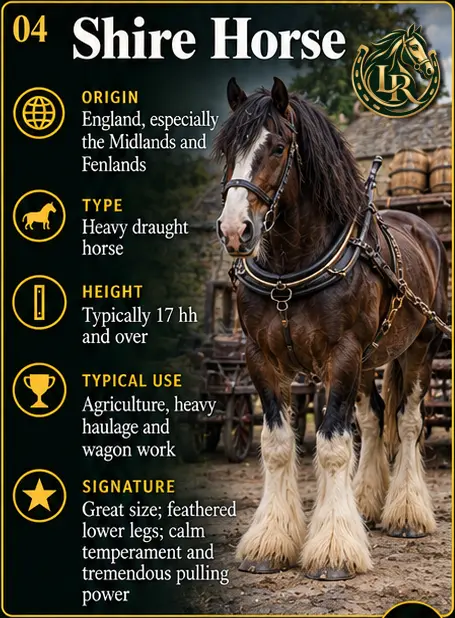 Shire Horse, Britain's gentle giant heavy horse with feathered legs and powerful build
What makes the Shire special?
The Shire's defining features are its immense strength, substantial bone, powerful frame and generally steady working disposition.
Despite their enormous size, many Shires are surprisingly willing and responsive when correctly handled.
Their combination of strength and controlled movement made them particularly valuable for pulling heavy loads.
Who is a Shire Horse suitable for?
Although some Shires are ridden successfully, their size creates practical challenges.
Tack, mounting facilities, transport, stabling, feed requirements and veterinary care all need careful consideration.
A calm temperament does not eliminate the risks associated with handling such a large animal.
Best suited to: Experienced adult owners, driving enthusiasts, heavy-horse specialists and those with suitable facilities.
18. Clydesdale — Scotland's Powerful and Elegant Draught Horse
- Origin: Lanarkshire, Scotland, particularly the River Clyde region
- Height: Commonly around 16–18hh
- Traditional uses: Agricultural work, haulage, carting and industrial transport
- Modern uses: Driving, ceremonial work, showing, forestry and leisure activities
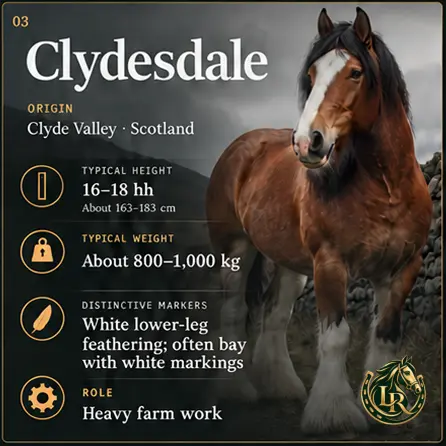 Clydesdale horse with distinctive white leg markings and abundant feathering, Scotland's elegant draught breed
The Clydesdale developed in Scotland as a strong agricultural and transport horse.
Its distinctive appearance, often featuring extensive white leg markings and abundant feathering, makes it immediately recognisable.
What makes the Clydesdale special?
Clydesdales combine great pulling strength with relatively active, expressive movement.
Their long, powerful strides made them well suited to farm and transport work.
Their spectacular appearance has also helped them remain popular in public displays and ceremonial driving.
Who is a Clydesdale suitable for?
Clydesdales can be rewarding horses for experienced owners with an interest in heavy breeds.
Some are suitable for riding, but their height, weight and considerable strength require knowledgeable management.
Best suited to: Experienced adults, heavy-horse enthusiasts, driving specialists and owners with adequate land and facilities.
19. Suffolk Punch — The Traditional English Farm Horse
- Origin: Suffolk, eastern England
- Height: Commonly around 16.1–17.2hh
- Traditional uses: Ploughing, agricultural work and farm haulage
- Modern uses: Heritage farming, forestry, driving and showing
The Suffolk Punch is one of Britain's oldest established heavy-horse breeds.
Developed principally for agricultural work, it differs noticeably from the taller, more heavily feathered Shire and Clydesdale.
All registered Suffolk Punch horses are chestnut, traditionally described within the breed as chesnut.
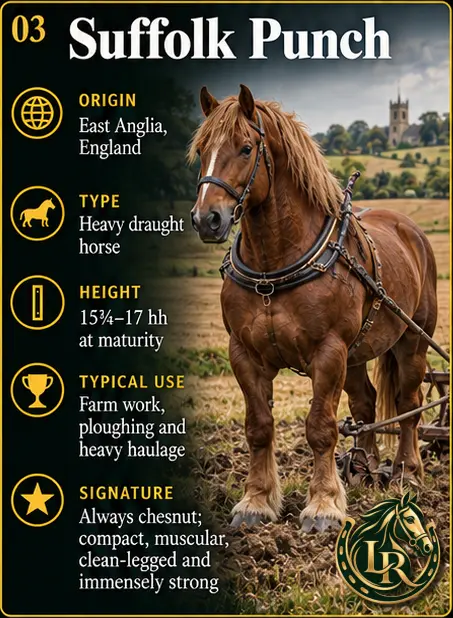 Chestnut Suffolk Punch, the traditional English farm horse with a compact, muscular build
What makes the Suffolk Punch special?
The Suffolk Punch is compact, muscular and exceptionally powerful.
Its relatively low centre of gravity and strong, rounded build reflect the requirements of heavy agricultural work.
The breed became valued for its steady pulling ability and willingness to work consistently.
Who is a Suffolk Punch suitable for?
The Suffolk Punch is generally better suited to owners interested in heavy-horse management, agricultural heritage and driving than to those seeking a conventional riding-club horse.
Best suited to: Experienced heavy-horse owners, driving enthusiasts, conservation projects and traditional farming operations.
20. Cleveland Bay — The Elegant and Versatile Yorkshire Horse
- Origin: Cleveland district of northeast England
- Height: Breed-standard guideline approximately 16–16.2hh
- Traditional uses: Pack work, coach pulling, light agricultural work and riding
- Modern uses: Driving, dressage, jumping, showing and recreational riding
The Cleveland Bay is one of Britain's historic native horse breeds.
Originally developed in Yorkshire, its strength, stamina and practical temperament made it useful for several forms of transport and work.
As carriage transport became more important, Cleveland Bays were valued for their ability to combine strength with active, efficient movement.
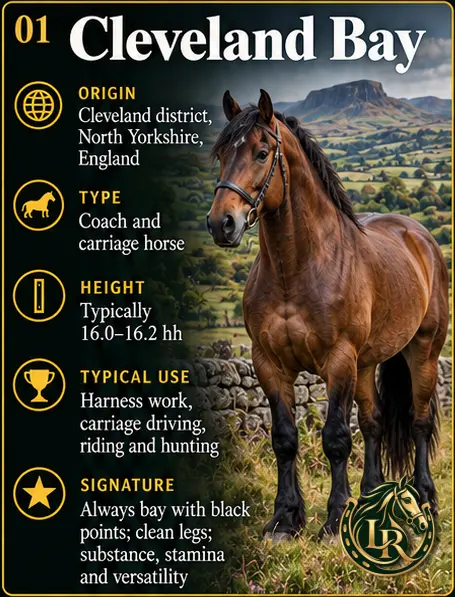 Cleveland Bay horse, the elegant bay-coloured Yorkshire breed with black points
What makes the Cleveland Bay special?
The Cleveland Bay occupies an interesting position between heavy working horses and lighter riding horses.
It combines substance, stamina and strength with the movement required for athletic work.
Its influence can also be found in the development of other European riding and carriage breeds.
Purebred Cleveland Bays are bay, with black points.
Who is a Cleveland Bay suitable for?
A well-trained Cleveland Bay can suit an adult rider seeking a larger, substantial all-round horse.
However, their size and strength mean confident handling is important.
Best suited to: Experienced adults, dressage enthusiasts, driving competitors, showing owners and riders seeking a versatile substantial horse.
Source: Cleveland Bay Horse Society — breed standard.
21. Hackney Horse and Hackney Pony — Britain's High-Stepping Performers
- Origin: England, particularly Norfolk and Yorkshire roadster bloodlines
- Height: Hackney Horse generally over 14.2hh; Hackney Pony 14.2hh or under
- Traditional uses: Road transport, carriage work and fast trotting
- Modern uses: Driving competitions, showing and selected ridden activities
The Hackney developed from horses bred for efficient, energetic trotting and road travel.
In the era before motor vehicles, horses capable of covering distances at a good pace were highly desirable.
The Hackney became particularly associated with impressive movement and carriage driving.
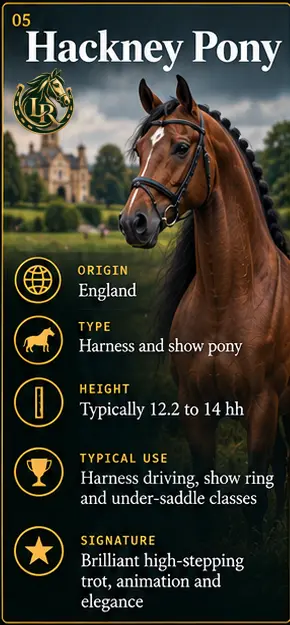 Hackney Pony showing the breed's spectacular high-stepping action and elegant carriage
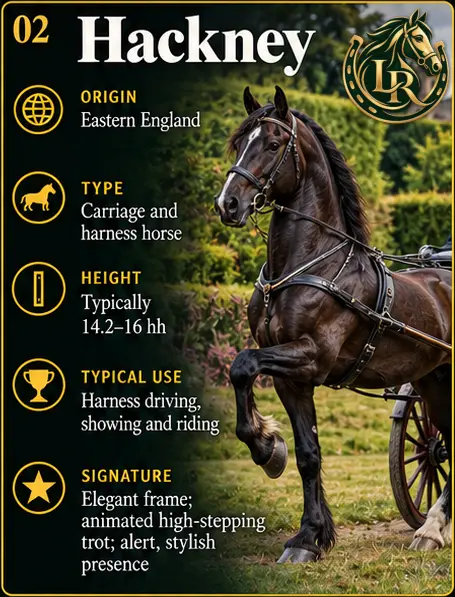 Hackney Horse showing the breed's elegant high-stepping trot and proud carriage
What makes the Hackney special?
The breed's most obvious characteristic is its exceptionally elevated, animated trot.
Strong hindquarter engagement and expressive movement give the Hackney a distinctive appearance.
Hackneys are generally energetic and athletic, characteristics valued in driving but potentially challenging for less experienced handlers.
Who is a Hackney suitable for?
Hackneys tend to appeal to knowledgeable riders and drivers who appreciate their energetic character.
They are not usually the obvious first choice for someone seeking a particularly quiet, uncomplicated beginner's horse.
Best suited to: Experienced handlers, driving enthusiasts, competitive showing owners and riders comfortable with forward-going horses.
The Hackney is recognised as a native equine breed within the UK government's native-breed framework.
Part Seven: Other Distinctive Breeds Developed in Britain
Not every breed associated with the British Isles belongs to the traditional Mountain and Moorland or heavy-horse groups.
The following two breeds illustrate how Britain's equine heritage also includes distinctive coat patterns and the development of internationally influential performance horses.
22. British Spotted Pony — Britain's Colourful Rarity
- Origin: Britain; precise early ancestry is uncertain
- Height: Miniature, riding pony and cob types, with a registered height range extending up to 14.2hh
- Traditional uses: General pony work and driving
- Modern uses: Showing, driving, recreational riding and breeding
The British Spotted Pony is notable for its distinctive spotted coat patterns.
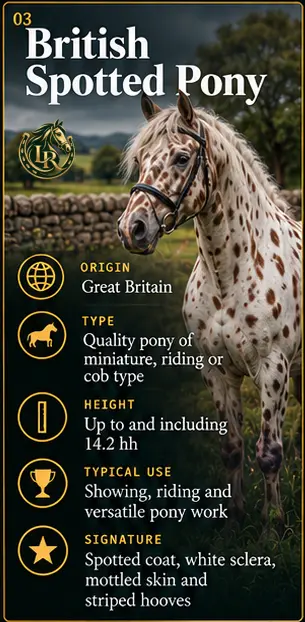 British Spotted Pony showing its distinctive spotted coat, a rare and colourful native British breed
Although spotted horses have a long history in Europe, the precise ancestry of Britain's spotted pony population is not fully established.
The modern breed's development and registration are more clearly documented.
What makes the British Spotted Pony special?
Its striking coat is the most obvious attraction, but appearance is not the only consideration.
Depending on size and type, these ponies can participate in driving, recreational riding and other suitable equestrian activities.
The breed includes substantial variation in height and build.
Who is a British Spotted Pony suitable for?
Suitability depends heavily on the particular pony's size, type, temperament and training.
A small, quiet riding-type pony may suit a child, while a larger, more substantial animal may be suitable for an appropriately sized adult.
Best suited to: Native and rare-breed enthusiasts, families, showing owners and riders who appreciate distinctive colouring.
23. Thoroughbred — Britain's Great Racing Horse
- Origin: England, developed principally during the seventeenth and eighteenth centuries
- Height: Commonly around 15.2–17hh, with considerable variation
- Original purpose: Racing
- Modern uses: Racing, eventing, showjumping, dressage, polo and recreational riding
The Thoroughbred deserves a place in any broad discussion of Britain's equine heritage, although it differs from the older regional native pony breeds.
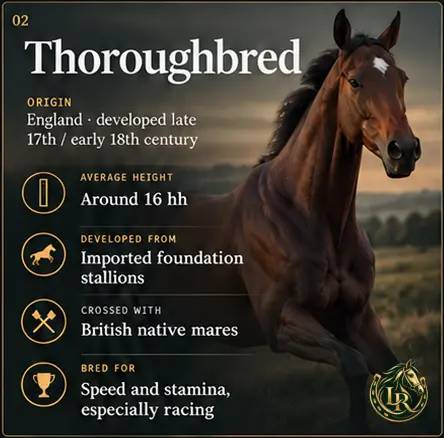 Thoroughbred horse, Britain's great racing breed, developed for speed, stamina and athletic performance
The breed was developed in Britain using imported foundation bloodlines, including Arabian, Barb and Turk-type influences, crossed with existing mares.
Selective breeding produced a horse particularly suited to speed and athletic performance.
What makes the Thoroughbred special?
Thoroughbreds are renowned for their speed, stamina, athleticism and efficient movement.
Their relatively light build and powerful cardiovascular capacity have helped make them outstanding racehorses.
Those same qualities can be valuable in eventing and other competitive disciplines.
Who is a Thoroughbred suitable for?
An appropriately retrained Thoroughbred can become an excellent riding horse.
However, many are sensitive, energetic and highly responsive, particularly when transitioning from racing.
A former racehorse may need substantial time, training and management adjustments before becoming a suitable recreational mount.
Best suited to: Experienced or well-supported riders, eventing enthusiasts, competitive amateurs and owners committed to patient retraining.
Breed note: The Thoroughbred is British-developed rather than an ancient indigenous landrace. It is included here because of its major contribution to the equestrian history of the British Isles.
The UK government's native-breeds list includes the Thoroughbred in its recognised equine classifications.
Part Eight: Which Native Breed Is Right for You?
Choosing a horse or pony should never be based solely on breed, appearance or reputation.
Nevertheless, understanding the characteristics for which a breed was developed can help you identify suitable candidates.
Native Breed Comparison Guide
The following table provides an at-a-glance overview. Rider suitability assumes an appropriately sized rider and an individual horse or pony with suitable training and temperament.
| Breed | Height | Particularly suited to | Potential rider |
|---|---|---|---|
| Exmoor | 11.1–12.3hh | Hacking, conservation | Confident child, small adult |
| Dartmoor | Up to 12.2hh | Pony Club, showing | Child, developing rider |
| New Forest | Up to 14.2hh | All-round riding, jumping | Child, teenager, small adult |
| Fell | Up to 14hh | Hacking, trekking | Confident teenager, adult |
| Dales | 14–14.2hh preferred | Hacking, driving | Confident adult |
| Shetland | Up to 10.2hh | Children's activities, driving | Small child with supervision |
| Highland | 13–14.2hh | Trekking, hacking | Teenager, adult |
| Eriskay | 12–13.2hh | Hacking, light driving | Child, lightweight adult |
| Welsh A | Up to 12hh | Children's riding, showing | Child |
| Welsh B | Up to 13.2hh | Pony Club, jumping | Established young rider |
| Welsh C | Up to 13.2hh | Riding, driving, showing | Confident teenager, small adult |
| Welsh D | Over 13.2hh | All-round riding, driving | Confident teenager, adult |
| Connemara | 12.2–14.2hh | Jumping, eventing | Confident child, teenager, adult |
| Kerry Bog | Approx. 10–11.2hh | Light work, driving | Small child, experienced handler |
| Irish Draught | Ideally 15.2–16.3hh | Hacking, hunting, all-round riding | Adult |
| Traditional Irish Cob | Commonly 13–16hh | Hacking, driving | Adult, family |
| Shire | Commonly 16.2–18hh+ | Heavy work, driving | Experienced adult owner |
| Clydesdale | Commonly 16–18hh | Driving, heritage work | Experienced adult owner |
| Suffolk Punch | Commonly 16.1–17.2hh | Farm work, driving | Experienced heavy-horse owner |
| Cleveland Bay | Around 16–16.2hh | Riding, driving, dressage | Confident adult |
| Hackney Horse/Pony | Varies by type | Driving, showing | Experienced handler |
| British Spotted | Up to 14.2hh | Showing, riding, driving | Depends on type |
| Thoroughbred | Commonly 15.2–17hh | Sport, eventing, riding | Experienced or supported rider |
Which Native Breeds Might Suit Different Riders?
For children learning to ride: Consider a well-schooled Dartmoor, Welsh Section A or suitable Shetland. The individual's training, temperament and size are far more important than the breed label.
For ambitious Pony Club riders: Connemaras, New Forest Ponies and Welsh Section Bs offer plenty of potential for riders interested in jumping, dressage and general competition.
For adults who enjoy countryside hacking: Fells, Dales, Highlands, Welsh Cobs and suitably trained Irish Cobs can offer a combination of substance, stamina and versatility.
For adult riders interested in competition: Connemaras, Welsh Cobs, Irish Draughts, Thoroughbreds and Cleveland Bays are among the breeds worth investigating, depending on the discipline.
For driving and traditional working activities: Shetlands, Fells, Dales, Welsh Cobs, Hackneys and Britain's heavy-horse breeds offer a fascinating range of driving possibilities.
Are Native Ponies Easier to Keep?
Native ponies are often described as hardy, economical and relatively low maintenance.
There is some truth in this reputation, but it needs careful interpretation.
Many native breeds developed in environments where food was limited and weather conditions were demanding. Their ability to maintain body condition on relatively modest forage was a survival advantage.
Modern domestic management can create the opposite problem.
The risk of overfeeding
Many native ponies maintain weight very efficiently. When provided with rich pasture and calorie-dense feed, some become overweight.
Obesity is associated with an increased risk of laminitis and metabolic conditions, including equine metabolic syndrome.
Owners should therefore pay particular attention to:
- Maintaining an appropriate body condition.
- Providing sufficient forage without excessive energy intake.
- Managing grazing carefully, particularly during periods of rapid grass growth.
- Providing regular, appropriate exercise.
- Monitoring hoof health and signs of laminitis.
- Seeking veterinary advice when unexplained weight gain, regional fat deposits or repeated laminitis occurs.
Native ponies should never be assumed to be immune to illness simply because they are hardy. Their digestive systems still need the same forage-based care as any horse — our guide to the horse's digestive system and gastric ulcers explains why.
Choosing the right height and carrying capacity
A strong-looking pony is not automatically capable of carrying a heavy adult.
Rider suitability depends on the combined weight of the rider and equipment, as well as the animal's conformation, fitness, age, health, soundness and the duration and intensity of work.
A short-backed, substantial pony may be capable of carrying an appropriately sized adult, but this should always be judged individually.
There is no universal weight limit that can safely be applied to every horse or pony of a particular breed.
Hardy natives still feel a British winter, too — even the toughest breeds benefit from the seasonal preparation covered in preparing your horse for winter.
Five Things to Consider Before Buying a Native Horse or Pony
1. Temperament matters more than breed reputation. A quiet individual from an energetic breed may be more suitable than a sharp or inexperienced pony from a breed regarded as docile.
2. Training and experience are essential. A well-schooled eight-year-old pony may offer a very different experience from an unbacked youngster of the same breed.
3. Consider what you actually want to do. A leisurely countryside hacker, a children's first pony and an ambitious competition prospect have very different requirements.
4. Think about management before appearance. A native pony prone to excess weight may require restricted grazing and careful forage management, while a heavy horse may need substantial facilities and specialist equipment.
5. Always obtain an independent veterinary examination before purchase. A pre-purchase examination helps identify health and soundness concerns relevant to the intended use. It cannot guarantee future soundness or suitability, but it is an important safeguard. Veterinary fees are a significant part of ownership costs — see our guide to rising equine veterinary costs in the UK for what to budget.
Part Nine: Protecting Britain's and Ireland's Native Breeds
Our native breeds are living connections to the agricultural, industrial and cultural history of the British Isles.
Without these animals, entire aspects of rural life would have developed very differently.
Yet several traditional British breeds face significant conservation challenges.
Mechanisation reduced the demand for working horses during the twentieth century. At the same time, changing agricultural practices, competition from modern riding breeds and declining breeding populations placed pressure on some traditional bloodlines.
The UK government's June 2026 Native Breeds Support list identifies several native equine breeds as at risk, including the Dales, Dartmoor, Eriskay, Exmoor, Fell, Highland and New Forest ponies, together with the Cleveland Bay, Clydesdale, Hackney, Shire, Suffolk and all four Welsh sections.
The Shetland Pony and Thoroughbred are listed separately as not at risk under that particular scheme.
These classifications relate to breeding-population thresholds. They do not mean that every at-risk breed is equally close to extinction, and other conservation organisations may use different methods to assess genetic risk.
How can horse owners help?
Supporting native breeds does not necessarily mean becoming a breeder.
Owners and enthusiasts can make a meaningful contribution by:
- Considering native breeds when searching for a suitable horse or pony.
- Supporting responsible breeders who maintain recognised studbook bloodlines.
- Visiting agricultural shows featuring native-breed classes.
- Supporting recognised breed societies and conservation organisations.
- Promoting lesser-known breeds and their practical abilities.
- Participating in suitable conservation grazing projects.
- Learning about traditional driving, farming and working-horse activities.
Responsible breeding is particularly important for rare breeds, where maintaining genetic diversity may be as important as maintaining numbers.
Conclusion: A Remarkable Equestrian Heritage Worth Preserving
From the exposed landscapes of Exmoor and the Shetland Islands to the mountains of Wales and the green countryside of Ireland, native horses and ponies represent centuries of adaptation, partnership and selective breeding.
Each breed tells a different story.
The Shetland demonstrates remarkable strength in miniature. The Connemara combines native hardiness with athletic performance. The Welsh Cob offers power and versatility, while the Fell and Highland continue the traditions of reliable working ponies.
Meanwhile, the Shire, Clydesdale and Suffolk Punch remind us how heavily British agriculture and industry once depended upon horsepower.
For modern riders, these breeds offer something equally valuable: a wide choice of temperaments, sizes, abilities and riding experiences.
The best horse or pony is not necessarily the most fashionable breed, the tallest animal or the one with the most impressive pedigree. It is the individual whose temperament, training, physical abilities and management requirements genuinely suit its rider and owner.
By appreciating and supporting our native breeds, we help ensure that an extraordinary part of our equestrian heritage remains available to future generations.
If you've enjoyed this guide, there's plenty more practical equestrian knowledge to explore in our Guides & Tips library.
Fancy a little horse-themed self-discovery? Try What Breed Are You at Heart? in Your Daily Horse Fix. It's a playful personality match, not a horse-buying recommendation.
Frequently Asked Questions
What are the main native pony breeds of Britain?
The traditional Mountain and Moorland showing groups include Shetland, Exmoor, Dartmoor, Welsh Sections A, B, C and D, New Forest, Fell, Dales, Highland and Connemara. Other native breeds include the Eriskay and Kerry Bog Ponies.
Which British native pony is best for a beginner?
A mature, well-trained Dartmoor, Welsh Section A or New Forest may be suitable, depending on the rider's size and experience. Breed alone cannot determine suitability for a beginner.
Can adults ride native ponies?
Yes. Many native breeds, including Highland, Dales, Fell, Connemara and Welsh Cobs, can be suitable for appropriately sized adult riders. The individual pony's build, condition, soundness and workload must be considered.
Which native breed is best for showjumping?
Connemara, New Forest and Welsh ponies have strong reputations as versatile jumping ponies. Individual ability, training and conformation remain the deciding factors.
What is the difference between a Fell and a Dales Pony?
Both originate from northern England and share a history of working in difficult hill country. Dales Ponies are generally more substantial, with a preferred height of 14–14.2hh, whereas Fell Ponies have a maximum height of 14hh. Both can make excellent riding and driving ponies.
Are native ponies cheaper to keep than horses?
Not necessarily. Some native ponies need less supplementary feed, but all equines require appropriate veterinary care, farriery, dentistry, forage, shelter and routine management. Their efficient metabolism can also make weight management particularly important.
Are Britain's native horse breeds endangered?
Some are at risk, although conservation status varies between breeds and assessment systems. The Eriskay Pony, Cleveland Bay, Suffolk Horse and several other native breeds are the focus of conservation efforts.
Debbie Irwin
Livery Yard Manager & Equestrian Professional
Debbie has run professional showing yards and mixed livery yards in Lincolnshire and Essex for over 30 years. She has competed and taught at various levels. She writes about practical horse health, yard life, livery and everyday horse health and management.
Support Debbie on Ko-fi ☕Found this guide helpful? LocalRiding is run independently without ads. If you'd like to chip in towards the site's upkeep, you can buy Debbie a hot drink on a cold day on Ko-fi, she'll really appreciate it.