
Horse care
Equine Winter Hoof Care: Keeping Your Horse's Feet Healthy Through the Wet and Cold
Practical advice for protecting your horse's hooves through a wet British winter: thrush, abscesses, mud fever, dry standing, field management, farrier care and daily checks.
By Debbie Irwin · 2 September 2026 · 15 min read
A British winter can be particularly challenging for your horse's hooves. Persistent rain, muddy gateways, waterlogged paddocks and freezing temperatures all place additional demands on hoof health. But with careful management, regular checks and the right farriery routine, many common winter hoof problems can be prevented.
From October through to March, horse owners across the UK face familiar challenges: fields become saturated, gateways turn to mud, and finding somewhere dry for a horse to stand can become increasingly difficult.
For some horses, winter brings little more than muddy legs and additional cleaning. Others develop softened hoof walls, loose shoes, thrush, bruising or painful abscesses.
The good news is that hoof problems aren't an inevitable consequence of winter.
Understanding how moisture affects the hoof, recognising early warning signs and maintaining a consistent routine can make a considerable difference to your horse's comfort and soundness.
This LocalRiding guide explains the practical steps owners can take to protect their horses' hooves throughout the colder months.
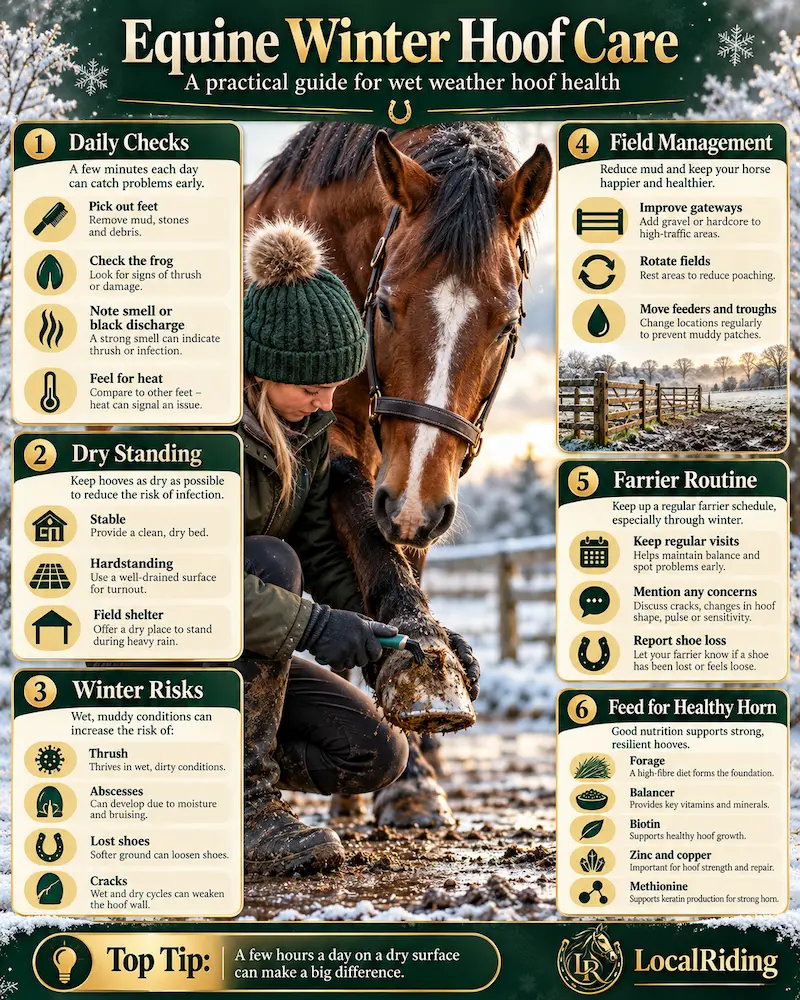 Equine winter hoof care infographic: daily checks, dry standing, winter risks, field management, farrier routine and feeding for healthy horn
1. Understanding How Winter Affects Your Horse's Hooves
The horse's hoof is a complex, living structure designed to support considerable weight, absorb concussion and withstand everyday movement over different surfaces.
Its outer hoof wall is primarily composed of keratin, a tough structural protein that provides strength and protection.
Despite its strength, hoof horn responds to environmental moisture.
The Effects of Persistent Wet Conditions
When hooves remain wet for prolonged periods, the horn absorbs moisture and can become softer.
Softened hoof horn may be more susceptible to wear, distortion and damage, particularly if the horse is travelling over abrasive or uneven surfaces.
Problems can become more pronounced when conditions repeatedly change between very wet and dry.
Moisture fluctuations can contribute to deterioration in already vulnerable horn, particularly around cracks, old nail holes and stretched white-line areas.
Winter conditions can also favour microorganisms associated with infections such as thrush.
However, moisture alone doesn't explain every winter hoof problem. Hoof balance, conformation, nutrition, infection, workload and underlying disease all influence hoof health.
Why Muddy Gateways Are Such a Problem
The worst conditions often occur in areas where horses spend considerable time standing.
Gateways, water troughs and feeding areas become heavily poached when the same ground is repeatedly churned up.
Deep mud can:
- Keep the hoof and lower leg continuously wet.
- Conceal stones, sharp objects and uneven ground.
- Make movement more difficult.
- Increase contamination around the frog and sole.
- Contribute to slipping or twisting injuries.
- Damage the skin around the pastern and heel.
Persistent mud should be viewed as a management issue, not simply an unavoidable inconvenience.
Providing suitable areas where horses can stand and move comfortably is an important part of winter welfare.
2. Common Winter Hoof Problems and How to Recognise Them
Early identification makes many hoof problems easier to manage.
Thrush: Infection of the Frog
Thrush is a common infection affecting the frog and surrounding grooves of the hoof.
The frog is the triangular, flexible structure on the underside of the foot that contributes to the hoof's normal function.
Thrush is associated with microbial activity and is often encouraged by persistently wet, unhygienic conditions or deep, poorly maintained frog clefts.
Common signs include:
- A strong, unpleasant smell.
- Dark or black discharge.
- Softened or damaged frog tissue.
- Deep, narrow grooves around the frog.
- Sensitivity when cleaning the affected area.
- Lameness in more advanced cases.
Mild cases may initially cause little obvious discomfort, which is why routine inspection is valuable.
Prevention: Pick out hooves daily, maintain clean bedding, provide dry standing and ensure regular farriery care.
If thrush develops, seek advice from your farrier or veterinary surgeon about appropriate cleaning and treatment.
Avoid applying strong chemicals, concentrated disinfectants or irritating substances to damaged frog tissue without professional guidance.
Persistent thrush, bleeding, significant tenderness or associated lameness warrants veterinary assessment.
Hoof Abscesses: A Common Cause of Sudden Lameness
A hoof abscess develops when infection becomes trapped within the hoof, creating pressure against sensitive tissues.
It can be extremely painful.
An affected horse may appear perfectly sound one day and severely lame the next.
Possible signs include:
- Sudden, marked lameness.
- Reluctance or refusal to bear weight.
- Increased warmth in the affected foot.
- A stronger digital pulse.
- Pain when pressure is applied to particular areas.
- Occasionally, swelling around the pastern or lower limb.
Abscesses may develop following bruising, penetration injuries or bacterial entry through defects in the hoof wall or white line.
Wet conditions can contribute to the risks, particularly where hoof structures are already compromised.
Important: Sudden severe lameness is not always an abscess. Fractures, penetrating injuries and other serious conditions can present similarly.
If your horse suddenly becomes severely lame or refuses to bear weight, contact your vet promptly. Do not dig into the sole or attempt to drain a suspected abscess yourself.
If a nail or other penetrating object is embedded in the hoof, leave it in place, prevent further movement and contact your vet urgently.
Loose or Lost Shoes
Some horses become more prone to losing shoes during winter, particularly if hoof horn is weakened, the shoeing interval is too long or the horse frequently moves through deep, sticky ground.
A lost shoe can damage the hoof wall and leave the sole vulnerable to bruising.
Check shoes daily for:
- Raised or displaced clenches.
- Movement between shoe and hoof.
- Bent or exposed nails.
- Uneven wear.
- A shoe that appears twisted or partially detached.
If a shoe becomes loose, stop riding and arrange professional attention.
Never continue working a horse with a partially detached shoe.
Hoof Cracks and White-Line Problems
Changes in moisture, hoof balance and mechanical loading can contribute to cracks and separation within already weakened hoof structures.
Small superficial cracks may be relatively insignificant, but deeper cracks can cause discomfort or allow contamination to enter.
Watch for:
- Cracks extending upwards towards the coronary band.
- Separation along the white line.
- Crumbling hoof-wall edges.
- Unusual flaring.
- Repeated damage around nail holes.
Discuss new or worsening cracks with your farrier.
Cracks associated with bleeding, instability or lameness require prompt professional assessment.
3. Establish a Daily Winter Hoof-Care Routine
Consistent daily care is one of the most effective ways to identify problems before they become serious.
You don't need expensive equipment or complicated products.
A hoof pick, suitable brush, good lighting and a few minutes of careful observation are often the most useful tools.
Pick Out the Hooves Every Day
Check each foot at least once daily and preferably before and after riding.
Remove mud, stones and compacted debris from the sole and around the frog.
Pay particular attention to the collateral grooves on either side of the frog and the central cleft.
Work carefully to avoid injuring sensitive or damaged tissues.
Inspect More Than Just the Sole
While lifting each foot, check:
- The condition of the frog.
- Any unpleasant odour.
- The appearance of the white line.
- Cracks, chips or broken horn.
- Loose shoes or raised clenches.
- Unusual tenderness.
- Objects lodged in the foot.
Compare all four hooves rather than examining each in isolation.
Changes in appearance or sensitivity are often easier to recognise when you know what is normal for your horse.
Check for Heat and Digital Pulses
Learning how your horse's feet normally feel can be extremely useful.
Check for unusual warmth and become familiar with the digital pulse, which can be felt near the fetlock or pastern.
A stronger-than-normal digital pulse may indicate inflammation or pain within the foot.
However, heat and pulse changes do not identify a particular disease on their own.
An increased digital pulse can occur with abscesses, laminitis and other painful hoof conditions.
If your horse is lame, reluctant to move or showing signs of significant hoof pain, seek veterinary advice rather than relying on these signs alone.
4. Give Hooves Somewhere Dry to Stand
One of the most beneficial winter management improvements is providing access to a suitable dry or well-drained surface.
Horses don't necessarily need to remain stabled simply because the fields are wet.
Indeed, prolonged confinement can create its own physical and behavioural welfare problems.
The aim is to balance movement, companionship and turnout with protection from persistently saturated ground.
Suitable Dry-Standing Options
Depending on your facilities, consider:
- A well-drained turnout area.
- Properly constructed hardstanding.
- A surfaced track or loafing area.
- A field shelter with suitable drainage.
- A clean stable with dry bedding.
The surface should be safe, comfortable and appropriate for the horses using it.
Hardstanding must be correctly constructed. Poor drainage or badly installed hardcore can create new problems, including sharp stones, uneven footing and standing water.
A clean, properly maintained surfaced area is preferable to simply spreading loose rubble over deep mud.
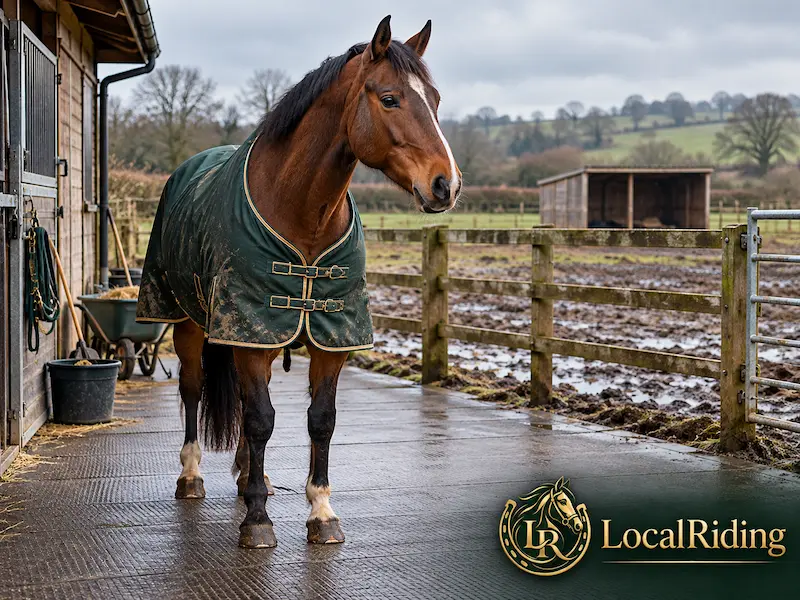 A horse in a turnout rug standing on dry rubber matting outside its stable, away from the muddy paddock
Avoid Excessive Stabling
Keeping horses indoors for long periods isn't automatically the best solution.
Movement supports normal hoof function, circulation and overall welfare.
Where field turnout is limited, consider alternative opportunities for safe movement and social contact.
The objective is not to keep hooves permanently dry, but to avoid prolonged exposure to damaging conditions while maintaining the horse's natural needs.
5. Managing Muddy Fields, Gateways and Water Troughs
Winter hoof care begins with the environment.
A badly poached gateway can undermine even an excellent daily hoof-care routine.
Improve High-Traffic Areas
Focus attention on locations where horses frequently gather.
Potential improvements include:
- Properly installed and compacted aggregate surfaces.
- Equine-appropriate ground-stabilisation systems.
- Suitable drainage.
- Reinforced entrances.
- Purpose-built surfaced feeding areas.
Avoid sharp, unstable or inappropriate materials.
Any surface installed in a horse-accessible area should be suitable for equine use and maintained so that dangerous edges or exposed components cannot cause injury.
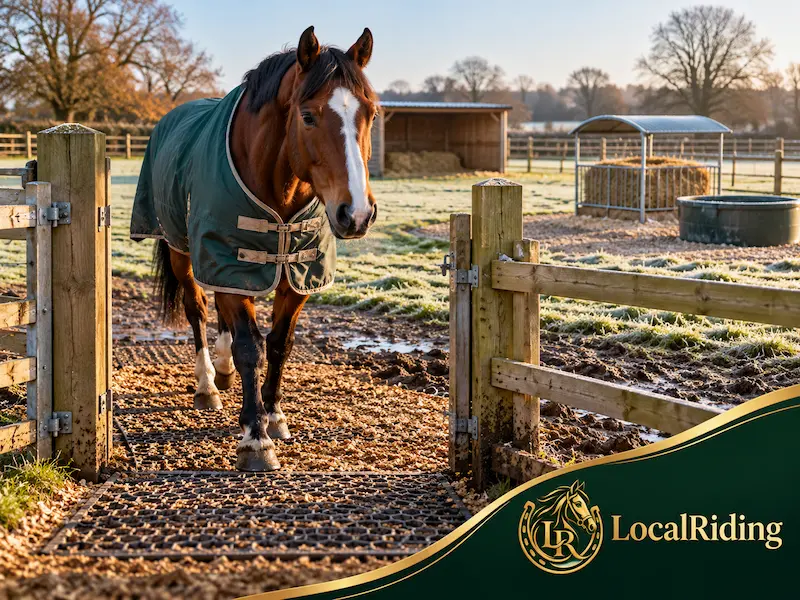 A rugged horse walking through a field gateway laid with rubber grid mats and woodchip to reduce winter mud
Rotate Fields Where Possible
Resting heavily used areas can reduce further deterioration.
However, rotation should not result in overcrowding or inadequate turnout elsewhere.
Manage Feeding Locations
Where practical, move field feeders or use designated surfaced feeding areas to reduce concentrated damage.
Make sure feeding arrangements remain safe and don't create unnecessary conflict between horses.
Monitor Water Trough Areas
Water troughs are particularly prone to becoming muddy.
Check for leaks, overflowing troughs and drainage problems.
In freezing weather, ensure water remains accessible and that ice doesn't create dangerous footing.
6. Mud Fever: Protecting the Skin Around the Hoof
Although mud fever is not a disease of the hoof itself, it is closely associated with winter leg and foot management.
Mud fever is a common term for forms of pastern dermatitis affecting the skin around the lower legs, heels and pasterns.
Prolonged moisture, skin damage and infection can contribute to the condition, although the underlying causes vary.
Recognising Mud Fever
Possible signs include:
- Crusty scabs around the pasterns and heels.
- Matted hair.
- Red, inflamed or damaged skin.
- Cracks and soreness.
- Swelling and heat.
- Lameness in more severe cases.
Horses with heavily feathered legs can be particularly difficult to inspect thoroughly.
Should You Wash Muddy Legs Every Day?
Repeatedly washing legs and leaving them damp can aggravate vulnerable skin.
For healthy skin with ordinary surface mud, it is often preferable to allow mud to dry and remove it gently when appropriate.
However, once skin becomes inflamed, cracked or infected, management may require a different approach.
Follow veterinary guidance on cleansing and treatment rather than assuming that simply leaving all mud in place is beneficial.
Avoid aggressive scrubbing or forcibly removing painful scabs.
Do Barrier Creams and Turnout Boots Help?
Barrier creams and leg protection can be useful in certain circumstances, but they're not suitable for every horse.
Products applied to dirty or damp skin may trap contaminants, while poorly fitting boots can rub or retain moisture.
Choose products carefully and monitor the skin beneath any protection.
If mud fever develops, particularly with swelling, significant pain or lameness, ask your vet to assess the condition and recommend treatment.
7. Keep Regular Farrier Appointments Throughout Winter
Your horse's hoof growth may slow during colder months, but that doesn't mean professional hoof care can be neglected.
Regular trimming and shoeing help maintain appropriate hoof balance, minimise distortion and identify developing problems.
How Often Should the Farrier Visit?
Intervals vary according to the horse's hoof growth, conformation, workload and shoeing requirements.
As a general guide:
- Shod horses commonly require attention approximately every four to six weeks.
- Barefoot horses may be able to go longer, depending on individual circumstances.
Some horses require shorter intervals, particularly where hoof balance, disease or repeated shoe loss is an issue.
Follow the schedule recommended by your registered farrier rather than automatically extending visits during winter.
Should Your Horse Be Barefoot or Shod?
Both approaches can be suitable.
Barefoot horses may manage extremely well with appropriate hoof quality, trimming, diet and working surfaces.
Other horses benefit from shoes or alternative hoof protection, particularly where they require support, additional protection or specific therapeutic farriery.
Hoof boots may also be useful for some horses during exercise.
The decision should be based on individual needs rather than the assumption that either barefoot management or shoeing is universally better.
Work as a Team
Keep your farrier informed about:
- Increased sensitivity or lameness.
- Frequent shoe loss.
- Changes in turnout.
- New cracks.
- Altered wear patterns.
- Changes to workload or diet.
If your horse is under veterinary care for a hoof problem, coordination between the vet and farrier can be especially valuable.
8. Winter Nutrition: Healthy Hooves Start from Within
Strong hoof horn depends on more than external conditions.
Nutrition, general health and metabolism all contribute to normal hoof growth.
Build the Diet Around Suitable Forage
For most horses, a balanced forage-based diet should form the foundation of daily feeding.
Appropriate vitamin and mineral intake supports the production and maintenance of healthy hoof horn.
Important nutrients include:
- Biotin, which has evidence of benefit in some horses with poor hoof quality.
- Zinc, involved in normal skin and hoof function.
- Copper, important for connective tissue and structural processes.
- Amino acids, including those needed for keratin production.
- Adequate dietary protein and energy.
However, supplementation isn't always necessary.
A suitable balancer may address nutritional gaps in a forage-based diet, but the correct choice depends on the existing diet and the individual horse.
Don't Expect Overnight Results
Hoof horn grows slowly.
Any improvement in horn quality from a corrected diet will take months to become visible and considerably longer to grow through the entire hoof wall.
It is therefore important to maintain appropriate nutrition consistently rather than regularly switching supplements in search of quick results.
Before adding several hoof supplements, consider reviewing the complete diet with a qualified equine nutritionist or veterinary surgeon.
Remember Laminitis Risk
Some horses and ponies are especially vulnerable to laminitis, including animals with metabolic disorders.
Winter doesn't eliminate that risk.
Sudden dietary changes, excess body condition and certain underlying diseases can still contribute to problems.
If your horse shows signs such as an unusual stance, reluctance to move, painful feet or strong digital pulses, contact your vet urgently.
Suspected laminitis should never be treated as a routine hoof-care problem.
9. Riding and Exercise During Winter
Winter footing presents challenges both in the field and under saddle.
Deep mud, frozen ruts, slippery surfaces and hard ground can all affect comfort and safety.
Deep Mud
Working through deep or sticky mud can increase muscular effort and create uneven loading of the limbs.
Avoid prolonged work on unsuitable ground.
Frozen Ground
Frozen ruts and hard, uneven surfaces can produce concussion and increase the risk of injury.
Choose suitable surfaces and adjust workload to the conditions.
Snow and Ice
Snow may compact into balls underneath shod hooves, creating unstable footing.
Farriers can advise on suitable snowball-prevention measures where these are needed.
Avoid riding on icy surfaces where reliable traction cannot be maintained.
Maintaining Movement
Where normal riding is restricted, appropriate alternatives may include controlled groundwork, turnout on safe surfaces or other exercise suited to the horse's condition.
Never force exercise through suspected pain or lameness.
10. Recognise When Your Horse Needs Urgent Help
Some hoof problems can initially be managed through routine farriery advice.
Others require urgent veterinary assessment.
Contact Your Vet Urgently If:
- Your horse becomes suddenly severely lame.
- The horse refuses or struggles to bear weight.
- You suspect laminitis.
- A nail or sharp object has penetrated the hoof.
- There is significant swelling, heat or severe pain.
- A wound involves sensitive structures around the hoof.
- Your horse is deteriorating rapidly.
If you suspect a serious injury, keep the horse calm, limit unnecessary movement and follow your vet's instructions.
Do not attempt to dig into a suspected abscess, remove deeply embedded objects or administer painkillers without appropriate veterinary advice.
When dealing with a painful foot, early professional assessment is usually far safer than waiting to see whether the problem resolves.
11. Your October-to-March Winter Hoof-Care Plan
Good winter hoof management is easier when you prepare before the worst weather arrives.
October–November: Prepare for Wet Weather
- Inspect drainage and turnout areas.
- Repair damaged fencing and gateways.
- Review your farrier schedule.
- Identify suitable dry-standing areas.
- Check hoof condition before prolonged wet weather.
- Review diet and forage supplies.
December–January: Maintain the Routine
- Pick out hooves daily.
- Monitor frog condition and shoe security.
- Check bedding remains clean and dry.
- Inspect pasterns and heels for mud fever.
- Watch for frozen surfaces and slippery conditions.
- Maintain appropriate movement and turnout.
February–March: Assess Winter Damage
- Review worn or damaged turnout areas.
- Check hooves for cracks and white-line problems.
- Discuss any recurring shoe loss with your farrier.
- Monitor changes in grazing and body condition.
- Plan pasture repairs and spring field management.
Actual conditions vary considerably across the UK, so adapt the schedule to your local weather rather than relying solely on the calendar.
12. The LocalRiding Winter Hoof-Care Checklist
Daily
- Pick out and inspect all four hooves.
- Check for unusual odours or discharge.
- Look for cracks, stones and debris.
- Check shoes and clenches where applicable.
- Inspect the lower legs and heels.
- Monitor movement and soundness.
- Ensure suitable dry standing is available.
Weekly
- Review muddy gateways and feeding areas.
- Check bedding and stable drainage.
- Inspect water trough surroundings.
- Monitor developing hoof cracks or wear.
- Review changes in turnout and exercise.
Throughout Winter
- Keep regular farrier appointments.
- Maintain a balanced forage-based diet.
- Provide appropriate turnout and movement.
- Adapt riding to ground conditions.
- Address signs of infection or lameness promptly.
- Review management if hoof problems repeatedly occur.
Final Thoughts: Consistency Is the Key to Winter Hoof Health
British winters will always bring challenges for horse owners.
We can't control the rainfall, prevent every field from becoming muddy or guarantee that horses will never develop a hoof problem.
But we can influence the conditions in which our horses live and the care they receive.
Daily checks, regular farriery, suitable nutrition, sensible turnout management and prompt attention to early warning signs can make a substantial difference.
Remember that healthy hooves are only one part of good winter welfare. Horses also need appropriate movement, social contact, shelter, forage and access to fresh water.
The best winter hoof-care routine isn't necessarily the most complicated or expensive. It's the one you can maintain consistently, throughout the wettest and coldest months.
With a little preparation and careful observation, your horse can come through winter comfortable, sound and ready for the better riding weather ahead.
This article provides general information and is not a substitute for individual veterinary or farriery advice.
Debbie Irwin
Livery Yard Manager & Equestrian Professional
Debbie has run professional showing yards and mixed livery yards in Lincolnshire and Essex for over 30 years. She has competed and taught at various levels. She writes about practical horse health, yard life, livery and everyday horse health and management.
Found this guide helpful? LocalRiding is run independently without ads. If you'd like to chip in towards the site's upkeep, you can buy Debbie a hot drink on a cold day on Ko-fi, she'll really appreciate it.