
Ownership
First Pony Budget: The True Cost of Owning a Pony in the UK
The purchase price is only the beginning. The main costs of owning a pony in the UK, realistic example budgets and how to avoid the financial surprises that catch first-time owners out.
By LocalRiding Team · 20 August 2026 · 15 min read
Buying your first pony is exciting, particularly when it's the fulfilment of a childhood dream. But the purchase price is only the beginning. The real financial commitment comes from keeping your pony healthy, comfortable, properly cared for and happy throughout its life.
Whether you're buying a child's first pony, a family pony or a native breed for yourself, understanding the costs before making that commitment is essential.
There's livery to pay, forage to buy, regular farrier visits, vaccinations, dental checks and insurance. Then come the unexpected expenses: a torn rug, an emergency veterinary visit or a pony that suddenly needs specialist care.
And, of course, there's the enjoyable spending: riding lessons, Pony Club activities, shows, equipment and the occasional irresistible purchase from the tack shop!
The good news is that careful budgeting can make pony ownership far more manageable.
This guide explores the main costs of owning a pony in the UK, provides realistic example budgets and explains how to avoid some of the financial surprises that catch first-time owners unprepared.
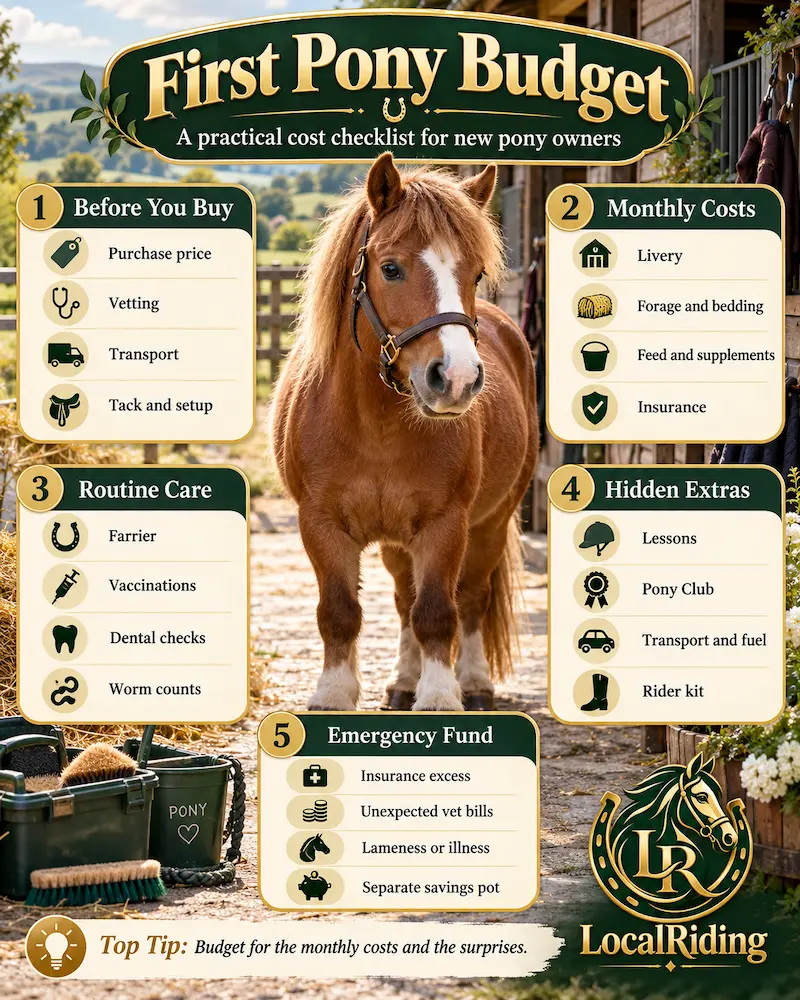 First pony budget infographic: the cost of owning a pony in the UK, from purchase and monthly costs to routine care, hidden extras and an emergency fund
1. Before You Buy: The Initial Costs
It's tempting to spend your entire budget on purchasing the best pony you can afford.
However, this could leave you short of money for the essential equipment and services needed immediately afterwards.
The Purchase Price
Pony prices vary enormously according to breed, age, size, temperament, experience and suitability for the intended rider.
An experienced, safe and reliable child's pony may command a surprisingly high price, particularly if it has a proven record in Pony Club activities, showing or competitions.
A young, inexperienced or challenging pony may cost considerably less initially, but could require more professional training and potentially present greater risks.
For a first pony, suitability and temperament should take priority over purchase price, colour, breed or appearance.
A genuinely suitable pony, even at a higher initial price, may be a safer and more economical long-term choice than an unsuitable bargain.
Pre-Purchase Veterinary Examination
Always consider arranging an independent veterinary examination before buying.
A pre-purchase examination assesses the pony's health and suitability for its intended work, although it cannot guarantee future soundness.
Typical UK guide prices in 2026 are:
- Two-stage vetting: approximately £250–£300.
- Five-stage vetting: approximately £350–£450 or more.
Veterinary travel charges and additional tests may increase the cost.
Discuss the appropriate examination with your vet, particularly if you're buying a pony for a child or plan to insure it.
Transport to the New Yard
Unless you have access to suitable transport, you'll need to arrange delivery.
Costs depend on distance, vehicle availability and whether the journey is shared with other horses.
Obtain quotations before agreeing to purchase. Check that the transporter is appropriately insured and experienced.
Essential Equipment
Your pony may come with a saddle, bridle and rugs, but never assume that everything included in a sale is suitable or in good condition.
You may need:
- A professionally fitted saddle and suitable bridle.
- Headcollar and lead ropes.
- Grooming kit and hoof pick.
- Feed and water buckets.
- Appropriate rugs, if needed.
- First-aid supplies.
- Stable tools and storage equipment.
- Suitable riding hat, footwear and other protective equipment.
A saddle should be checked by a qualified saddle fitter, even if it was previously used on the pony.
If you're buying for a child, ensure their riding hat meets a currently accepted safety standard and is professionally fitted. Never rely on a second-hand helmet with an unknown history.
Your First Pony Start-Up Fund
In addition to the purchase price, allow a separate amount for:
- Veterinary examination.
- Transport.
- Tack and equipment.
- Initial livery payment or deposit.
- Insurance.
- Any overdue routine healthcare.
- A financial emergency reserve.
LocalRiding Tip: Don't decide how much you can spend on buying a pony until you've calculated how much money you'll need to keep it.
2. The Biggest Regular Expense: Livery
Unless you have suitable land and facilities of your own, your pony will need somewhere to live.
Livery is often the largest predictable expense, and prices vary considerably across the UK.
Typical UK Livery Costs
| Type of livery | Indicative monthly cost |
|---|---|
| Grass livery | £80–£200 |
| DIY livery | £120–£300 |
| Part or full livery | £400–£1,000+ |
These broad figures reflect British Horse Society guidance reviewed in July 2026. Local quotations may fall outside these ranges.
DIY Livery
DIY is often the most economical option financially, but you take responsibility for daily care.
That normally means attending the yard to feed, check, muck out and manage your pony.
You must also arrange cover when you're ill, working late or on holiday.
Remember that DIY livery prices may not include hay, bedding, assisted turnout or other yard services.
Part Livery
Part livery provides an agreed level of assistance with daily care.
It may be particularly useful for working families, but the services included differ between yards.
Full Livery
Full livery generally covers most routine care, although exercise, tack cleaning and other services may cost extra.
It's convenient but represents a substantial financial commitment.
Grass Livery
Grass livery can be economical and may suit many native ponies particularly well.
However, living out requires suitable grazing, shelter, companionship, fresh water and additional forage when needed.
For ponies prone to laminitis or excessive weight gain, controlled grazing arrangements may be essential.
Cheaper livery isn't automatically better value. Consider the quality of care, turnout, safety, facilities and support available.
For more detailed advice, read our LocalRiding guide to Choosing the Right Livery Yard.
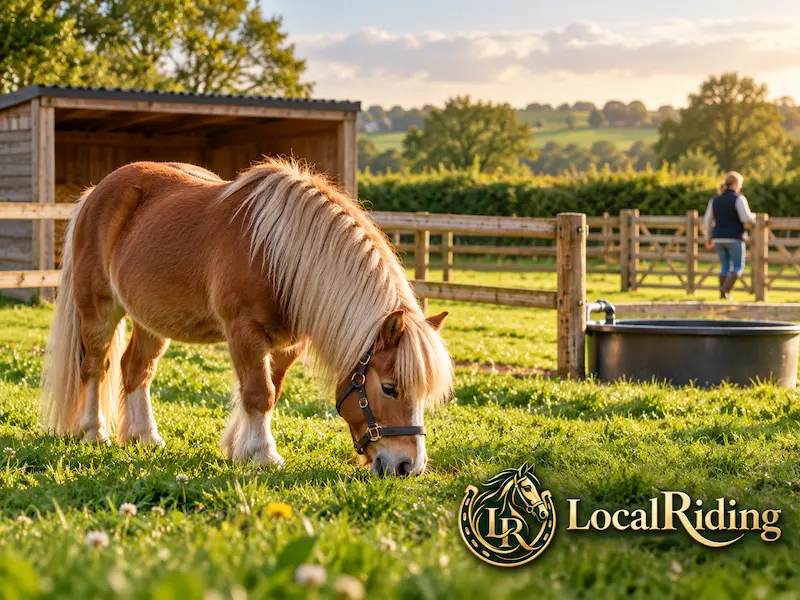 A first pony grazing in a well-fenced paddock with a field shelter and water trough
3. Feeding Your Pony: Forage Comes First
One of the most common misconceptions among new owners is that ponies require large quantities of expensive hard feed.
In reality, many healthy native ponies and good-doers can maintain their weight on an appropriate forage-based diet with suitable vitamin and mineral supplementation where needed.
Others, including growing, elderly, underweight or heavily worked ponies, may have different nutritional requirements.
Hay and Haylage
Forage is a major ongoing expense, particularly during winter or periods of restricted grazing.
The amount needed depends on the pony's weight, health, grazing availability and the nutritional value of the forage.
For example, a 300 kg pony may require approximately 4.5–6 kg of total daily dry matter from forage, depending on individual needs. If using hay, the as-fed weight will be higher because hay contains some moisture.
Ponies needing weight management may require carefully controlled forage provision rather than unrestricted access to rich grazing.
Never drastically restrict forage without professional guidance. Inadequate fibre intake and prolonged periods without suitable forage can create serious welfare problems.
Hard Feed and Supplements
Some ponies require additional feed to maintain condition or support their workload.
Others need only an appropriate vitamin and mineral supplement alongside suitable forage.
Before buying expensive feeds or supplements, establish what your pony actually requires.
An equine nutritionist or vet can help you avoid unnecessary expenditure while ensuring the diet is balanced.
Don't Forget Seasonal Changes
Your feeding budget may be relatively modest during good grazing conditions but rise considerably during winter.
Dry summers, poor hay harvests or increased transport costs can also affect forage prices.
Build sufficient flexibility into your monthly budget to accommodate these changes.
4. Bedding and Stable Supplies
If your pony is stabled, it needs suitable bedding to provide a dry, comfortable resting area.
Common options include straw, wood shavings, wood pellets and other specialist bedding materials.
The most economical option depends on local availability, the pony's needs, stable management and how much material is used.
Allow approximately £45 per month as an initial bedding budget reference, but recognise that some stabled ponies will cost considerably more, particularly during winter.
Additional purchases may include:
- Disinfectants and stable-cleaning products.
- Feed buckets and replacements.
- Bedding forks, brooms and wheelbarrows.
- Water containers and hoses.
- Stable mats and maintenance.
Check whether bedding and equipment are included in your livery arrangement before adding them separately to your budget.
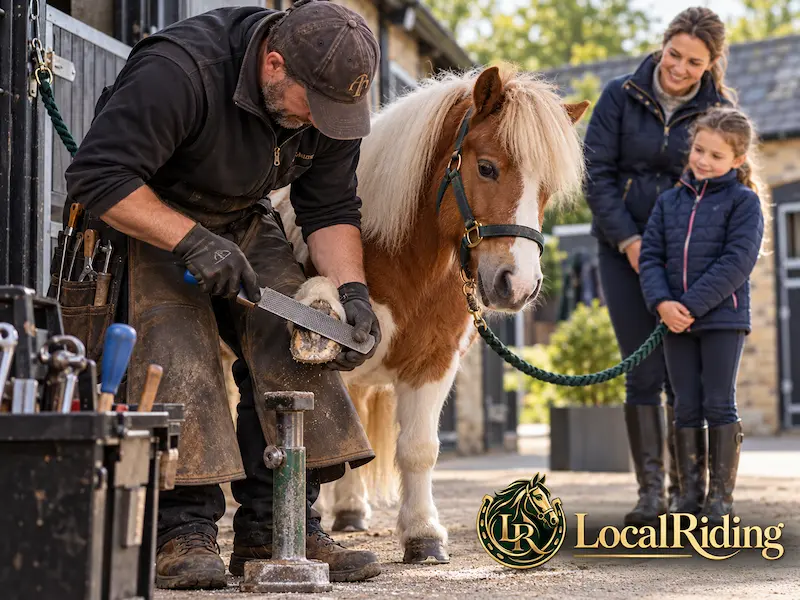 A farrier trims a first pony’s hoof while the young owner and her mother watch
5. Farrier and Hoof Care Costs
Every pony needs regular hoof care, even if it doesn't wear shoes.
Barefoot ponies still require appropriate hoof trimming and monitoring.
The frequency depends on hoof growth, conformation, workload and individual requirements.
As a general guide:
| Hoof care | Typical cost per visit |
|---|---|
| Barefoot trim | £30–£40 |
| Front shoes | £60–£70 |
| Full set of shoes | £90–£100+ |
Unshod ponies may need attention approximately every six to eight weeks. Shod ponies often require visits every four to six weeks.
These are guidelines rather than fixed intervals.
A barefoot pony trimmed every seven weeks at £35 per visit would cost approximately £260 annually.
A shod pony can cost substantially more.
Specialist remedial shoeing, hoof boots or additional veterinary care may increase expenditure.
Don't delay essential hoof care to save money. Poor hoof management can contribute to lameness and much greater expense later.
6. Routine Veterinary and Preventative Healthcare
Preventative healthcare should be part of your planned expenditure, not something you pay for only when a problem develops.
Vaccinations
Your pony will normally need vaccinations against equine influenza and tetanus, following veterinary advice and any relevant yard or competition requirements.
The frequency depends on the pony's vaccination history and the rules of the organisations involved.
If the vaccination course has lapsed or is incomplete, additional appointments may be necessary.
Ask your vet for an estimate of annual costs, including visit fees.
Dental Checks
Ponies need regular dental assessment, generally at least annually, with more frequent checks for some young, elderly or clinically affected animals.
Routine dental work is commonly around £50–£60 per visit, but sedation, travel or more complex treatment can increase the cost.
Worm Control
Modern parasite management should be based on risk assessment rather than simply administering wormers at fixed intervals.
This may involve:
- Faecal worm egg counts.
- Tapeworm testing where appropriate.
- Targeted worming following professional advice.
- Regular removal of droppings.
- Sensible pasture management.
A risk-based worm-control programme may cost approximately £50–£150 annually.
The aim is to protect your pony while reducing unnecessary treatments and the development of wormer resistance.
Saddle Fitting
Ponies can change shape considerably with age, work, seasonal grazing and changes in body condition.
An incorrectly fitting saddle can cause discomfort, pressure injuries and behavioural problems.
Allow for periodic professional saddle checks, commonly around £40–£100 per visit, plus any alteration or replacement costs.
7. Insurance: Understand What You're Paying For
Insurance deserves careful consideration because equine veterinary treatment can become expensive very quickly.
Policies differ substantially in price, exclusions, excesses and levels of cover.
Veterinary Fees Insurance
Veterinary insurance may help with eligible illness or injury costs, subject to the policy terms.
Before taking out cover, check:
- The maximum veterinary fee limit.
- Excesses and any percentage contributions.
- Exclusions for pre-existing conditions.
- Time limits on claims.
- Diagnostic imaging and referral provisions.
- Colic surgery cover, if available.
- Age-related restrictions.
- Whether exclusions could affect future treatment.
A cheaper premium can sometimes mean substantially less protection.
Public Liability Insurance
Ponies are powerful animals and accidents can occur even with a quiet, well-trained pony.
Public liability insurance is strongly recommended to protect against qualifying third-party claims.
Check whether you already have suitable cover through an equestrian membership organisation or another insurance policy before paying for additional protection.
Other Optional Cover
Depending on the pony's value and circumstances, you may also consider mortality, theft, straying, loss of use or tack insurance.
Not every type of cover will be necessary or financially worthwhile for every owner.
Important: Insurance is not a substitute for emergency savings. Owners may still face excesses, exclusions, treatment costs above policy limits and expenses that aren't insured.
8. The Costs First-Time Owners Commonly Forget
Some expenses are relatively small individually but make a noticeable difference over twelve months.
Riding and Training
Riding lessons remain valuable after purchasing your own pony, particularly for children and less experienced owners.
Professional instruction also helps owners recognise problems early and develop good riding and management habits.
Pony Club and Competitions
Memberships, rallies, camps, shows and competitions all require budgeting.
Costs may include entry fees, instruction, travel and occasional overnight accommodation.
Participation is optional, but children can quickly become enthusiastic about taking part in everything!
Transport
If you own a horsebox or trailer, allow for insurance, servicing, tyres, repairs, fuel and relevant inspections.
If you hire transport, obtain typical local quotations for routine journeys and emergencies.
Travel to the Yard
This is a particularly easy expense to overlook.
A yard ten miles from home means a twenty-mile round trip.
If you visit twice daily, that becomes forty miles a day — before allowing for lessons, vet appointments or other journeys.
Fuel, vehicle wear and travelling time can make an inexpensive but distant yard less economical than a closer alternative.
Replacement Equipment
Rugs tear, headcollars break, buckets crack and riding clothing wears out.
Maintain a small replacement-equipment allowance rather than treating every purchase as an unexpected expense.
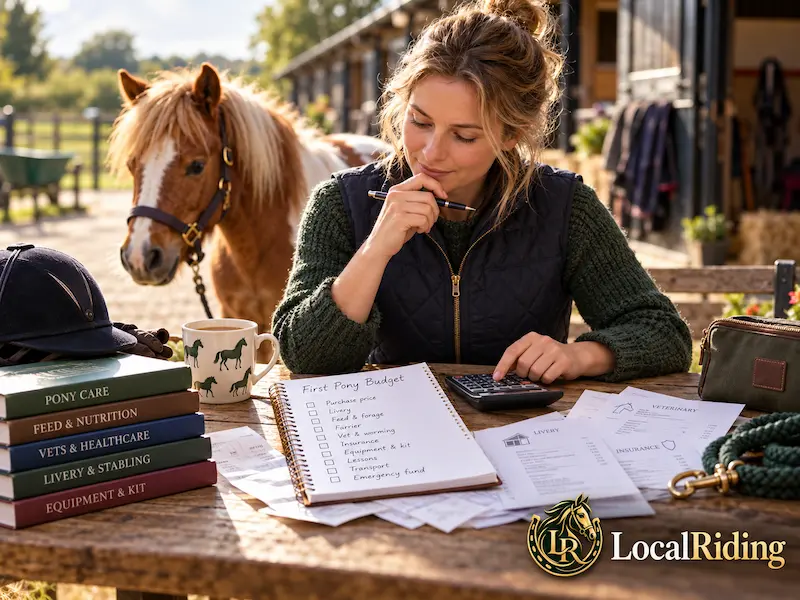 A pony owner works through a monthly first pony budget covering livery, feed, farrier, vet, insurance and kit
9. A Realistic Example: Monthly First Pony Budget
Let's consider a hypothetical family keeping a healthy, barefoot pony on DIY livery.
The example assumes a combination of grazing and stabling, independently purchased forage and bedding, and routine rather than specialist healthcare.
| Expense | Monthly allowance |
|---|---|
| DIY livery | £200 |
| Hay and forage | £85 |
| Bedding | £45 |
| Feed and supplements | £25 |
| Farrier (annualised) | £25 |
| Insurance | £45 |
| Routine healthcare and saddle checks | £35 |
| Yard travel and occasional transport | £40 |
| Equipment and miscellaneous | £30 |
| Emergency savings contribution | £75 |
| Total | £605 |
What Does That Mean Over a Year?
- Monthly budget: £605
- Annual budget: £7,260
- Of this, £900 goes into a separate emergency savings fund.
This is an illustrative planning example, not a predicted or national average cost.
The figures need adapting to local prices, the pony's circumstances and what the chosen yard includes.
It does not include the initial purchase, vetting, start-up equipment or substantial discretionary competition expenditure.
It also assumes that the emergency savings contribution remains available for future needs rather than being spent on routine care.
The important lesson is that an affordable purchase price doesn't necessarily mean affordable ownership.
10. Prepare for Unexpected Veterinary Bills
Even a carefully managed pony can develop an unexpected illness or injury.
Colic, laminitis, lameness, wounds and infectious illnesses may require urgent veterinary attention.
Some problems can be managed relatively simply; others require repeated visits, expensive diagnostic procedures, hospitalisation or surgery.
Bills can reach thousands of pounds in serious cases.
Building an Emergency Fund
Consider opening a separate savings account specifically for your pony.
Set up a standing order each month, just as you would for any other regular expense.
As a planning target, you could aim first for £500–£1,000 in readily accessible funds, then consider building towards £2,000–£3,000 or more according to your insurance arrangements and financial circumstances.
These are suggested savings targets, not guaranteed amounts sufficient to cover a particular emergency.
Even with insurance, check whether you may need to pay your veterinary practice before receiving reimbursement.
An emergency plan should include more than savings: know which vet to contact, how to arrange emergency transport and who can make decisions if you are unavailable.
Planning for Your Pony's Later Life
Pony ownership can last for decades.
A pony may eventually retire from ridden work while still requiring appropriate feeding, hoof care, veterinary attention and companionship.
Responsible ownership also means considering the costs of euthanasia and appropriate collection or disposal when the time comes.
These are difficult subjects, but financial preparation helps ensure decisions can be guided by welfare rather than immediate affordability.
11. How to Reduce Costs Without Compromising Welfare
Saving money is sensible. Cutting essential care isn't.
There are several practical ways to manage costs responsibly.
Choose a Yard That Matches Your Needs
An expensive full-livery package may be unnecessary if you have time and experience to manage your pony.
Equally, a cheap DIY yard may become costly when you add daily travel and paid assistance.
Compare the complete cost rather than the advertised livery fee.
Buy Forage and Bedding Cooperatively
Sharing bulk orders with other liveries may reduce delivery and unit costs.
Ensure feed and bedding are stored correctly and that group purchases don't compromise quality.
Buy Suitable Second-Hand Equipment
Second-hand grooming equipment, stable tools and some rugs can offer good value.
However, inspect items carefully and don't compromise on safety.
A used saddle still needs professional fitting, and protective riding equipment should meet appropriate safety requirements.
Avoid Unnecessary Supplements
Many products are marketed to horse owners, but not every pony needs them.
Seek qualified advice before adding expensive feeds or supplements.
Maintain Equipment
Cleaning and storing tack, rugs and stable equipment correctly helps prolong their useful life.
Consider a Loan or Share
A pony loan or share can provide valuable practical experience before purchasing.
It may help you understand the real demands of care, although responsibility and costs should always be clearly agreed in writing.
Never Economise on Essential Welfare
Routine farrier care, dental checks, veterinary treatment, suitable forage and safe accommodation are not optional luxuries.
Delaying necessary care may result in suffering and much more expensive problems.
12. The First Pony Budget Checklist
Before agreeing to buy, make sure you can answer the following questions.
Initial Purchase
- Have I allowed for the purchase price?
- Can I afford a suitable pre-purchase veterinary examination?
- Have I budgeted for transport and equipment?
- Is suitable livery arranged?
- Do I have emergency savings available immediately?
Regular Care
- Do I know the full monthly livery cost?
- Have I allowed for winter forage and bedding?
- Can I afford regular farrier care?
- Have I obtained insurance quotations?
- Have I budgeted for vaccinations, dental care and worm control?
Practical Ownership
- Can I afford regular travel to the yard?
- Do I have reliable care arrangements for holidays and illness?
- Have I allowed for lessons and activities?
- Can I afford to replace damaged equipment?
- Have I considered retirement and long-term care?
Financial Resilience
- Can I continue paying the essential bills if my income changes?
- Do I understand my insurance limits and exclusions?
- Can I meet the cost of a veterinary emergency?
- Have I researched realistic prices in my area?
- Am I comfortable with the annual cost rather than just the monthly estimate?
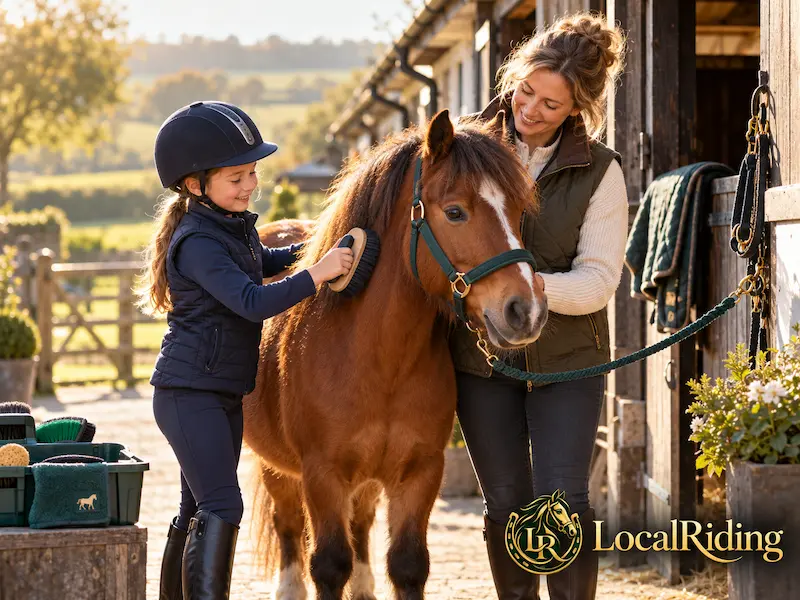 A child grooms her first pony at the yard with her mother
13. The Final Question: Can You Afford the Pony for Its Lifetime?
Buying your first pony is an emotional decision.
There's something very special about seeing a pony waiting at the gate, learning to recognise its personality and developing the trust that makes ownership so rewarding.
But a pony is also a long-term financial and welfare commitment.
Ponies may live well into their twenties or thirties, sometimes longer, and their needs change throughout their lives.
A young child's first pony might still need a loving home long after that child has grown up, gone to university or developed other interests.
Before buying, consider what happens if:
- Your child loses interest in riding.
- The pony can no longer be ridden.
- Your household circumstances change.
- You need to move home.
- Veterinary or management costs increase.
- Your income unexpectedly falls.
You don't need unlimited money to provide a pony with an excellent home, but you do need a realistic, sustainable plan.
Final Thoughts: Budget for the Pony, Not Just the Dream
Pony ownership brings enormous rewards: companionship, confidence, responsibility and countless memorable experiences.
For children, caring for a pony can teach valuable life skills. For adults, it can offer friendship, outdoor activity and a welcome escape from everyday pressures.
The key is to make sure financial commitments don't overshadow those rewards.
Research local prices, calculate your annual expenditure, maintain emergency savings and choose a pony whose needs genuinely suit your lifestyle.
A first pony should be the beginning of a wonderful partnership — not the beginning of an avoidable financial struggle.
With careful preparation, realistic expectations and a little financial discipline, owning your first pony can remain one of life's most enjoyable experiences.
LocalRiding Team
LocalRiding.com
Helping horse owners make informed decisions about equine care, management and welfare.