
Livery
Horse Livery Prices UK 2026: DIY, Part & Full Livery Costs
Compare 2026 DIY, assisted, part, full and working livery costs, understand recent price rises and plan a realistic monthly horse ownership budget.
By Debbie Irwin · 2 October 2026 · 13 min read
The cost of keeping a horse at livery has risen substantially during the first half of the 2020s. For many owners, however, the increase has not appeared as one dramatic rise. Instead it has arrived through higher livery charges, more expensive forage and bedding, increased farriery and veterinary costs, and a growing number of services that were once included in the basic livery fee becoming separately chargeable.
The best current benchmark is the 2026 Livery Pricing Survey from LiveryList/YardWise, based on 768 responses from yard owners and managers across 81 UK counties. The survey was conducted in December 2025 and published in 2026. It recorded an average £201 per calendar month for DIY livery, £516 for five-day part livery and £695 for seven-day full stabled livery. Full ridden livery averaged £1,010 per month.
Those averages conceal an enormous range. DIY prices submitted to the survey ran from £75 to £500 per month, while full ridden livery ranged from £450 to £2,123 per month. Location matters, but so do facilities, grazing, arena quality, staffing, forage and bedding allowances and precisely what yard staff are expected to do.
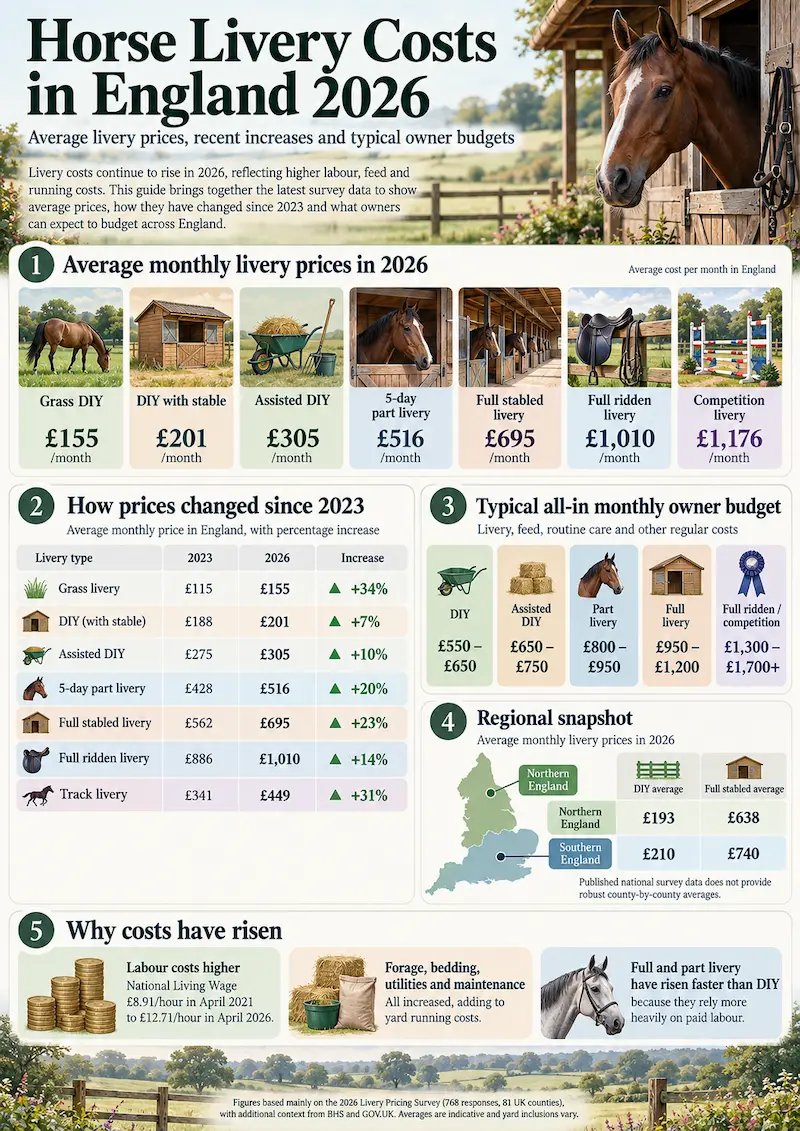
An overview of horse livery prices and the costs to consider in 2026. Open the image to view it full size.
Typical Horse Livery Prices in 2026
The following gives perhaps the clearest current picture of the market. Monthly figures are those reported by the LiveryList survey; weekly equivalents have been calculated from the monthly figures.
| Livery type | 2026 average per month | Approx. weekly equivalent | Typical arrangement |
|---|---|---|---|
| Grass DIY | £155 | £36 | Grazing; owner provides day-to-day care |
| DIY with stable | £201 | £46 | Stable and grazing; owner does all horse care |
| Assisted DIY | £305 | £70 | DIY plus regular morning or evening assistance |
| 5-day part livery | £516 | £119 | Yard provides full care for five days; owner usually covers remaining days |
| Full grass livery | £325 | £75 | Horse lives out with seven-day care |
| Full stabled livery | £695 | £160 | Seven-day care; some forage and bedding generally included |
| Full ridden livery | £1,010 | £233 | Full care plus at least two exercise sessions per week |
| Competition livery | £1,176 | £271 | Full care and exercise; competition fees and transport usually extra |
| Track/Equicentral livery | £449 | £104 | Track or Equicentral management |
| Retirement livery – stabled | £792 | £183 | Seven-day care for retired horse |
| Schooling/sales/breaking livery | £1,072 | £247 | Full care plus at least four exercise sessions per week |
These are averages rather than recommended prices. The survey itself stresses that facilities and inclusions differ greatly between yards.
The British Horse Society provides a somewhat broader consumer-facing range, putting grass livery at approximately £80–£200 per month, DIY at £120–£300 and part/full livery at £400–£1,000 or more per month in its July 2026 Horse Cost Guide.
The figures therefore agree reasonably well: a conventional DIY stable in England costing around £40–£55 per week in 2026 is not unusual, while professionally staffed full livery increasingly sits around £150–£200 per week, with premium and competition yards substantially above this.
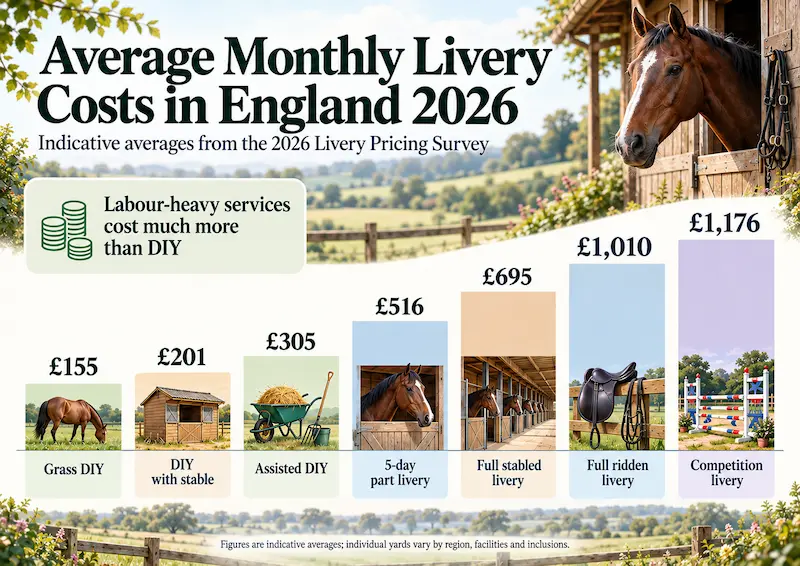
Compare average monthly livery charges alongside the detailed price table above. Open the image to view it full size.
How Much Have Livery Prices Increased?
A perfect five-year England-only comparison is difficult because there was no equivalent nationwide livery-price survey in 2021 using exactly the same methodology.
There is, however, excellent comparable data from January 2023 to the 2026 survey.
| Livery type | 2023 average | 2026 average | Increase |
|---|---|---|---|
| Grass livery | £115 | £155 | +34% |
| DIY | £188 | £201 | +7% |
| Assisted DIY | £275 | £305 | +10% |
| 5-day part livery | £428 | £516 | +20% |
| Full stabled livery | £562 | £695 | +23% |
| Full ridden livery | £886 | £1,010 | +14% |
| Track livery | £341 | £449 | +31% |
That is a significant rise over only three years.
Particularly interesting is the difference between DIY and labour-intensive livery. DIY increased by only 7%, whereas five-day part livery rose by 20% and full livery by 23%.
Labour Has Become Much More Expensive
In April 2021, the National Living Wage for workers aged 23 and over was £8.91 per hour. From April 2026, the National Living Wage for workers aged 21 and over is £12.71 per hour. Even ignoring the change in the qualifying age, that represents an increase of about 43% in the headline hourly rate.
That matters enormously to a full-livery yard. Turning out, bringing in, mucking out, filling haynets, feeding, rug changing, field management and routine checks all require paid labour seven days a week.
DIY livery passes most of that labour requirement back to the horse owner. It is therefore unsurprising that DIY prices have risen considerably more slowly than full and part livery.
General Inflation Has Also Been Substantial
The ONS Consumer Prices Index stood at 112.1 in August 2021 and 143.6 in August 2026, an increase of approximately 28% over five years.
Not every yard expense follows CPI precisely, but businesses have faced increases in electricity, fuel, machinery, fencing, insurance, maintenance, wages and consumables.
Forage has also been problematic. A 2026 survey of more than 2,100 horse owners reported significant regional shortages and prices of around £6.85 nationally for small hay bales, with many respondents actually paying £8–£12; large round bales were often £70–£100 where supplies were tight.
LiveryList reports that some yards have consequently stopped offering unlimited hay or bedding and moved those costs outside the basic livery package.
Does Location Make a Difference?
Very definitely.
For DIY livery, the 2026 survey recorded:
| Area | Average/month | Difference from UK average |
|---|---|---|
| UK | £201 | — |
| England overall | £202 | Effectively average |
| Northern England | £193 | -4% |
| Southern England | £210 | +5% |
| Wales | £168 | -17% |
| Scotland | £207 | +3% |
For seven-day full stabled livery:
| Area | Average/month | Difference from UK average |
|---|---|---|
| UK | £695 | — |
| England overall | £692 | -1% |
| Northern England | £638 | -8% |
| Southern England | £740 | +6% |
| Wales | £649 | -7% |
| Scotland | £595 | -15% |
The geographical premium is therefore more pronounced for full livery.
The published survey unfortunately does not release the underlying county-by-county averages, even though responses came from 81 counties. Producing a table saying, for example, “Lincolnshire -8%, Surrey +24%, Kent +17%” would therefore imply a degree of statistical precision the available dataset does not support.
There is clearly substantial variation within the broad regions, though. A Lincolnshire yard currently advertises seven-day full livery at £650 per month where horses live out during summer, or £845 per month for year-round stabling, with forage, bedding and routine care included.
At the other end of the geographic market, the London Equestrian Centre's 2026 working livery ranges from £635 to £750 per month, despite the owner's horse being available for use in riding-school lessons for up to 12 hours each week.
That demonstrates why postcode can sometimes matter as much as livery type.
What Exactly Are You Paying For?
One of the biggest traps when comparing livery prices is comparing labels rather than services.
There is no universally standard definition of “part livery”. One yard might mean weekday turnout and mucking out; another may include hay, bedding, feeding and rug changes. Similarly, “full livery” may or may not include exercise, grooming, holding for the vet or farrier, clipping, hard feed or unlimited forage.
Owners therefore need to compare the service specification, not simply the price.
DIY Livery
The yard normally supplies the stable, grazing and common facilities. The owner supplies the labour.
You will normally be responsible for mucking out, feeding, turnout, bringing in, rugs, grooming and arranging routine care.
Hay, bedding and feed may all be additional.
Assisted DIY
Essentially DIY with selected services purchased from the yard. A common arrangement is morning turnout and feeding by staff while the owner handles the evening routine.
It can work particularly well for horse owners with fixed working hours.
Part Livery
The yard takes responsibility for a substantial part of the horse's routine. Five-day packages are particularly common, with owners taking over at weekends.
Hay and bedding are more likely to be included, but this must be checked.
Full Livery
The yard normally takes responsibility for the horse's complete daily routine: feeding, turnout, bringing in, mucking out, rugs and routine care.
Exercise is not automatically included.
That distinction explains the gap between the 2026 averages of £695 for full stabled livery and £1,010 for full ridden livery.
Working Livery
Working livery is normally offered by riding schools. The horse receives discounted livery in return for being available for lessons.
The arrangement can offer substantial savings, but owners need to understand exactly:
- how many hours the horse can be used;
- what standard of rider may ride it;
- whether jumping is permitted;
- the owner's guaranteed riding days;
- competition availability; and
- how workload and welfare are monitored.
Working livery prices are particularly difficult to average because the economic bargain between horse owner and riding school varies enormously.
The Livery Fee Is Not the Cost of Owning the Horse
This distinction is important.
A £200 DIY livery bill does not mean the horse costs £200 per month.
The BHS's 2026 guide puts hard feed at approximately £36–£60 per month and bedding at around £45 per month. A full set of shoes typically costs £90–£100 or more, with regular visits needed, while dentistry, saddle fitting, vaccinations and worm-control programmes must also be budgeted.
Horse & Hound's March 2026 budget gives a useful example of the costs outside the basic livery charge: £60 per month for feed, £60 hay, £45 bedding, £100 insurance and £65 farriery, plus provision for vaccinations, dentistry, physiotherapy, saddle fitting and worm control.
Using current 2026 livery averages together with those owner costs gives a more realistic picture.
Illustrative Monthly Horse-Ownership Budget
For comparison, assume a normally shod ridden horse with approximately:
- £60 feed
- £100 insurance
- £65 farrier
- £8 vaccinations
- £8 dentistry provision
- £17 physiotherapy
- £12 saddle fitting
- £10 worm testing/control
That is roughly £280 per month before livery, hay or bedding.
| Arrangement | Typical livery | Likely additional monthly costs* | Approx. total |
|---|---|---|---|
| Grass DIY | £155 | £315–£400 | £470–£555 |
| DIY stable | £201 | About £385 | About £585 |
| Assisted DIY | £305 | £350–£385 | £655–£690 |
| 5-day part | £516 | £280–£340 | £795–£855 |
| Full stabled | £695 | £280–£340 | £975–£1,035 |
| Full ridden | £1,010 | £280–£340 | £1,290–£1,350 |
| Competition livery | £1,176 | £300+ before competing | £1,475+ |
*Illustrative figures only. Whether forage, bedding and feed are included materially changes the result.
Competition entries, lessons, transport, horsebox ownership, tack replacement, rug repairs and unexpected veterinary treatment are not included.
A competition horse can therefore readily cost well over £15,000 per year before substantial competition expenses or veterinary problems.
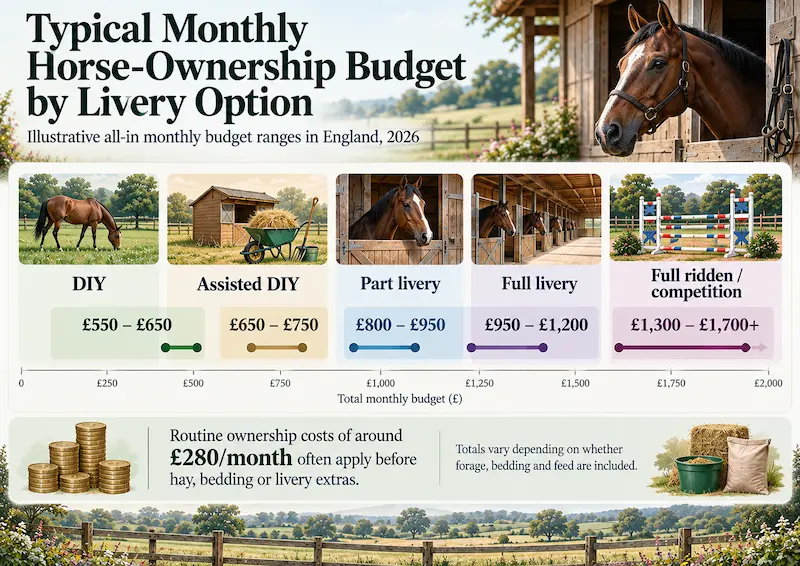
Illustrative ownership budgets include routine care as well as livery; inclusions vary by yard. Open the image to view it full size.
DIY Livery Can Have a Hidden Cost: The Owner's Time
Financial comparisons also frequently overlook the value of the owner's labour.
A DIY owner might visit the yard twice each day. If that requires only 45 minutes per visit, the total is already more than 10 hours every week, before riding.
Add driving time, mucking out, field maintenance and waiting for farriers or vets and DIY ownership can represent hundreds of hours each year.
This is why a £45–£50-per-week DIY yard should not automatically be regarded as “expensive” when compared with a £120-per-week part-livery package. The latter may be purchasing five to ten hours of somebody else's labour every week as well as forage and bedding.
Why Some Seemingly Expensive Yards May Actually Represent Better Value
The headline price needs to be considered alongside what the yard provides.
A £50-per-week DIY yard that includes an all-weather arena, year-round turnout, secure tack storage, horsebox parking, water and electricity may offer better value than a £35 yard where hay, turnout, arena use, trailer storage and lighting are separately charged.
Similarly, a £170-per-week full-livery yard including unlimited forage, quality bedding, seven-day turnout and bring-in, appointment attendance and arena use may ultimately cost less than a nominal £140 package carrying £150–£200 a month in extras.
This is becoming particularly important as businesses try to control unpredictable forage and bedding costs.
Are Livery Yards Simply Increasing Prices to Improve Profits?
The available evidence suggests a more complicated picture.
LiveryList reported that rising forage costs, staffing costs, minimum-wage increases and general operating expenses have made financial viability a major concern since Covid. Some yards have closed because their previous pricing structure was no longer sustainable.
Almost 40% of survey respondents said they had changed their packages, services or operation, including reducing inclusions such as unrestricted forage or bedding.
In other words, part of the recent increase represents the industry catching up with costs that had previously been absorbed by yard owners.
That may also explain the striking difference between the survey's cheapest and most expensive yards. At the extreme ends, a DIY place cost £75 per month while another charged £500; full stabled livery ranged from around £303 to £1,550. Those cannot sensibly be assumed to be identical products simply because they carry the same livery label.
What Should a Horse Owner Budget in 2026?
For an ordinary leisure horse in England, a sensible starting point is approximately:
- DIY: around £550–£650 per month all-in for routine ownership.
- Assisted DIY: around £650–£750 per month.
- Part livery: roughly £800–£950 per month.
- Full livery: commonly £950–£1,200 per month, potentially substantially more in southern England and premium yards.
- Full ridden/competition livery: approximately £1,300–£1,700+ per month before competition entries, transport, coaching and major veterinary expenses.
These should be treated as budgeting figures rather than tariffs. A barefoot native pony living mainly at grass will cost considerably less; a large competition horse requiring specialist feed, four shoes, extensive bedding and professional schooling can cost considerably more.
To try your own local figures, use our First Pony Budget Calculator, which keeps livery charges, routine care and emergency savings separate.
The Bottom Line
The interesting story in the 2026 figures is not simply that horse livery has become more expensive.
It is where the largest increases have occurred.
Between 2023 and 2026, DIY rose just 7%, compared with 20% for five-day part livery and 23% for full stabled livery. At the same time, the statutory National Living Wage has risen approximately 43% since 2021, while general consumer prices have increased by roughly 28% over the same five-year period.
That strongly suggests that labour, forage and operating costs are increasingly determining the livery price, rather than the stable itself.
For horse owners, that makes comparing yards more complicated—but also more important. The meaningful question in 2026 is no longer simply:
“How much is your livery?”
It is:
“What exactly does that price include?”
County-by-County Livery Price Comparisons
A precise county-by-county percentage table is not currently supported by the published national dataset. The 2026 LiveryList study collected responses across 81 counties but publishes regional North/South England results rather than individual county sample sizes and averages.
Publishing figures such as “Lincolnshire -8%, Surrey +24% or Kent +17%” without a sufficiently large county-level dataset would therefore imply a level of accuracy that the available evidence does not justify.
A useful future development would be a dedicated 2026 England Livery Price Index based on advertised prices from multiple yards in each county, separated into DIY, assisted DIY, part, full and working livery. That would allow meaningful comparisons between areas such as Lincolnshire, Yorkshire, Kent, Essex, Surrey and the West Midlands.
For context, a DIY price of £45 per week equates to approximately £195 per calendar month, which sits very close to the 2026 survey averages of £201 nationally and £202 for England.
Sources and Further Reading
- LiveryList / YardWise — 2026 Livery Pricing Survey Findings
- British Horse Society — Horse Cost Guide UK
- GOV.UK — National Minimum Wage and National Living Wage Rates
- Office for National Statistics — Inflation and Price Indices
- LiveryList — UK Hay Availability and Pricing Survey
- Horse & Hound — How Much Does a Horse Cost Per Month?
- Cliff Farm Livery — Full and Part Livery Prices
- London Equestrian Centre — Livery
Debbie Irwin
Livery Yard Manager & Equestrian Professional
Debbie has run professional showing yards and mixed livery yards in Lincolnshire and Essex for over 30 years. She has competed and taught at various levels. She writes about practical horse health, yard life, livery and everyday horse health and management.
Support Debbie on Ko-fi ☕Found this guide helpful? LocalRiding is run independently without ads. If you'd like to chip in towards the site's upkeep, you can buy Debbie a hot drink on a cold day on Ko-fi, she'll really appreciate it.