
Training
Understanding Horse Body Language: What Is Your Horse Telling You?
A practical UK guide to reading horse body language — ears, eyes, facial expression, tail, posture, ridden behaviour, stress and pain signs.
By Debbie Irwin · 21 April 2026 · 12 min read
Horses are highly expressive animals who communicate constantly through posture, movement, facial expression and behaviour. Learning to read these signals helps you become a safer, kinder and more confident horse owner, rider or handler.
Body language should never be read from one signal alone. A horse with pinned ears may be angry, sore, worried, concentrating or simply warning another horse to move away. Good interpretation means looking at the whole horse, the situation, the horse's normal behaviour and any recent changes.
Why horse body language matters
Horses are prey animals. Their first response to uncertainty is often to avoid, freeze or flee. Before a horse bites, kicks, bolts, refuses, bucks or rears, they will usually give smaller warning signs. These may include tension, avoidance, pinned ears, tail swishing, moving away, wide eyes, raised head carriage, reluctance to be touched, or changes in breathing and posture.
Recognising these early signals can help you:
- Handle horses more safely on the ground.
- Notice discomfort before it becomes a bigger problem.
- Improve ridden communication.
- Reduce stress during grooming, tacking up, travelling and vet visits.
- Build a more trusting relationship with your horse.
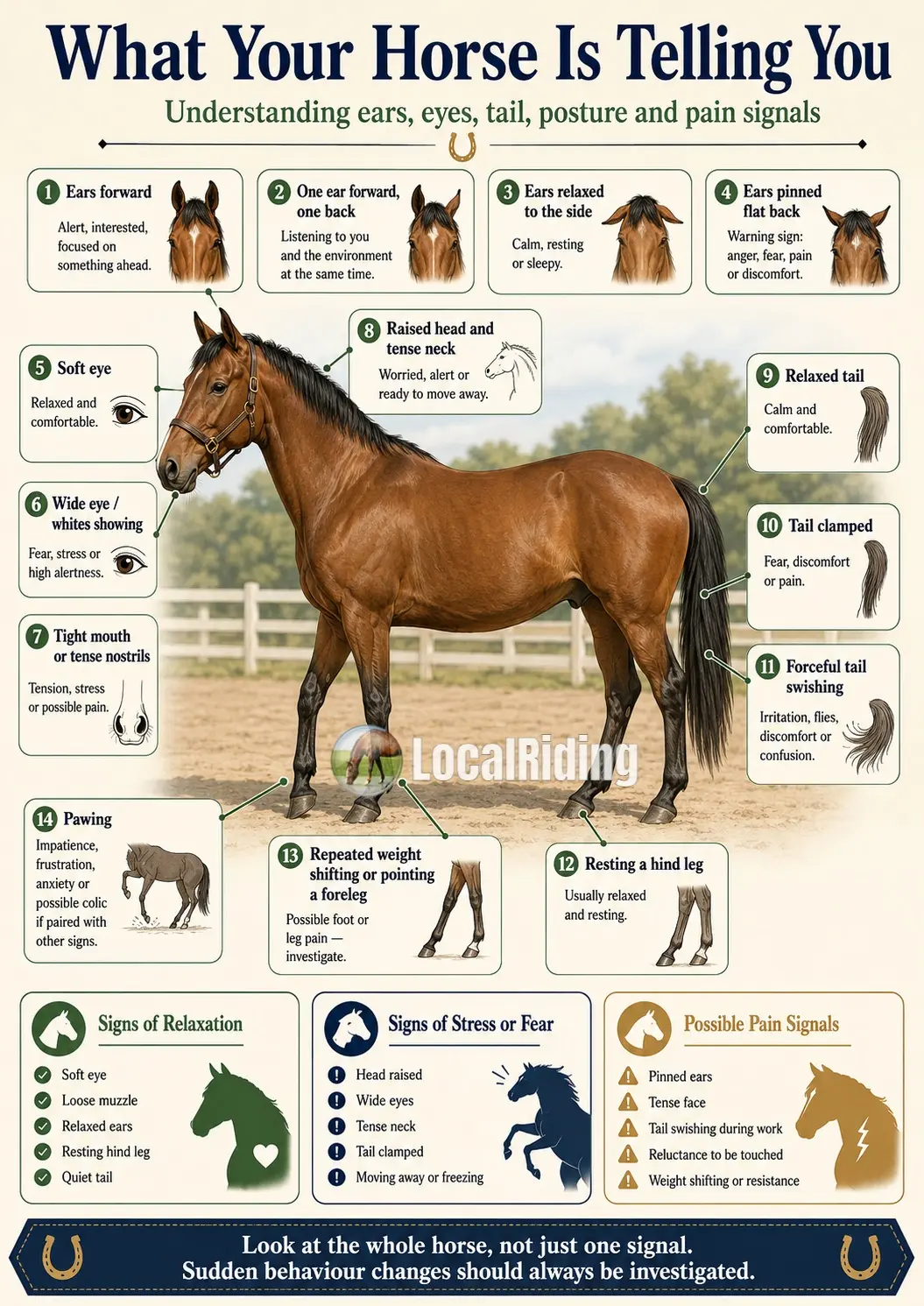 Annotated infographic showing horse body language signals — ears, eyes, mouth, tail, leg positions and pain signs — with summary panels for relaxation, stress and pain
A quick visual reference for the main horse body language signals. Always read the whole horse — not one signal in isolation.
The ears: one of the clearest signals
A horse's ears are highly mobile and often give useful clues about attention, mood and tension. However, ears should always be interpreted with the eyes, nostrils, mouth, head carriage, tail and body posture.
Ears pricked forward
Forward ears usually indicate interest, alertness or attention. Your horse may be watching something in the distance, listening to another horse, or focusing on an object, person or movement.
One ear forward and one ear back
This often means the horse is splitting attention between two things. Under saddle, one ear may be listening to the rider while the other tracks the environment. This is common and not necessarily a problem.
Relaxed ears
Ears resting softly to the side can suggest relaxation, dozing or contentment, especially if the horse has a soft eye, lowered head and loose muscles.
Ears pinned flat back
Ears laid flat against the neck are a warning sign. They may indicate anger, fear, pain, frustration, defensive behaviour or a desire to be left alone. Do not ignore pinned ears, especially if combined with a tense muzzle, wrinkled nostrils, tail swishing, lifting a hind leg, threatening to bite or turning the hindquarters towards you.
Eyes and facial expression
The eyes can reveal a great deal about how a horse is feeling. Look for softness, tension, blinking, eye shape, and whether the whites of the eyes are showing.
Soft eyes
A relaxed horse often has a soft, calm eye. The eyelids may look slightly drooped, the facial muscles appear loose, and the horse may blink normally. This is commonly seen when a horse is resting, being groomed gently, or feeling secure.
Wide or white-rimmed eyes
A wide eye showing the white can indicate fear, surprise, stress or high arousal. Some horses naturally show more white than others, so compare the expression with that horse's normal face and the situation.
Hard or tense expression
Tension around the eye, a fixed stare, tight nostrils, compressed lips or a clenched jaw may suggest stress, discomfort or pain. A horse that looks "shut down" or unusually dull may also be unwell or overwhelmed.
Facial signs of pain
Research into equine pain has shown that horses may display recognisable facial changes when in pain. These can include tension above the eyes, a withdrawn or unfocused expression, strained chewing muscles, a tense mouth, dilated nostrils and changes in ear position. Pain-scoring systems such as the Horse Grimace Scale were developed to help assess these facial changes more objectively.
Important: facial expression can support your judgement, but it is not a substitute for veterinary assessment. If your horse's expression changes suddenly or is accompanied by lameness, colic signs, sweating, reluctance to move, loss of appetite or abnormal behaviour, contact your vet.
Nostrils, muzzle and mouth
The lower face is often overlooked, but it can provide important information.
Relaxed muzzle
A relaxed horse usually has soft lips, a loose muzzle and normal breathing. The nostrils should not look tight, flared or strained at rest.
Wrinkled or elongated nostrils
Wrinkled, flared or elongated nostrils can appear when a horse is anxious, angry, in pain, working hard or highly alert. Consider the context: a horse galloping in a field will flare the nostrils normally, but a horse standing still with tense nostrils and pinned ears may be warning you.
Tight mouth or clenched jaw
A tight mouth, clamped lips, grinding teeth or a tense jaw can be signs of discomfort, stress, dental pain, bit discomfort, gastric pain or general tension. If this appears during ridden work, check teeth, bit fit, bridle fit, saddle fit and rider contact.
Licking and chewing
Licking and chewing can have different meanings. It may occur when a horse is relaxed, processing information, anticipating food, or coping with stress. Avoid assuming it always means submission or relaxation. Look at the whole body and situation.
Head and neck position
Head carriage changes with attention, balance, training, pain and emotion.
Lowered head and relaxed neck
A horse standing with a low head, relaxed neck, soft eyes and resting posture is often calm or sleepy. However, a very low head combined with dullness, reluctance to move or loss of appetite may suggest illness.
High head and tense neck
A raised head, rigid neck and fixed stare often suggest alertness, worry or tension. The horse may be preparing to move away from something they find threatening.
Turning the head away
Turning away from a person, saddle, bridle, brush or rug may be an avoidance signal. The horse may be worried, confused, sore, or anticipating something unpleasant.
Tail carriage and movement
The tail is another useful indicator, especially when read with the rest of the body.
Relaxed tail
A relaxed tail usually hangs naturally and moves softly with the horse's body. Gentle swishing may simply be a response to flies.
High or arched tail
A raised tail can indicate excitement, playfulness, alertness, high spirits or social display. Some breeds naturally carry their tails higher than others.
Clamped tail
A tail pressed tightly against the hindquarters can indicate fear, anxiety, discomfort, cold, back pain or reluctance. If this appears with a tight back, hollow posture or resistance to being touched, investigate further.
Vigorous tail swishing
Repeated or forceful tail swishing, especially during ridden work, may indicate irritation, discomfort, frustration, flies, poor saddle fit, back pain, sharp teeth, bit discomfort or confusing rider aids. It should not be dismissed as "naughtiness" without checking for causes.
Legs, feet and weight shifting
How a horse stands and uses their legs can reveal comfort, irritation or pain.
Resting a hind leg
A horse resting one hind leg with the toe touching the ground is often relaxed. This is common when resting or dozing. The horse should be able to stand square and use the leg normally when asked to move.
Resting or pointing a foreleg
Repeatedly resting, pointing or unloading a foreleg can indicate pain in the foot, leg or shoulder. Unlike a relaxed hind-leg rest, persistent foreleg pointing should be investigated.
Shifting weight
Constantly shifting weight from one foot to another may indicate discomfort, foot pain, laminitis, soreness, fatigue or stress. If your horse is unwilling to bear weight or seems very uncomfortable, seek veterinary advice promptly.
Pawing the ground
Pawing can mean impatience, frustration, anxiety, anticipation of food, or pain. Pawing combined with looking at the flank, sweating, lying down or loss of appetite may be a sign of colic and should be treated urgently.
Stamping
Stamping is often a response to flies or irritation, but repeated stamping can also suggest skin irritation, mites, pain or frustration. Check the legs, feathers, skin and environment.
Lifting a hind leg
A horse lifting or threatening with a hind leg may be warning you to move away. This can happen when the horse is angry, frightened, sore, defensive or protective. Give the horse space and assess why they feel threatened.
Whole-body posture
Individual signs are useful, but whole-body posture often gives the clearest picture.
Relaxed posture
- Soft eye
- Loose jaw and muzzle
- Relaxed neck
- Natural breathing
- Quiet tail
- Even weight bearing
- Willingness to interact
Alert or worried posture
- Head raised
- Ears fixed on a sound or object
- Wide eyes
- Tense neck and back
- Tail raised or clamped
- Frozen stance or quick sideways movement
- Snorting or sharp breathing
Defensive or aggressive posture
- Ears pinned back
- Head snaking or swinging towards the target
- Threatening to bite
- Turning hindquarters towards a person or horse
- Lifting or waving a hind leg
- Swishing tail sharply
- Squealing, striking or kicking
Reading body language while grooming
Grooming is a useful time to learn your horse's preferences and notice discomfort.
Signs your horse is enjoying grooming
- Soft eyes
- Relaxed lower lip
- Leaning gently into the brush
- Mutual grooming gestures
- Lowered neck
- Calm breathing
Signs your horse may be uncomfortable
- Moving away from the brush
- Pinning ears
- Tail swishing
- Skin twitching repeatedly
- Biting at the air, rope or handler
- Threatening to kick
- Flinching when a particular area is touched
If your horse reacts strongly to brushing over the back, girth area, belly, poll, ears or legs, consider pain, ulcers, skin sensitivity, poor previous experiences, tack discomfort or fear. Adjust your handling and investigate the cause.
Body language when tacking up
Many horses show early signs of discomfort during tacking up. These signs are often labelled as bad manners, but they may be important welfare clues.
Warning signs during tacking up
- Walking away when the saddle appears
- Pinning ears when the girth is tightened
- Biting, nipping or swinging the head round
- Tail swishing
- Tensing the back
- Holding the breath or bloating the girth area
- Refusing the bit or raising the head for the bridle
- Becoming withdrawn or shut down
Possible causes include poor saddle fit, girth discomfort, back pain, ulcers, dental pain, bit discomfort, bridle pressure, poor handling history or anticipation of stressful work. If the behaviour is new, worsening or intense, seek professional advice.
Body language under saddle
Ridden behaviour is communication. A horse who resists, rushes, naps, bucks, rears, refuses or becomes difficult may be confused, frightened, uncomfortable or in pain.
Signs of tension or discomfort when ridden
- Ears pinned or constantly flicking back in tension
- Tail swishing during transitions or leg aids
- Hollowing the back
- Opening the mouth or crossing the jaw
- Head tossing or repeated snatching at the reins
- Rushing, jogging or refusing to go forward
- Resistance on one rein
- Difficulty bending one way
- Unusual spooking or startle responses
- Bucking, rearing, bolting or planting
These signs do not automatically mean the horse is being difficult. Check pain, tack fit, teeth, feet, workload, rider balance, training gaps and environmental stress before assuming a behaviour is deliberate disobedience.
Recognising stress in horses
Stress can be short-term, such as when a horse is startled, or long-term, such as when a horse is not coping with their routine, workload, environment or social situation.
Possible signs of stress
- Calling repeatedly
- Box walking or fence walking
- Weaving or crib-biting
- Loss of appetite
- Dullness or withdrawal
- Excessive reactivity
- Reluctance to be caught
- Sudden change in ridden behaviour
- Girthiness or sensitivity
- Poor performance
- Aggression towards people or horses
Stress may be linked to pain, gastric ulcers, isolation, restricted turnout, unsuitable feeding, inconsistent handling, travel, competition pressure, lack of forage, lack of companionship or an inappropriate workload.
Recognising pain: subtle signs matter
Horses may hide pain, especially around unfamiliar people or in busy environments. Chronic pain can be subtle and may show as a change in behaviour rather than an obvious limp or wound.
Signs that may indicate pain
- Change in personality or general demeanour
- Reluctance to be groomed, tacked up or mounted
- Reduced appetite
- Standing apart from other horses
- Repeatedly lying down or not lying down at all
- Changes in facial expression
- Reduced performance
- Becoming nappy, resistant or explosive
- Uneven movement or reluctance to turn
- Difficulty with transitions
- Repeated ear pinning, tail swishing or tension under saddle
A horse who was previously forward-going and willing but becomes reluctant, resistant or anxious is telling you something important. Do not simply push through the behaviour. Investigate the cause.
Signs you should call a vet
Body language can alert you to a problem, but some situations need prompt veterinary advice.
Contact your vet if you notice:
- Sudden or severe behaviour change
- Signs of colic, such as pawing, flank watching, sweating, lying down or rolling
- Reluctance to bear weight on a limb
- Persistent lameness or stiffness
- Loss of appetite or dullness
- Abnormal breathing or sweating at rest
- Repeated signs of pain when tacking up or riding
- Unexplained aggression
- Headshaking, mouth pain signs or difficulty eating
- Any behaviour that is unusual for your horse and does not resolve quickly
How to respond to your horse's signals
Reading body language is only useful if you respond appropriately. The goal is not to punish communication, but to understand and address it.
Practical steps
- Pause and assess the whole situation.
- Give the horse space if they are warning you.
- Check whether the horse is frightened, confused or in pain.
- Look for patterns: when, where and with whom does the behaviour happen?
- Review tack fit, dental care, foot balance, workload and routine.
- Use calm, consistent handling rather than force.
- Seek help from a vet, qualified behaviourist, saddle fitter, dentist, farrier or instructor where needed.
Quick body language reference guide
| Signal | Possible meaning | What to do |
|---|---|---|
| Ears forward | Alert, interested, focused | Notice what the horse is looking at |
| Ears pinned flat | Anger, fear, pain or warning | Give space and assess the cause |
| Soft eye and relaxed muzzle | Calm or comfortable | Continue gentle handling |
| Wide eye showing white | Fear, stress or high arousal | Reduce pressure and increase safety |
| Tail clamped | Fear, discomfort or pain | Check context, body and tack |
| Forceful tail swishing | Irritation, flies, pain or confusion | Check environment, tack and rider aids |
| Pawing | Impatience, frustration, anxiety or pain | Check for colic signs or stress triggers |
| Repeated weight shifting | Foot pain, discomfort or stress | Check feet and seek advice if persistent |
Frequently asked questions
How can I tell if my horse is happy?
A content horse often appears relaxed, with soft eyes, a loose muzzle, normal breathing, relaxed ears, steady appetite and willingness to interact. Happiness also depends on good welfare: turnout, companionship, forage, comfort, appropriate work and freedom from pain.
Why does my horse pin their ears when I tack up?
This may indicate discomfort, anxiety or anticipation of pain. Check saddle fit, girth, back, teeth, bit, bridle fit and past experiences. If the behaviour is new or worsening, seek professional advice.
Does tail swishing always mean pain?
No. Tail swishing may be caused by flies, excitement or irritation. However, repeated forceful tail swishing during ridden work can indicate discomfort, poor tack fit, confusing aids or pain and should be investigated.
What does it mean when a horse shows the whites of their eyes?
It can be a sign of fear, surprise or stress, although some horses naturally show more white than others. Always compare with the horse's normal expression and read the whole body.
Why does my horse move away when I approach?
Your horse may be worried, avoiding being caught, anticipating work, experiencing discomfort, or responding to previous handling. Approach calmly, avoid chasing, and look for patterns in when the behaviour happens.
Can horses hide pain?
Yes. Some horses show pain subtly through changes in behaviour, facial expression, posture, appetite, movement or performance. A sudden change in behaviour should always be taken seriously.
Final advice
Your horse is communicating all the time. The more carefully you observe, the better you will understand what is normal for that individual horse and what might signal stress, fear, discomfort or pain.
Good horsemanship begins with listening. If your horse's behaviour changes, do not dismiss it — investigate it.
Debbie Irwin
Livery Yard Manager & Equestrian Professional
Debbie has run professional showing yards and mixed livery yards in Lincolnshire and Essex for over 30 years. She has competed and taught at various levels. She writes about practical horse health, yard life, livery and everyday horse health and management.
Support Debbie on Ko-fi ☕Found this guide helpful? LocalRiding is run independently without ads. If you'd like to chip in towards the site's upkeep, you can buy Debbie a hot drink on a cold day on Ko-fi, she'll really appreciate it.