
Training
Natural Horsemanship in the UK: A Practical Pressure and Release Guide
A balanced UK guide to natural horsemanship — pressure and release, groundwork, positive reinforcement, clicker training, safety and ethical horse training.
By Debbie Irwin · 16 March 2026 · 12 min read
Natural horsemanship has changed the way many UK horse owners think about training, groundwork and relationship building. At its best, it encourages clearer communication, better timing, safer handling and greater awareness of the horse's emotional state.
However, "natural horsemanship" is a broad label. It can include thoughtful, welfare-led groundwork, but it can also be misunderstood or applied too forcefully. This guide explains the key ideas behind pressure and release, how they relate to modern learning theory, and how to begin safely and ethically with your horse.
What is natural horsemanship?
Natural horsemanship is an approach to horse training that aims to work with equine behaviour, body language and learning patterns rather than relying only on force or mechanical control. It is often associated with trainers such as Tom Dorrance, Ray Hunt, Monty Roberts and Pat Parelli, whose methods influenced many horse owners in the UK and internationally.
The central idea is that the horse learns best when the handler is clear, consistent, observant and fair. Natural horsemanship often places strong emphasis on groundwork, timing, personal space, calm leadership, desensitisation, confidence building and the horse's willingness to respond.
Modern evidence-based horse training goes further by explaining these ideas through learning theory. The International Society for Equitation Science emphasises that pressure cues should be released at the onset of the correct response, that delays in reinforcement are ineffective and unethical, and that punishment should be avoided where possible.
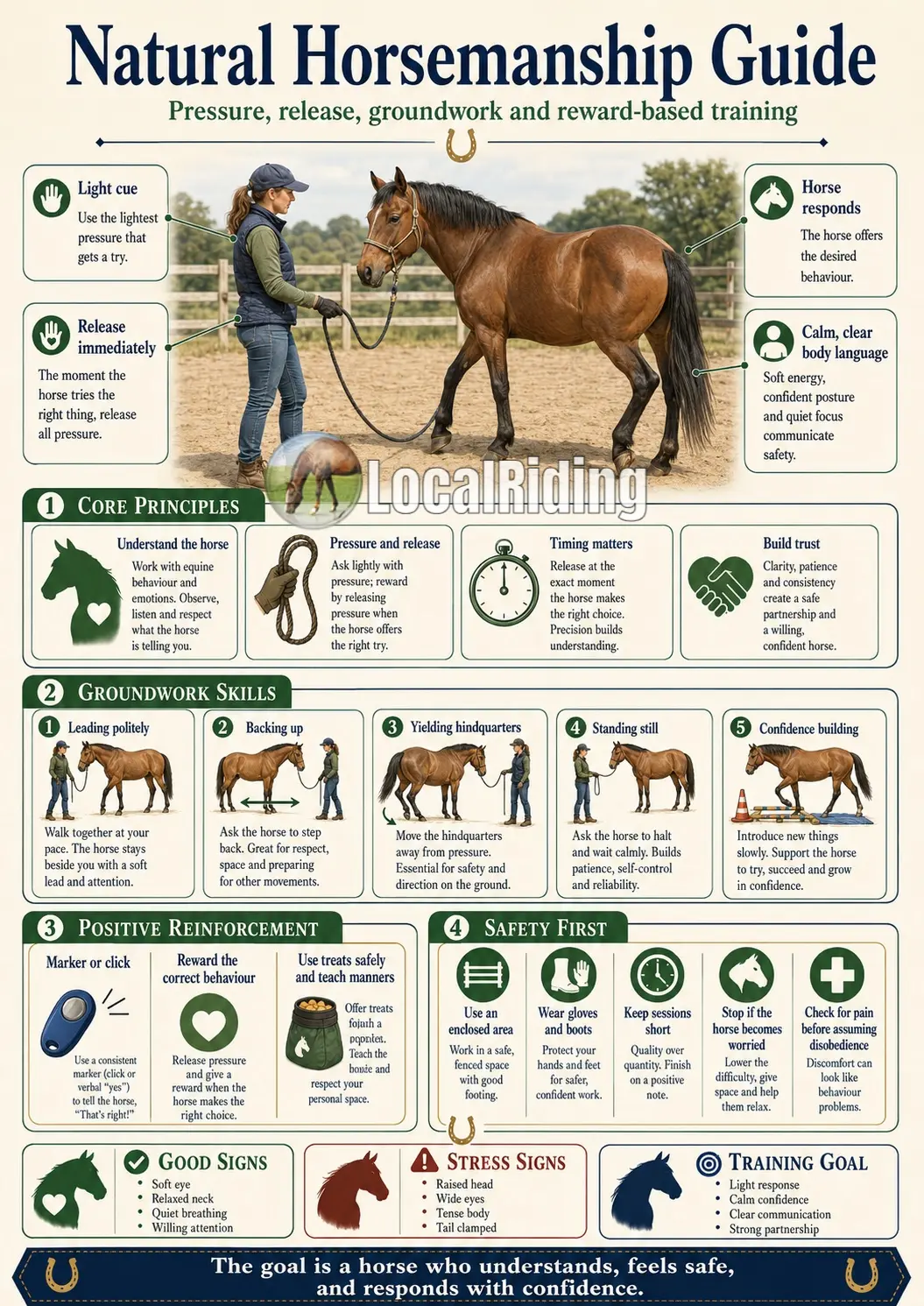 Natural Horsemanship Guide infographic — light cue and immediate release, core principles, groundwork skills, positive reinforcement, safety tips and stress signs
Core principles, groundwork skills and safety reminders for pressure-release and reward-based training at a glance.
Natural horsemanship and welfare: a balanced view
Natural horsemanship is not automatically kind just because it uses the word "natural". The welfare value depends on how the method is applied. Good training should reduce fear, avoid pain, protect the horse's confidence and help the horse understand what is being asked.
Pressure can be used lightly and clearly as a cue, but it should not escalate into fear, chasing, intimidation or flooding. Evidence-based behaviour guidance explains that pressure-release training works when pressure is removed as soon as the desired response is offered, but also warns that pressure should never cause pain or induce fear because both are detrimental to learning.
The most useful approach for many owners is not "natural horsemanship versus traditional training" or "pressure-release versus rewards". It is good horsemanship: clear cues, correct timing, patient repetition, emotional awareness, appropriate rewards and respect for the individual horse.
Understanding pressure and release
Pressure and release is one of the most common ways horses are trained, whether on the ground or under saddle. In learning-theory terms, this is usually called negative reinforcement. "Negative" does not mean bad; it means something is removed. The horse learns that a response makes the pressure stop.
Simple example
- The handler applies a light cue on the lead rope.
- The horse steps forward.
- The handler immediately softens or releases the rope.
- The horse learns that stepping forward removes the pressure.
The timing of the release is the lesson. If you release too late, the horse may not understand which behaviour produced the release. If you keep pressure on after the horse has tried, the horse may become confused, dull, anxious or defensive.
The pressure scale: start light, increase only if needed
Good pressure-release work should begin with the lightest clear cue. The horse should have a chance to respond before the pressure increases. This is sometimes described as "ask, tell, insist", but it must be done with fairness and feel.
A humane pressure scale might look like this:
- Prepare: position your body and focus clearly.
- Ask softly: use the lightest cue the horse understands.
- Clarify: increase the cue slightly if there is no response.
- Reward instantly: release the pressure as soon as the horse tries correctly.
- Reset: pause, breathe and repeat calmly.
The aim is not to keep increasing pressure. The aim is to teach the horse to respond to lighter and lighter cues over time.
What pressure and release is not
Pressure and release should not mean frightening the horse until they submit. It should not involve chasing, trapping, pulling continuously, hitting, drilling, flooding or forcing the horse into a state of helplessness.
Avoid:
- Holding pressure after the horse has responded
- Escalating too quickly
- Using pressure that causes panic or pain
- Punishing a horse for being confused or frightened
- Repeating exercises until the horse becomes tired or shut down
- Ignoring signs of stress, lameness or discomfort
A quiet horse is not always a relaxed horse. Some horses freeze, withdraw or stop offering behaviour when overwhelmed. Good training should produce understanding, not shutdown.
Recognising the horse's emotional state
Natural horsemanship depends on observation. Before asking for more, check what your horse is telling you.
Signs your horse may be relaxed and learning
- Soft eye
- Regular breathing
- Loose muzzle
- Relaxed neck
- Willing attention
- Rhythmic movement
- Ability to pause and stand quietly
Signs your horse may be stressed or overwhelmed
- Raised head and tense neck
- Wide eyes or showing whites of the eyes
- Clamped tail
- Repeated tail swishing
- Snorting, rushing or trying to leave
- Freezing or becoming unresponsive
- Barging, biting, striking or threatening to kick
- Repeated licking and chewing with a tense body
If stress rises, make the task easier. Reduce pressure, increase distance, slow down, return to something the horse understands, or stop the session.
Join-up: useful idea or overused technique?
Join-up is closely associated with Monty Roberts and is often performed in a round pen. The handler uses body position, movement and pressure to influence the horse's movement, then releases pressure and invites the horse to approach.
Many UK horse owners have found round-pen work interesting and helpful, but join-up should be approached carefully. It is not a magic fix, and it is not suitable for every horse, every handler or every problem. If done badly, it can become chasing or flooding rather than communication.
Use caution with join-up if:
- The horse is very fearful or traumatised
- The horse is young and inexperienced
- The horse is lame, unfit or unwell
- The handler lacks timing or experience
- The pen surface or fencing is unsafe
- The session relies on exhaustion rather than understanding
For many everyday owners, simple groundwork exercises are safer and more useful than dramatic round-pen sessions.
Groundwork: the foundation of clear communication
Groundwork teaches the horse to understand cues before those cues are used under saddle. It also helps the handler improve timing, body awareness and consistency.
Useful groundwork skills
- Leading politely without barging or lagging
- Stopping from a light cue
- Backing up calmly
- Moving the shoulders
- Moving the hindquarters
- Yielding to light pressure
- Standing quietly
- Lowering the head
- Loading practice in small steps
- Confidence work with safe objects and environments
Groundwork should not be about endless circles or making the horse "respect" the handler through intimidation. It should create clarity, confidence and safety.
Basic exercise: leading with pressure and release
This simple exercise teaches the horse to follow a light feel on the lead rope.
How to do it
- Work in a safe enclosed area with a well-fitted headcollar and lead rope.
- Stand beside the horse's shoulder, facing the direction you want to go.
- Take a soft feel on the rope without pulling hard.
- Wait for the horse to shift weight or take one step forward.
- Release the rope immediately.
- Pause and praise calmly.
- Repeat until the horse follows the light cue.
Reward the first try. At the beginning, even a small weight shift may be enough. You can ask for more steps once the horse understands.
Basic exercise: yielding the hindquarters
Yielding the hindquarters helps with handling, personal space and body control.
How to do it
- Stand near the horse's shoulder, facing the hindquarters.
- Keep the lead rope short enough for safety but not tight.
- Look towards the hindquarters and use a light cue with your hand, rope or schooling whip as an extension of your arm.
- Ask the horse to step the inside hind leg away and across.
- Release immediately when the horse makes the correct attempt.
- Reward, pause and repeat on both sides.
Do not poke, jab or chase. The goal is a calm step away from a light cue, not rushing or spinning.
Positive reinforcement and clicker training
Positive reinforcement means adding something the horse values after the desired behaviour, making that behaviour more likely to happen again. In horse training this often means food rewards, scratches or other pleasant outcomes.
Clicker training uses a marker signal, such as a click, tongue sound or short word, to mark the exact behaviour being rewarded. The marker is followed by a reward. This can help horses understand precisely what earned the reward.
Research comparing training approaches has explored the behavioural and physiological effects of negative and positive reinforcement in horses, including rehabilitated horses. Positive reinforcement and blended approaches are increasingly discussed within equine welfare and training research.
Positive reinforcement can be useful for:
- Trailer loading
- Standing for the farrier
- Accepting sprays or clippers
- Vet handling
- Target training
- Liberty work
- Confidence-building
- Teaching calm behaviours
Food reward safety tips
- Teach polite treat-taking first.
- Use a marker signal so the horse knows what is being rewarded.
- Keep rewards small.
- Deliver food away from your body space.
- Do not reward mugging, pushing or biting.
- Stop and reset if the horse becomes overexcited.
Combining pressure-release and rewards
Many effective trainers use pressure-release and positive reinforcement together. For example, you may use a light lead-rope cue, release the pressure when the horse steps forward, then add a scratch or food reward. ISES describes this as combined reinforcement and recommends using tactile or food rewards where appropriate to amplify pressure-release rewards.
This can be especially useful when retraining a worried horse, building motivation, improving handling skills, or teaching behaviours that require confidence rather than obedience alone.
Natural horsemanship tools: what you actually need
You do not need expensive branded equipment to begin. Good timing, observation and safety matter more than specialist gear.
Useful equipment
- A safe, enclosed arena, school or pen
- A well-fitted headcollar or training halter
- A suitable lead rope
- A schooling whip or stick used as an arm extension, not for punishment
- Gloves, hat and sturdy footwear
- Poles, cones or safe objects for exercises
- A treat pouch and small rewards if using positive reinforcement
A rope halter can apply strong pressure if used harshly. It should be used with light hands and good feel. Never tie a horse up in a rope halter or any equipment that does not release safely.
Getting started safely
If you are new to natural horsemanship or groundwork, begin with simple exercises in a safe, enclosed space. Avoid working in a field with loose horses, on slippery ground, or in an area where the horse can run into obstacles.
Beginner safety checklist
- Wear a riding hat, gloves and safe boots.
- Use a safe enclosed arena or pen.
- Start with a calm, familiar horse if possible.
- Keep sessions short and positive.
- Work on one skill at a time.
- End on a small success.
- Do not wrap the lead rope around your hand.
- Stay out of kicking range.
- Do not kneel, sit or lie near the horse.
- Seek help if the horse is aggressive, fearful or dangerous.
Choosing a UK natural horsemanship trainer or clinic
The UK has many trainers offering groundwork, horsemanship, behavioural support and confidence clinics. Quality varies, so choose carefully.
Look for a trainer who:
- Prioritises horse welfare and emotional state
- Explains learning theory clearly
- Uses calm, fair handling
- Avoids fear, flooding and punishment
- Works within their competence
- Refers to vets, saddle fitters, farriers or qualified behaviourists when needed
- Encourages questions rather than demanding blind obedience
- Adapts to the individual horse
- Has suitable insurance and professional experience
Be cautious of anyone promising instant fixes, blaming every problem on "lack of respect", or using techniques that leave horses frightened, exhausted or shut down.
Common problems and how groundwork can help
My horse barges when led
Work on leading, stopping and backing up from light cues. Reward the horse for staying beside you without crowding. Check whether the horse is anxious, rushing to grass, or has learned to push through pressure.
My horse will not stand still
Teach standing as a behaviour, not as an absence of movement. Ask for one second of stillness, release, reward and gradually build duration. Check for discomfort, flies, separation stress or anticipation of work.
My horse is hard to catch
Do not chase. Build positive associations with your approach, reward the horse for facing you, and practise catching without always bringing the horse in to work. Consider whether the horse is avoiding discomfort or an unpleasant routine.
My horse will not load
Break loading into small steps: approach, stand near the ramp, touch the ramp, one foot on, step back, repeat. Use calm pressure-release and rewards. Do not wait until competition day to practise.
My horse is nappy or reluctant under saddle
Groundwork may help with communication, but ridden resistance can be pain-related. Check teeth, back, saddle fit, feet, ulcers, rider balance and workload before treating it as a training issue.
Ethical principles for pressure-release training
- Use the lightest effective cue.
- Release immediately when the horse tries correctly.
- Reward effort, not just perfection.
- Do not use pain or fear as training tools.
- Do not punish confusion.
- Keep sessions short enough for the horse to succeed.
- Watch for stress and reduce difficulty when needed.
- Teach the horse what to do, not just what not to do.
- Check for pain before assuming disobedience.
- Use professional help when safety is at risk.
Frequently asked questions
Is natural horsemanship the same as groundwork?
No. Groundwork is training done from the ground. Natural horsemanship often includes groundwork, but it is a broader philosophy that may also include ridden work, liberty work, round-pen work and relationship-based handling.
Is pressure and release cruel?
Pressure and release is not automatically cruel. It can be clear and humane when pressure is light, the horse understands the cue, and the release is immediate. It becomes harmful when pressure causes fear, pain, confusion or learned helplessness.
Can I use treats with natural horsemanship?
Yes. Many owners successfully combine pressure-release with positive reinforcement. The key is to teach polite treat manners and use a clear marker so the horse understands what behaviour is being rewarded.
What is the biggest mistake people make with pressure and release?
The most common mistake is poor timing. If the release comes too late, the horse may not connect it with the desired behaviour. Another common mistake is using too much pressure too quickly.
Do I need a round pen?
No. Many useful groundwork exercises can be done in a safe arena, school, stable yard or enclosed area. A round pen can be helpful in experienced hands, but it is not essential.
Can natural horsemanship fix behavioural problems?
It may help with communication and confidence, but not every problem is a training problem. Pain, fear, poor tack fit, dental issues, ulcers, unsuitable management and previous experiences can all cause behaviour changes. Investigate the cause, not just the symptom.
Final advice
Natural horsemanship is most valuable when it encourages owners to slow down, observe carefully and communicate more clearly. Pressure and release can be useful, but it must be light, well-timed and fair. Positive reinforcement can add motivation and confidence. Groundwork can improve safety and understanding when it is done calmly and thoughtfully.
The goal is not control at any cost. The goal is a horse who understands, feels safe, and can respond with confidence.
Debbie Irwin
Livery Yard Manager & Equestrian Professional
Debbie has run professional showing yards and mixed livery yards in Lincolnshire and Essex for over 30 years. She has competed and taught at various levels. She writes about practical horse health, yard life, livery and everyday horse health and management.
Support Debbie on Ko-fi ☕Found this guide helpful? LocalRiding is run independently without ads. If you'd like to chip in towards the site's upkeep, you can buy Debbie a hot drink on a cold day on Ko-fi, she'll really appreciate it.