
Riding
Starting Your Riding Journey in the UK: A Beginner & Novice Guide
A beginner-friendly UK guide to learning to ride — choosing a riding school, what to expect from lessons, building position and confidence, and hacking safely.
By Debbie Irwin · 29 April 2026 · 11 min read
Whether you are booking your first lesson, returning to riding after a break, or looking to build confidence, the UK offers excellent opportunities to learn safely and progressively. This guide explains how to choose a riding school, what to expect from your first lessons, how to develop a secure position, and how to progress from arena basics to hacking safely.
Horse riding is rewarding, physical and confidence-building, but it is also a skill that should be learned carefully. Good instruction, suitable horses, correct equipment and steady progression are the foundations of a safe and enjoyable riding journey.
Choosing a riding school in the UK
For most beginners, the best place to start is a professional riding school or equestrian centre. The UK has a strong network of approved centres offering structured lessons for children, teenagers and adults.
Look for a centre that is approved by a recognised organisation such as the British Horse Society (BHS), the Association of British Riding Schools (ABRS+), the Pony Club, or another reputable equestrian body. BHS-approved centres can be searched through the BHS riding-centre directory, although the BHS advises checking directly that a centre's current approval status is up to date.
What to look for before booking
- Clean, safe and well-maintained facilities
- Suitable beginner horses and ponies with calm temperaments
- Qualified, insured and experienced instructors
- Clear lesson structure for complete beginners
- Correctly fitted hats available to borrow or hire
- Good yard safety standards
- Friendly staff who explain what to expect
- Policies for safeguarding, accidents and cancellations
- Safe mounting blocks, enclosed arenas and appropriate supervision
Instructor qualifications vary, but many UK riders look for coaches with BHS qualifications, Pony Club coaching qualifications, British Equestrian-recognised coaching awards, or equivalent experience. The BHS qualification pathway is commonly known as the Stages, beginning at Stage 1 and progressing through care, riding and coaching levels.
What to expect from your first riding lesson
Your first lesson will usually focus on safety, confidence and basic control rather than speed. A good instructor will introduce you to the horse, explain how to mount safely, check your position, and teach simple aids for halt, walk, steering and balance.
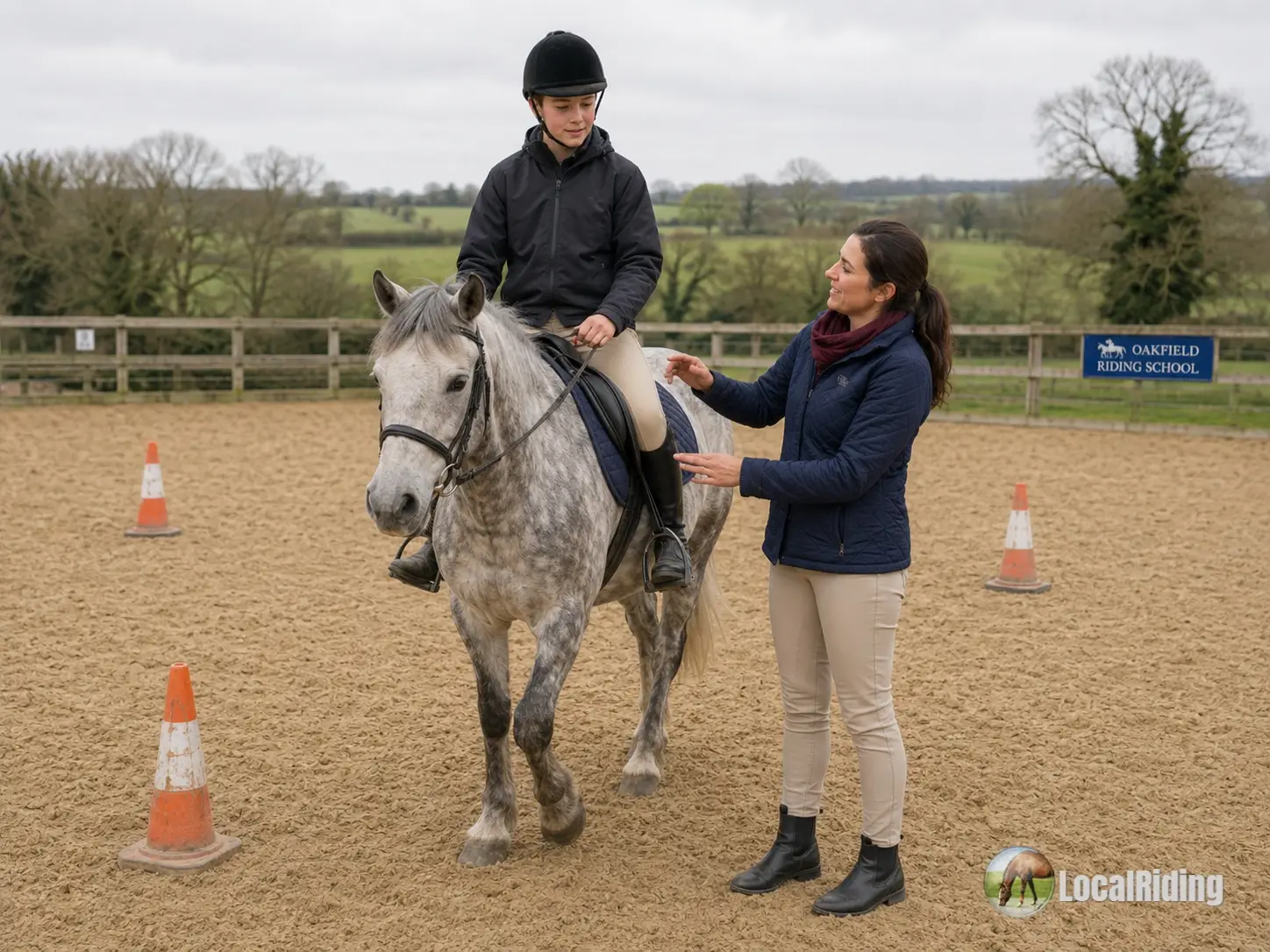 Young beginner rider on a grey pony at a UK riding school, with an instructor adjusting position and giving guidance in a sand arena
A patient first lesson at a UK riding school — focused on safety, position and basic control.
Beginner lessons often cover:
- How to approach and behave around horses safely
- How to mount and dismount correctly
- How to hold the reins
- Basic rider position
- Starting, stopping and steering in walk
- Simple school movements such as circles and changes of rein
- Rising trot once the rider is ready
- How to communicate calmly with the horse
Do not worry if it feels unfamiliar at first. Riding uses balance, coordination and muscles that many people have not used before. Most riders need several lessons before the basics start to feel natural.
What to wear for your first lessons
You do not need to buy expensive equipment before your first ride, but you do need to dress safely.
Recommended beginner clothing
- A correctly fitted riding hat that meets current safety standards
- Comfortable trousers with minimal seams, such as leggings or jodhpurs
- Boots or shoes with a small heel and smooth sole
- Gloves to improve grip and protect your hands
- A fitted top or jacket that will not flap or catch
- Weather-appropriate layers for outdoor arenas
Avoid trainers, sandals, heavy walking boots with deep treads, loose scarves, dangling jewellery, and anything that could become caught in the reins, saddle or stirrups.
Under the Highway Code, children under 14 must wear a securely fastened riding helmet that complies with the relevant regulations when riding on roads, unless an exemption applies. Other riders are also strongly advised to follow the same safety standard.
The importance of a balanced riding position
A correct, balanced position is the foundation of good riding. It helps you stay secure, communicate clearly and avoid interfering with the horse's movement.
When viewed from the side, the classic position places the ear, shoulder, hip and heel close to a vertical line. This does not mean sitting stiffly. A good position should be tall, relaxed and elastic.
Key position points
- Look ahead, not down at the horse's neck.
- Keep shoulders relaxed and open.
- Sit evenly on both seat bones.
- Let your legs hang long around the horse.
- Keep heels gently down without forcing them.
- Maintain soft elbows and quiet hands.
- Breathe steadily and avoid gripping with the knees.
Tension travels through the rider's body and can affect the horse. Many beginner problems, such as bouncing in trot, tipping forward, pulling on the reins or gripping with the knees, improve as the rider becomes more balanced and relaxed.
Developing confidence and balance
Confidence grows through repetition, good instruction and suitable horses. Do not rush. A rider who feels safe and balanced in walk and trot will usually progress more successfully than one pushed too quickly into canter or jumping.
Useful beginner exercises
- Riding large circles in walk to improve steering
- Changing rein across the diagonal
- Halting at markers around the arena
- Riding transitions between halt and walk
- Rising trot on the lunge with instructor support
- Short periods without stirrups in a safe enclosed arena
- Practising light seat at walk before progressing to poles
Riding without stirrups can help develop balance and core stability, but it should only be done under supervision on a suitable horse in a safe enclosed area.
Understanding the scales of training
The scales of training are a progressive framework used in dressage and wider horse training. They are often described as: rhythm, suppleness, contact, impulsion, straightness and collection.
Beginners do not need to master advanced theory immediately, but understanding the basic idea is useful. Good riding is not just about making the horse go faster or perform movements; it is about helping the horse move calmly, rhythmically and in balance.
The six scales in simple terms
- Rhythm: the horse moves in a regular, consistent tempo.
- Suppleness: the horse is relaxed and able to bend through the body.
- Contact: the rider has a soft, steady connection through the reins.
- Impulsion: the horse has energy and willingness from behind.
- Straightness: the horse travels evenly through the body and limbs.
- Collection: the horse carries more weight behind, used in more advanced work.
For a new rider, the first three — rhythm, suppleness and contact — are especially important. A calm walk, a balanced trot, soft turns and steady hands are all early steps towards better riding.
Arena exercises for UK riders
Many UK riders deal with limited arena time, wet weather, short winter days and variable outdoor surfaces. A focused session helps you make the most of your lesson or schooling time.
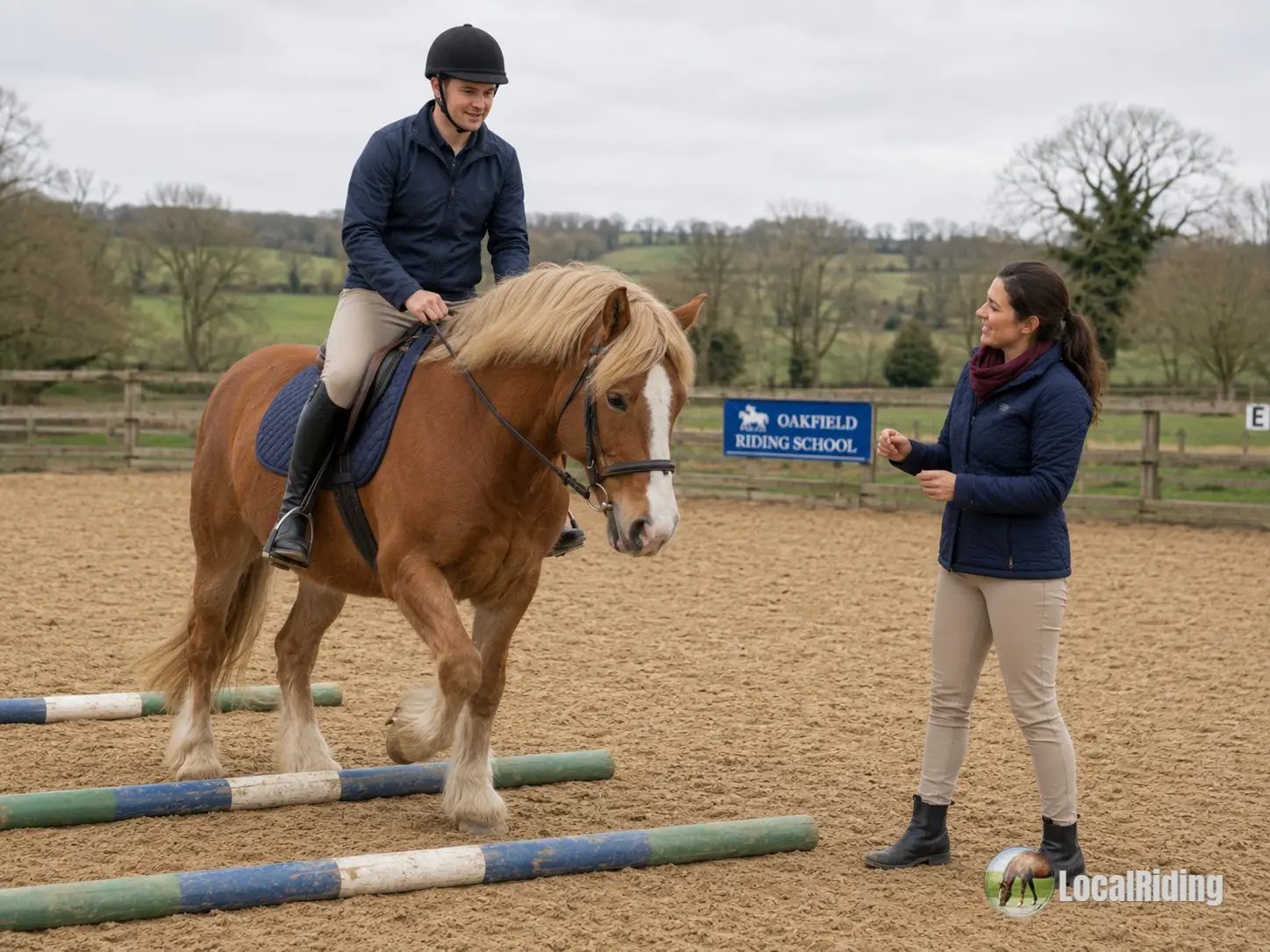 Adult beginner riding a chestnut pony over a row of ground poles in an outdoor arena, with an instructor watching nearby
Pole work is one of the best beginner exercises — it builds rhythm, balance and confidence.
Simple schooling exercises
- 20-metre circles: improve rhythm, steering and bend in walk, trot and, later, canter.
- Serpentines: encourage suppleness, changes of bend and better control of the shoulders.
- Transitions: develop responsiveness, balance and attention.
- Changes of rein: help the rider practise planning and accurate lines.
- Poles on the ground: improve rhythm, confidence and coordination.
- Leg yield: introduces sideways movement once the rider has secure basic aids.
- Walk-halt-walk exercises: teach the horse to listen and the rider to use seat, leg and hand together.
Keep exercises short and purposeful. Quality matters more than endless repetition. If the horse becomes tense, tired or confused, return to an easier exercise and rebuild calmly.
Learning basic horse care
Riding is only one part of horsemanship. Understanding how to care for horses makes you safer, more confident and more respectful around them.
Useful early horse-care skills
- Approaching a horse safely
- Putting on a headcollar
- Leading correctly
- Tying up safely under supervision
- Grooming and picking out feet
- Recognising signs of discomfort or stress
- Understanding basic feeding and turnout routines
- Checking tack before and after riding
- Cooling down after exercise
Many riding schools and equestrian centres offer stable-management sessions, pony days or BHS Challenge Awards for riders who want to build practical knowledge alongside riding skills.
Progressing from beginner to novice
Every rider progresses at a different pace. Age, confidence, fitness, lesson frequency, previous experience and the type of horse all make a difference. Avoid comparing your progress with others.
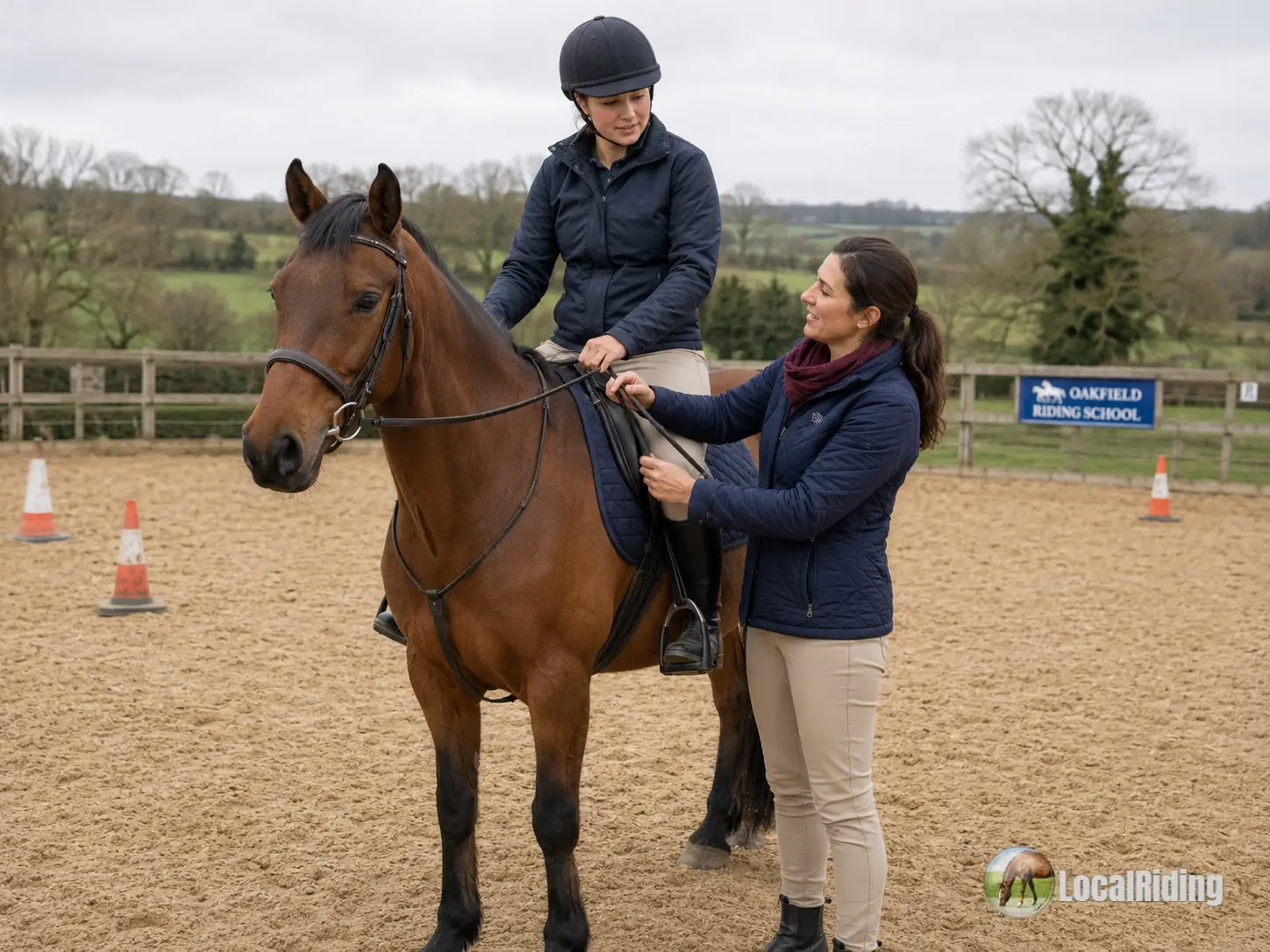 Novice rider on a bay horse in an outdoor arena, with an instructor checking position and stirrup length
Progressing from beginner to novice is about refining the basics, not rushing into harder work.
Typical milestones include:
- Riding independently in walk
- Steering accurately around the arena
- Rising trot with rhythm
- Riding school figures such as circles and serpentines
- Understanding basic aids for walk, trot and halt
- Cantering in a safe enclosed space when ready
- Riding over poles
- Learning basic jumping position, if desired
- Developing confidence hacking in a group
It is normal to have plateaus. Sometimes the best progress comes from improving the basics rather than moving on to something more difficult.
Hacking safely in the UK
Hacking is one of the great pleasures of riding in the UK, whether on quiet lanes, bridleways, woodland tracks, beaches, moorland or open countryside. However, it introduces extra hazards, including traffic, dogs, cyclists, uneven ground, gates, livestock and weather changes.
Before you hack out
- Wear a correctly fitted riding hat.
- Use hi-vis on both horse and rider.
- Carry a charged mobile phone on your body.
- Tell someone your route and expected return time.
- Check the weather and daylight hours.
- Choose a suitable horse and route for your experience.
- Ride with an experienced companion if you are new to hacking.
- Know the Highway Code rules that apply to horse riders.
The BHS recommends hi-vis in all conditions, not only in low light, because visibility can be affected by shade, weather, background colours, bends and driver attention.
If you plan to ride on roads or in open environments, consider completing the BHS Ride Safe Award. The BHS describes Ride Safe as helping riders gain confidence in common environments and notes that it is recognised in the Highway Code and recommended as best practice.
Road safety basics for new riders
Road riding should only be introduced when both horse and rider are ready. A nervous beginner on an inexperienced horse is not a safe combination for traffic.
Essential road-riding habits
- Ride on the left-hand side of the road.
- Keep both hands on the reins unless signalling.
- Signal clearly and early.
- Thank careful drivers when it is safe to do so.
- Never assume a driver has seen you.
- Avoid busy, fast or narrow roads where possible.
- Ride single file on narrow or busy roads.
- Use extra caution around bends, junctions and parked cars.
Under the Highway Code, drivers should pass horses slowly and carefully, giving plenty of room. Riders should also understand their own responsibilities, including visibility, positioning and safe communication with other road users.
Building fitness for riding
Riding is a physical activity. Good rider fitness improves balance, coordination, stamina and recovery. You do not need to be an athlete to start, but gentle off-horse exercise can help.
Helpful off-horse training
- Core-strength exercises
- Hip and hamstring mobility work
- Balance exercises
- Walking, cycling or swimming for stamina
- Gentle stretching after lessons
- Breathing exercises for nervous riders
If you have a medical condition, injury or reduced mobility, speak to the riding school before booking. Many centres can recommend suitable lesson types, horses or adaptive arrangements.
Common beginner mistakes
Every rider makes mistakes while learning. Good coaching helps you notice and correct them early.
- Looking down: this affects balance and direction.
- Gripping with the knees: this can push the rider out of the saddle.
- Pulling on the reins: this can confuse or upset the horse.
- Holding the breath: this creates tension in the rider's body.
- Rushing progression: confidence and safety matter more than speed.
- Ignoring horse care: good riders learn about the horse, not just the riding.
Choosing your riding pathway
Once you have the basics, you can shape your riding journey around your interests. The UK equestrian world offers many routes, including recreational hacking, riding-club activities, dressage, showjumping, eventing, endurance, showing, working equitation, TREC, horse agility and stable management.
You do not need to compete to be a good rider. Many riders simply enjoy lessons, hacking and caring for horses. Others use structured awards or qualifications to measure progress.
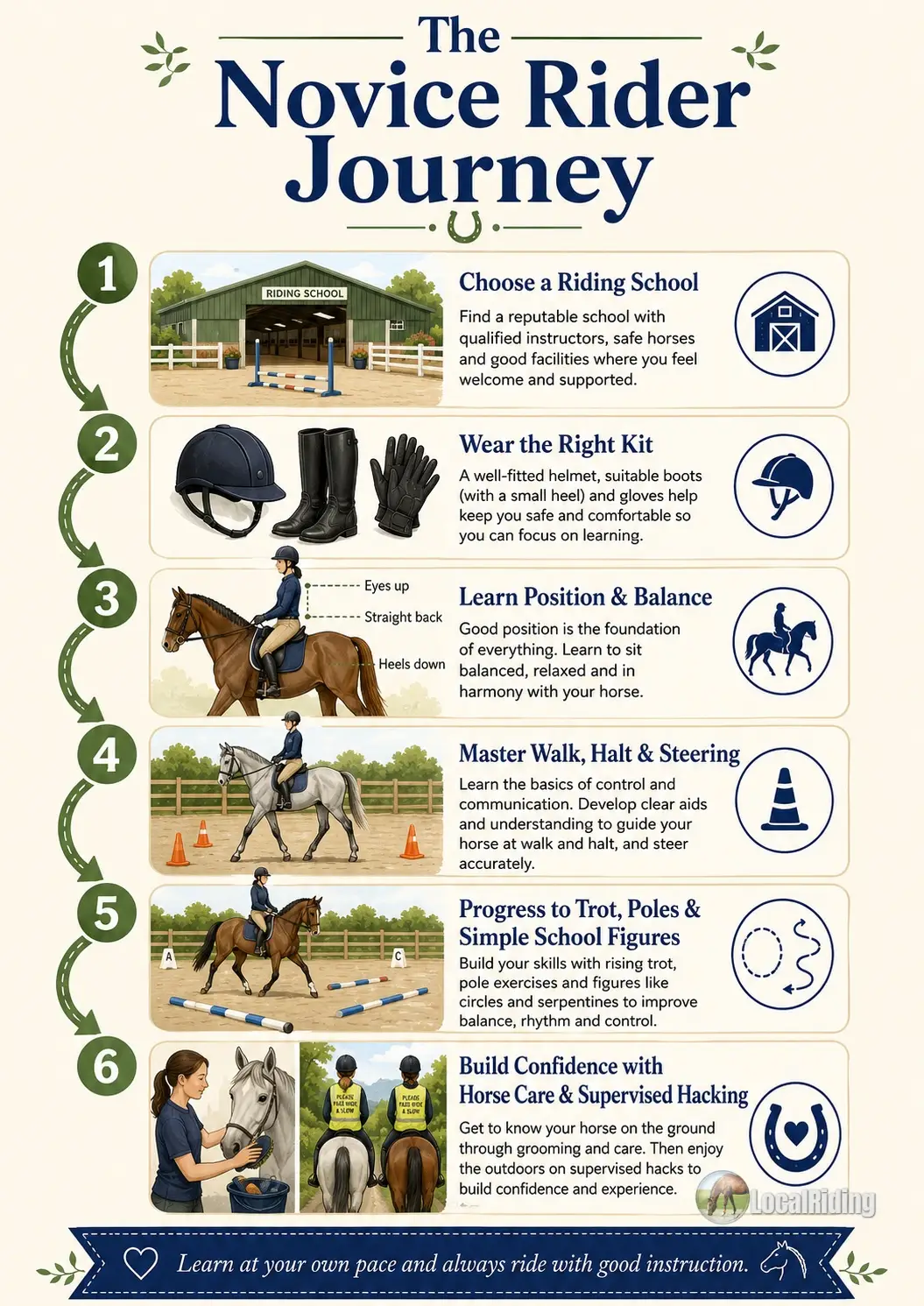 Infographic titled 'The Novice Rider Journey' showing six steps: choose a riding school, wear the right kit, learn position and balance, master walk halt and steering, progress to trot, poles and school figures, and build confidence with horse care and supervised hacking
The novice rider journey — a six-step path from your first lesson to confident, well-rounded riding.
Possible next steps
- Join a riding club or Pony Club branch or centre.
- Work through BHS Challenge Awards.
- Take stable-management lessons.
- Try polework, dressage, jumping or hacking lessons.
- Book a private lesson to focus on specific goals.
- Volunteer or help at a yard where appropriate and safe.
- Consider loaning or sharing a horse only when you have enough experience and support.
Beginner rider checklist
- Choose an approved or reputable riding school.
- Ask about instructor qualifications and beginner lesson structure.
- Wear a properly fitted riding hat and suitable footwear.
- Start with safe, supervised lessons.
- Focus on balance, position and confidence before speed.
- Learn basic horse care and stable safety.
- Use hi-vis when hacking or riding near roads.
- Know the Highway Code before riding on public roads.
- Progress at a pace that feels safe and sustainable.
Frequently asked questions
Am I too old to start horse riding?
No. Many adults start riding for the first time or return after years away. Choose a riding school that regularly teaches adult beginners and be honest about your confidence and fitness level.
How many lessons will I need before I can ride independently?
It depends on the rider, horse, lesson frequency and goals. Some people feel comfortable steering in walk after a few lessons, while others take longer. Independent riding should only come when your instructor feels you are safe and balanced.
Do I need my own riding hat?
Many riding schools provide hats for beginners, but regular riders often prefer to buy their own to ensure the best fit. Always use a hat that meets current safety standards and has not been damaged in a fall.
Should I start with group or private lessons?
Private lessons can be useful for nervous beginners or riders who want individual attention. Group lessons can be sociable and cost-effective once you are comfortable with the basics. Many riders use a mixture of both.
When can I start cantering?
You should only start cantering when you have a secure position, can ride a balanced trot, and your instructor feels you are ready. Rushing into canter too soon can damage confidence.
Is hacking suitable for beginners?
Hacking can be suitable for beginners if it is supervised, on a sensible horse, and on an appropriate route. New riders should not hack alone or ride on roads without proper preparation.
Final advice for new UK riders
Starting your riding journey is exciting, but the best riders are built through patience, good habits and respect for the horse. Choose the right school, learn from qualified instructors, focus on balance and safety, and progress steadily.
Good riding starts with confidence, calmness and correct basics — not speed, jumping or rushing ahead.
Debbie Irwin
Livery Yard Manager & Equestrian Professional
Debbie has run professional showing yards and mixed livery yards in Lincolnshire and Essex for over 30 years. She has competed and taught at various levels. She writes about practical horse health, yard life, livery and everyday horse health and management.
Support Debbie on Ko-fi ☕Found this guide helpful? LocalRiding is run independently without ads. If you'd like to chip in towards the site's upkeep, you can buy Debbie a hot drink on a cold day on Ko-fi, she'll really appreciate it.